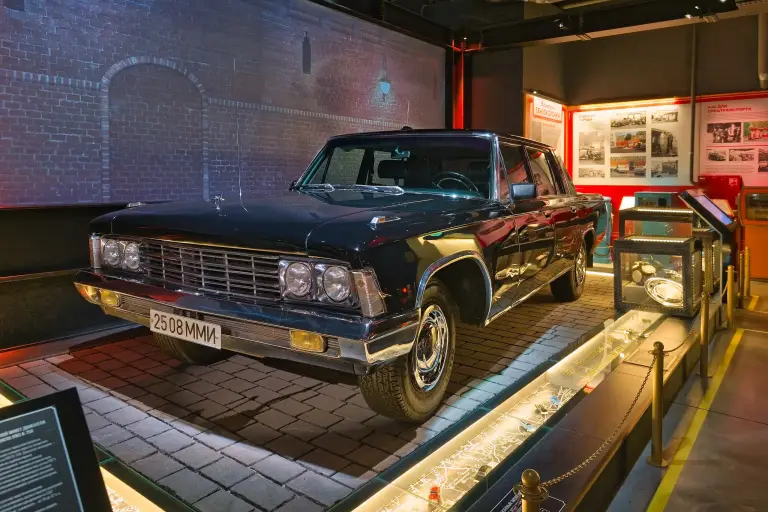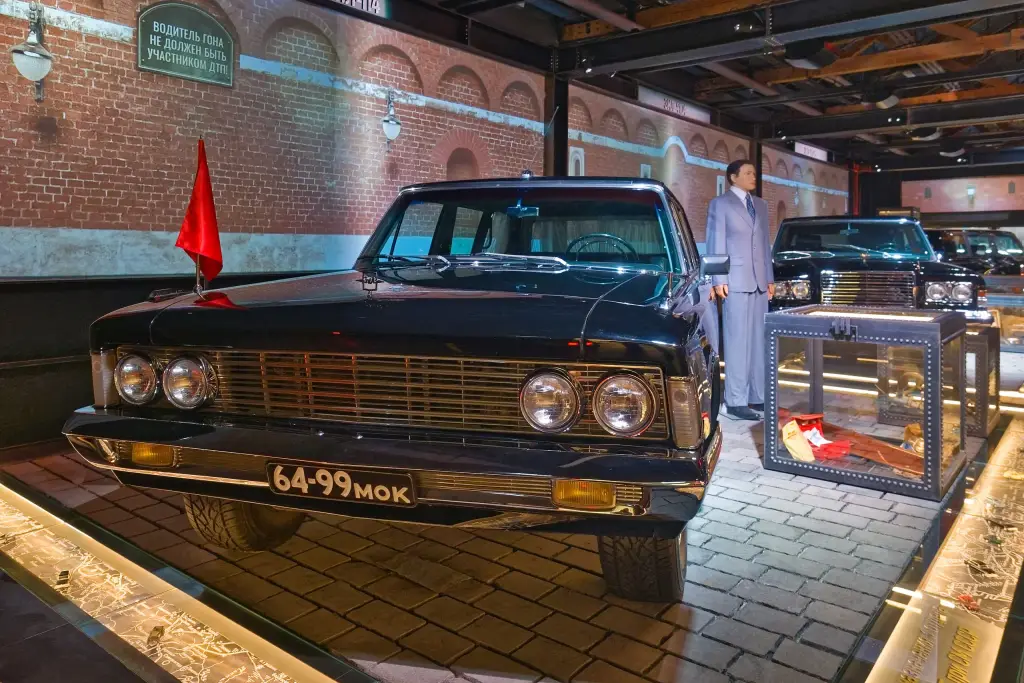
The ZIL-114 was the Soviet state limousine of 1967–1978, replacing the ZIL-111. It was larger, faster and better equipped than its predecessor, and its body became the basis for the ZIL-4104 family that followed.
ZIL-114 at a glance
| Maker | ZiL, Moscow |
|---|---|
| Production | 1967–1978 |
| Class | limousine for Politburo members |
| Engine | 6,959 cc V8, 300 hp |
| Transmission | two-speed automatic; three-speed from April 1975 |
| Brakes | four-wheel discs, first on a Soviet car |
| Suspension | torsion bars front, leaf springs rear |
| Length | 6,300 mm |
| Weight | 3,085 kg |
| Top speed | 193 km/h |
| Built | about 113–150 |
| Replaced by | ZIL-4104 |
History of the ZIL-114
A new generation
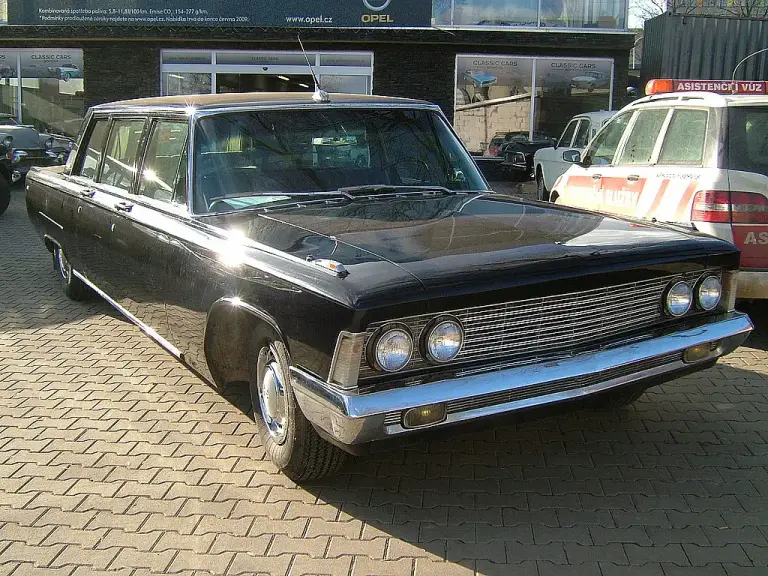
By the early 1960s the ZIL-111G was falling behind the angular new style that had replaced the chrome-laden American cars it imitated. Work on a replacement began then, and the first prototype was built in 1966; production started the following year and by 1968 the ZIL-114 had taken over the plant’s whole output of representative cars. The design was updated in 1971, mainly at the front, which was unified with the shorter ZIL-117 sedan.
Mechanical specification
The V8 was enlarged from 5,980 to 6,959 cc and its output rose by about 30 percent to 300 hp, raising the top speed from roughly 170 to 193 km/h. The engine had an aluminium block, a four-barrel carburettor, transistor ignition and hydraulic valve lifters that needed no adjustment. The gearbox was a two-speed automatic with a torque converter, joined by a three-speed option in April 1975. The ZIL-114 was the first Soviet car with disc brakes on all four wheels, served by three separate circuits, and it had power steering and a pedal-operated parking brake. The chassis used a stiff peripheral frame whose side members ran behind the sills. Front suspension was by longitudinal torsion bars, the rear axle remained on leaf springs.
Equipment and use
The car was 6.3 m long and weighed 3,085 kg. Equipment included air conditioning, electric windows on all doors, central locking, a remote-controlled driver’s mirror, heat-absorbing glass and a steering wheel that tilted away to ease entry. In October 1971 the ZIL-114 entered the Guinness Book of Records as the widest production car, and from October 1974 to 1976 as the heaviest. It was official transport for Politburo members and the top leadership only. The shortened ZIL-117 sedan was built for candidates to the Politburo and as an escort car.
Versions and legacy
Small numbers of the ZIL-114K with a cutaway roof were built, along with the ZIL-114E with shielded ignition and special communications, and two ZIL-114EA ambulances with a raised sedan-delivery body. The ZIL-114N of 1975 wore the body panels of the coming ZIL-4104 but kept the 114’s rear pillar. Production ended in 1978, when the ZIL-4104 took over; the 114’s body lived on in the 4104, 41045 and 41047.
Design and features
- Seven-litre V8: 300 hp and a top speed of 193 km/h, with hydraulic lifters needing no adjustment.
- Four-wheel disc brakes: the first Soviet car to have them, with three separate circuits.
- State limousine comfort: air conditioning, central locking, electric windows and a tilting steering wheel.
- Record size: listed by Guinness as the widest production car in 1971 and the heaviest from 1974 to 1976.
ZIL-114 versions
- ZIL-114 (1967–1978): the standard limousine.
- ZIL-114K: car with a cutaway roof so that occupants could stand.
- ZIL-114E: shielded ignition and special communications equipment.
- ZIL-114EA (1974): ambulance with a raised body, two built.
- ZIL-114N (1975): transition model with ZIL-4104 body panels.
The short-wheelbase sister car was the ZIL-117, and the 114 was replaced by the ZIL-4104. More cars are in the ZiL collection.
Sources
- ZIL-114, English Wikipedia: engine, transmission, brakes, dimensions, variants
- ЗИЛ-114, Russian Wikipedia: production years, numbers built, equipment