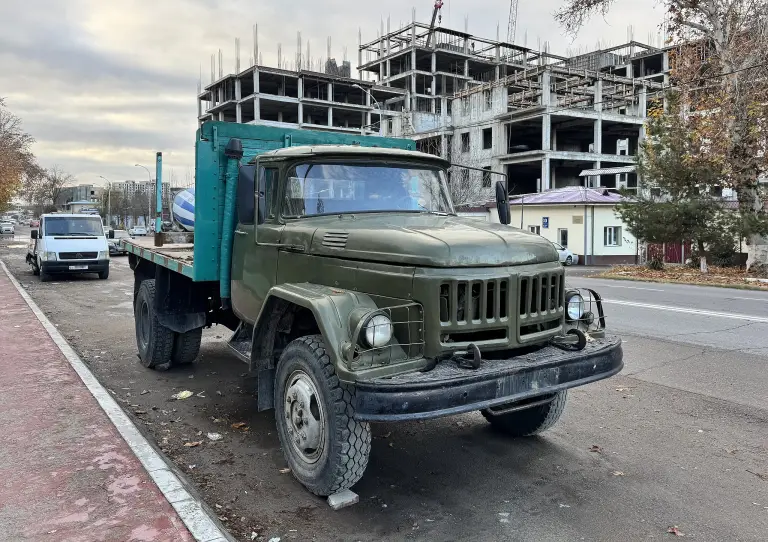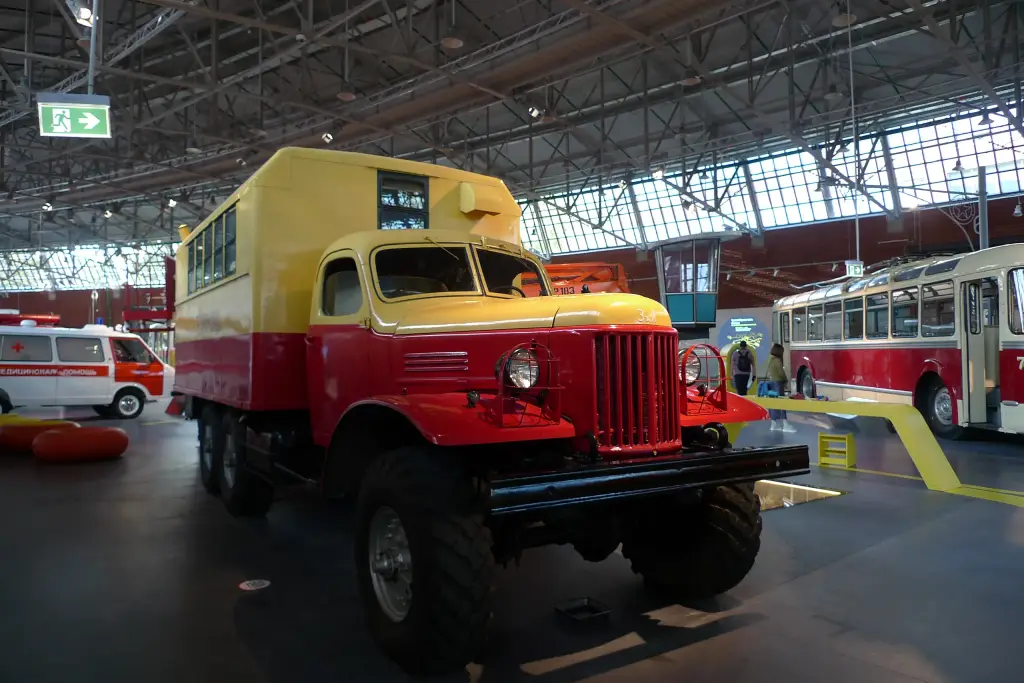
The ZIS-151 was a general-purpose 6×6 truck built by the Stalin factory in Moscow from 1948 to 1958. After the plant was renamed in 1956 the same truck was called the ZIL-151. It was the first major Soviet all-wheel-drive military truck of the post-war years.
ZIL-151 at a glance
| Maker | ZIS / ZiL, Moscow |
|---|---|
| Production | 1948–1958 |
| Class | 4.5 t 6×6 general-purpose truck |
| Engine | 5,555 cc inline-6, 92 hp |
| Gearbox | five-speed with two-speed transfer case |
| Length | 6,930 mm |
| Weight | 5,580 kg |
| Payload | 4,500 kg on road, 2,500 kg off road |
| Top speed | 55–60 km/h |
| Tyres | 8.25×20, dual rear wheels |
| Built | about 150,000 of all versions |
History of the ZIL-151
After the Lend-Lease trucks
The ZIS-151 replaced the American Studebaker US6 and GMC CCKW trucks supplied under Lend-Lease, and the older Soviet ZIS-6. Two prototypes were built in 1946: the ZIS-151-2 with dual rear wheels and the ZIS-151-1 with single rear wheels and a ZIS-150 cab. In summer 1947 comparative off-road trials against Studebaker and International trucks showed that the single-tyred prototype had the better cross-country performance, but the army insisted on dual rear wheels, which damaged dirt roads less. The first production batch left the plant in April 1948. Until 1950 the truck had a wooden-and-metal cab and the ZIS-120 engine, replaced afterwards by the ZIS-121. The steel cab arrived in 1950.
Chassis and engine
The ZIS-151 was a 6×6 with three live beam axles in a reinforced ladder frame: the front axle on semi-elliptic leaf springs, the rear tandem on quarter-elliptic springs with locating arms. The engine was a 5,555 cc side-valve six of 92 hp at 2,600 rpm, based on the Hercules JXD used in the Studebaker, with a compression ratio of 6.0; the gearbox had five speeds and the transfer case high and low ranges. The truck was 6.93 m long and weighed 5,580 kg, carried 4,500 kg on the road and 2,500 kg on dirt, and reached 55–60 km/h. Two 150-litre tanks and two spare wheels were fitted at the army’s request, which is why the frame is longer and the truck a tonne heavier than a Studebaker. Air brakes were used.
In service
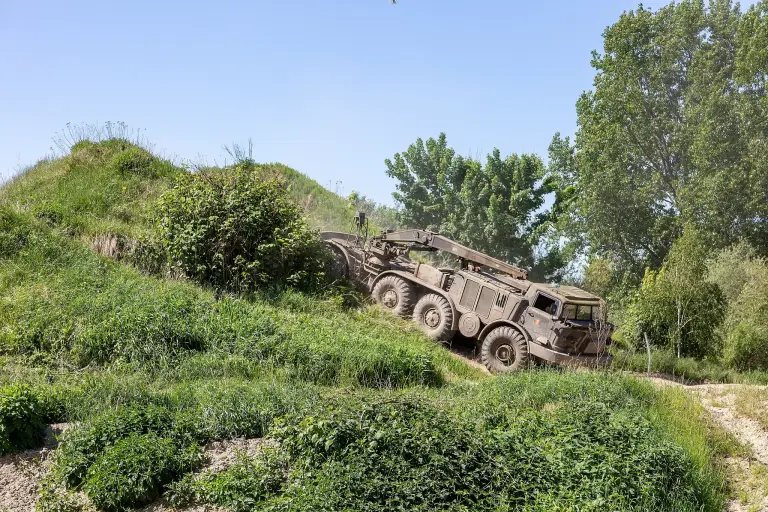
The ZIS-151 was the first Soviet production vehicle with three driven axles. It served widely in the armed forces and its chassis carried the BM-13-16 Katyusha, the BM-14-16, BM-24 and BMD-20 rocket launchers, the BTR-152 armoured personnel carrier, the BAV 485 amphibian, mobile workshops, fuel trucks and communications vehicles. The ZIS-151A had a winch and the ZIS-151B was a tractor unit. The truck was also built in China from 1956 as the Jiefang CA-30, which stayed in production until 1986.
Shortcomings
The ZIS-151 was heavy for its small wheels and low ground clearance, and its dual rear tyres cut deep ruts. In a long spring off-road run a year after production began it was clearly inferior to the two-axle GAZ-63, which repeatedly had to pull the ZIS trucks out of mud and snow; testers nicknamed the heavy trucks ‘irons’. In thick mud the rear wheels clogged into four barrels, and removing the outer tyres with a crowbar was miserable work. Production ended in 1958 with the arrival of the ZIL-157.
Design and features
- First Soviet post-war 6×6: three driven axles and a reinforced ladder frame built for army use.
- Simple six-cylinder engine: 5,555 cc and 92 hp, based on the Hercules JXD of the Studebaker US6.
- Weapon platform: chassis for the Katyusha, the BTR-152 and the BAV 485 amphibian.
- Long frame: two fuel tanks and two spare wheels, as the army demanded, added a tonne of weight.
ZIL-151 versions
- ZIS-151 / ZIL-151: the standard cargo truck, 1948–1958.
- ZIS-151A: version with a winch.
- ZIS-151D: shielded electrical equipment, 1955–1958.
- ZIS-151E and ZIS-151U: export versions for temperate and tropical climates.
- ZIS-121B: tractor-trailer version.
- BTR-152 and BAV 485: armoured personnel carrier and amphibian on the same chassis.
The ZIL-151 was replaced by the ZIL-157, and its chassis work led to the ZIL-164 generation of road trucks. More vehicles are in the ZiL collection.
Sources
- ZIS-151, English Wikipedia: history, engine, chassis, variants
- ЗИС-151, Russian Wikipedia: prototypes, production, shortcomings, numbers built