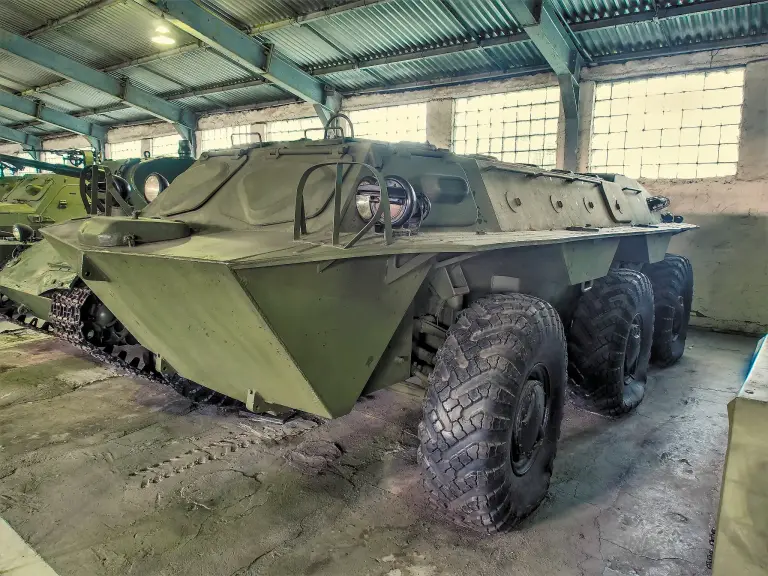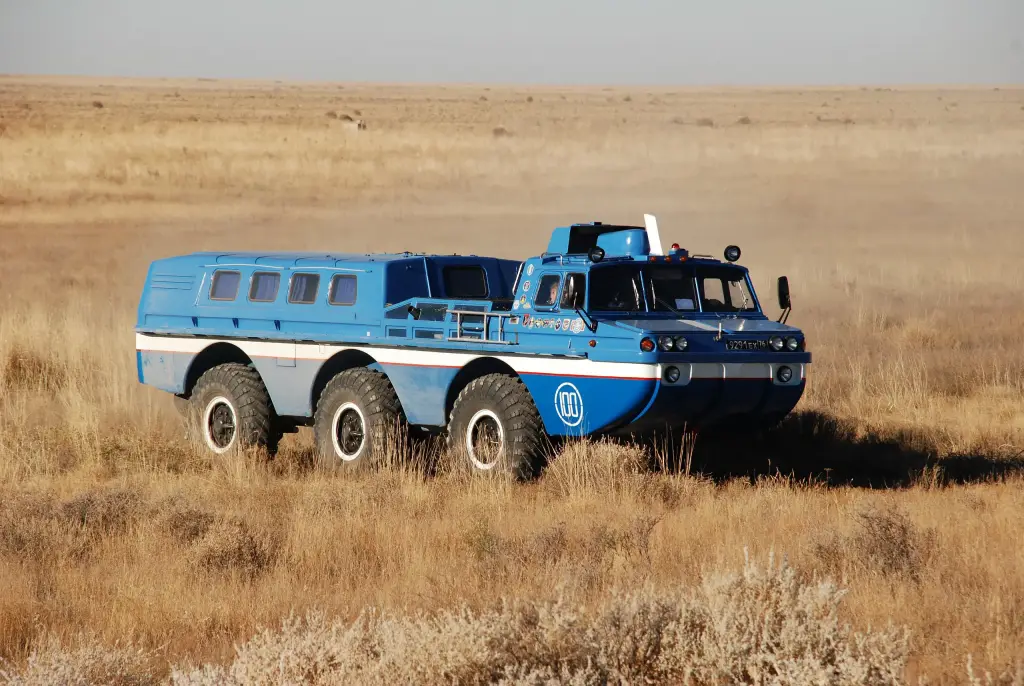
The ZIL-4906 was a three-axle amphibious machine built by ZiL for the Soviet space programme. With the passenger-carrying ZIL-49061 and the screw-rotor swamp vehicle ZIL-29061 it formed the 490 search and rescue complex, nicknamed the Blue Bird.
ZIL-4906 at a glance
| Maker | ZiL Special Design Bureau, Moscow |
|---|---|
| Built | from 1975 |
| Class | amphibious 6×6 search and rescue machine |
| Complex | 490, with ZIL-49061 and ZIL-29061 |
| Role | recovery of descent modules, crane work |
| Hull | glass-fibre reinforced polyester, watertight |
| Frame | aluminium alloys |
| Steering | front and rear wheels |
| Adopted | 1981 by the Soviet Air Force rescue service |
| Built | 14 including prototypes |
Based on the Russian Wikipedia articles on the ZIL-4906 and ZIL-49061; there is no English article.
History of the ZIL-4906
A new search and rescue complex
In the early 1970s the ZiL Special Design Bureau worked on replacements for the PEU-1 search and rescue vehicles. The existing machines could not reach crews of multi-seat Soyuz descent modules quickly enough, nor transport the descent modules of new Yantar reconnaissance satellites, and their wheeled chassis had clear limits in deep snow and marsh. The answer was a complete Search and Rescue Machine Complex (KPEM), including a vehicle of extremely high cross-country ability. From the mid-1960s the bureau had studied screw-rotor drives and pneumatic-roller chain designs, which shaped the later work.
The 490 complex
By summer 1975 the bureau had assembled the wheeled vehicles 4906 and 49061 and the screw-rotor swamp vehicle 2906. Trials followed; the 2906 failed and was replaced in 1979 by the 29061, a largely new design despite the similar index. The complex had three parts: the 4906, a floating three-axle machine with a platform for special cargo and a crane; the 49061, a floating three-axle machine with a passenger cabin; and the 29061 screw-rotor swamp vehicle, carried by the 4906. On adoption the 4906 became the PEM-2, the 49061 the PEM-1 and the 29061 the PEM-3, where PEM stands for Search and Rescue Machine. Soldiers called them ‘Pemkas’, and cosmonauts gave the blue-painted complex the name ‘Blue Bird’.
Construction
Where the earlier PEU vehicles used components of the 135 family, the 490 machines had their own transmission, suspension, steering and brakes, previously used only on bureau prototypes and later on the small-series ZIL-4972. The hull was watertight with smooth lines and was made of polyester resin reinforced with glass cloth; the frame, load-bearing structures and most unit housings were aluminium alloys. The transmission was of the side-shaft type with wheel hubs, the axles were spaced equally along the base and both front and rear wheels steered, and the machines carried radio, navigation and direction-finding equipment.
In service
The complex entered service with the Unified State Aviation Search and Rescue Service of the Soviet Air Force in 1981 and gradually replaced the PEU-1 family, recovering Soyuz crews and satellite descent modules. In 1992 a ZIL-4906 took part in support of the Europa-America-500 mission, the first privately funded space launch, and travelled by sea to Seattle. Only 14 ZIL-4906s were built, including prototypes.
Design and features
- Amphibious hull: a watertight glass-fibre-reinforced polyester body with smooth lines.
- Crane and platform: designed to lift and carry Soyuz descent modules and satellite capsules.
- Six-wheel drive: equal axle spacing, steering at both ends and a side-shaft transmission.
- Space programme service: part of the Blue Bird complex adopted by the Soviet Air Force in 1981.
ZIL-4906 versions
- ZIL-4906 (PEM-2): cargo and crane machine, 14 built including prototypes.
- ZIL-49061 (PEM-1): passenger version for the rescue team and crew, 15 built.
- ZIL-29061 (PEM-3): screw-rotor swamp vehicle carried by the 4906.
- ZIL-4972: small-series machine that shared the transmission and suspension units.
The 4906 worked with the ZIL-135 family lineage of special ZiL chassis, and other unusual machines are in the ZiL collection.
Sources
- ЗИЛ-4906, Russian Wikipedia: development, complex, construction, service
- ЗИЛ-49061, Russian Wikipedia: passenger version, numbers built