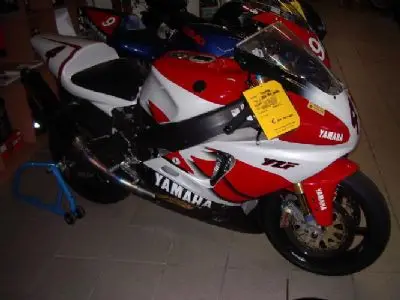
The Yamaha YZF-R7, also known as the OW-02, is a race homologation motorcycle that Yamaha built in a limited run of 500 units worldwide. It was designed for the Superbike World Championship and the Suzuka 8 Hours.
Yamaha YZF-R7 at a glance
| Maker | Yamaha Motor Company |
|---|---|
| Also called | OW-02 |
| Class | Race homologation sport bike |
| Production | 500 units worldwide, announced 1999 |
| Engine | 749 cc DOHC inline-four, five valves per cylinder |
| Power | 79 kW (106 hp) |
| Race kit power | up to 101 kW (135 hp) |
| Frame | shortened Deltabox II |
| Suspension | Öhlins |
| Engine internals | titanium valves and conrods |
| Dry weight | 189 kg |
| Purpose | Superbike World Championship and Suzuka 8 Hours |
Based on one source (English Wikipedia).
History of the Yamaha YZF-R7
The R7 was built as a homologation special, with only 500 units made worldwide so that the model could compete in the Superbike World Championship and the Suzuka 8 Hours. Its 749 cc DOHC inline-four had five valves per cylinder and produced 79 kW, or 106 hp in road trim.
Yamaha also produced two race kits for the R7. With the second, unused bank of fuel injectors activated and a pipe and ECU update, output rose to over 101 kW, or 135 hp. The chassis was built for racing straight from the crate, using geometry and information from the YZR500 machines of the period. It had Öhlins suspension, titanium valves and conrods, a shortened Deltabox II frame and a dry weight of 189 kg.
The R7 was expensive and rare, and it became controversial. Super Streetbikes magazine ranked it eighth in its list of the ten most exotic bikes ever, praising its Öhlins race suspension and looks but noting that as sold it was hobbled at only 100 hp and that small teams could not afford the racing upgrades needed to make it competitive; when they could, crankshafts failed. Yamaha had detuned the engines for all markets to meet German power regulations, since almost every buyer intended to modify the bike for racing anyway. Some club racers fitted the R1 engine into R7 frame mounts, a conversion nicknamed the R71, and Harris Performance built a bespoke R71 frame in small numbers.
When the R7 was announced in 1999, 50 were earmarked for the United States, ten of them for Yamaha’s factory team, and the waiting list far exceeded supply. The model is now a collectible: low-mileage, unmolested examples sell well above the original price, and one sold at a Bonhams auction for £37,375 in October 2023.
Design and features
- Homologation special: only 500 units, built to qualify for World Superbike.
- Five-valve four: a 749 cc engine making 106 hp in road trim and 135 hp with a race kit.
- Race chassis: YZR500-derived geometry, Öhlins suspension and a shortened Deltabox II frame.
- Collectible status: rare, expensive and now sought after by collectors.
Yamaha YZF-R7 versions
- YZF-R7 / OW-02 (1999): the road-going homologation machine.
- Race kit 1 and 2: Yamaha kits raising output to 135 hp.
- R71: unofficial club-racer conversion using a YZF-R1 engine.
The R7 was the racing-focused relative of the YZF-R1 and YZF-R6. More models are in the Yamaha collection.
Sources
- Yamaha YZF-R7, English Wikipedia: production, engine, chassis, race kits, reception, collectibility