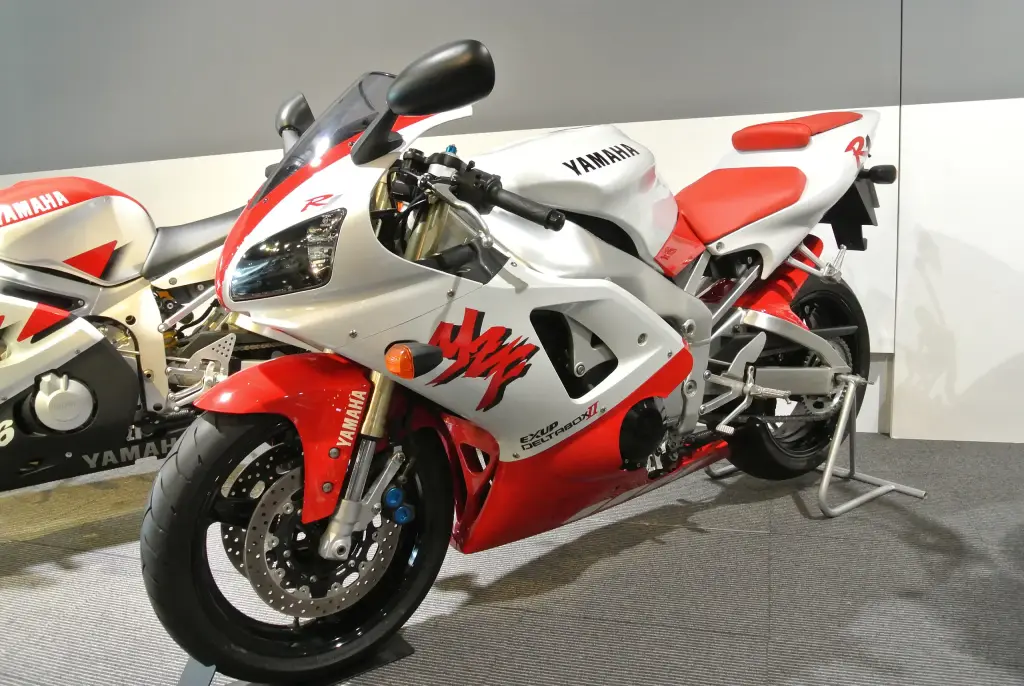
The Yamaha YZF-R1, often called simply the R1, is a 998 cc sports motorcycle that Yamaha first released in 1998. Its compact engine and chassis set a new standard for litre-class sport bikes.
Yamaha YZF-R1 at a glance
| Maker | Yamaha Motor Company |
|---|---|
| Class | Sports motorcycle |
| Engine | 998 cc inline-four |
| First released | 1998 |
| Major updates | 2000, 2002, 2004, 2006, 2007, 2009, 2015, 2018, 2020 |
| First wheelbase | 1,385 mm |
| First carburettors | four 40 mm Keihin CV |
| Front fork | 41 mm KYB upside-down |
| Front brakes | 300 mm semi-floating discs |
| Exhaust | EXUP power valve |
| Instrument panel | electronic with self-diagnosis |
Based on one source (English Wikipedia); the article covers the early generations described in the source.
History of the Yamaha YZF-R1
Yamaha launched the R1 in 1998 after redesigning the Genesis engine to make it more compact. The gearbox input shaft was raised and the output shaft placed beneath it, creating a “stacked gearbox” that other manufacturers later followed. The shorter engine allowed a shorter wheelbase and better centre of gravity, and the swingarm could be longer without lengthening the bike beyond its 1,385 mm wheelbase. Four 40 mm Keihin CV carburettors fed the engine.
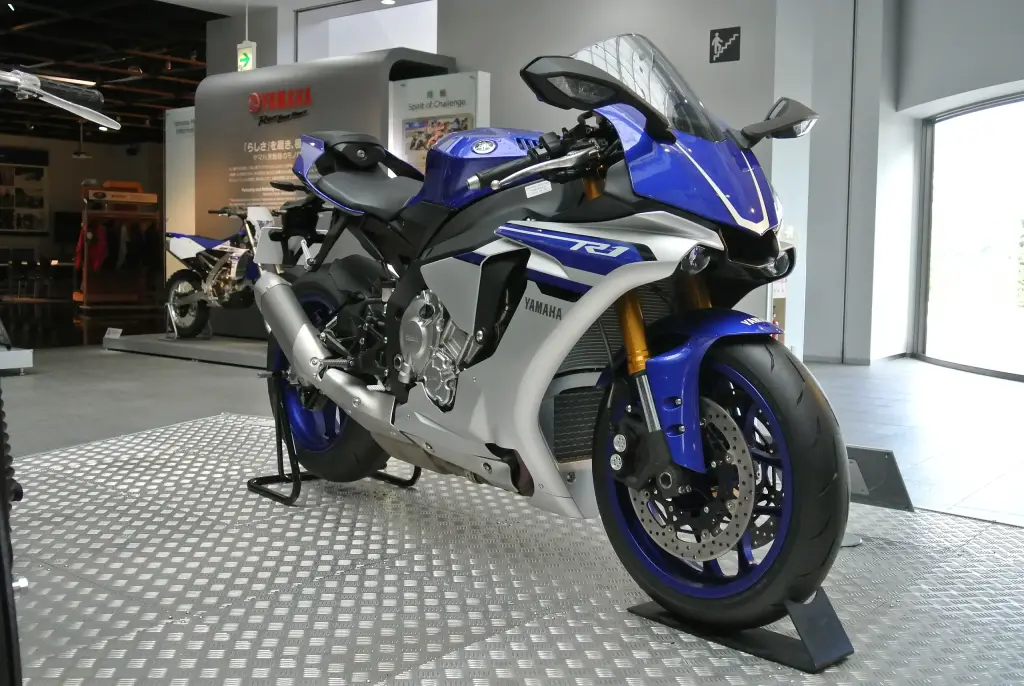
The first R1 also had a 41 mm KYB upside-down front fork, 300 mm semi-floating front discs, an electronic instrument panel with self-diagnosis and a digital speed readout, and Yamaha’s Exhaust Ultimate Power Valve, which controlled exhaust gas flow to maximise power across the rev range. The YZF-R6 followed in 1999 as the 600 cc version. The 1999 R1 changed little apart from paint and graphics, with a redesigned gear change linkage, a longer gear change shaft and a smaller fuel reserve.
In 2000 Yamaha sharpened the bike rather than redesigning it: dry weight fell by five pounds to 414 lb, the bodywork was slightly more aerodynamic and the seating position was revised to put more weight on the front. The carburettors were re-jetted, the camshafts lightened and the gearbox revised. For 2002 the R1 gained fuel injection, new high-silicon cylinder sleeves, a titanium 4-into-2-into-1 exhaust, a new Deltabox frame with 30 per cent more rigidity, a redesigned cooling system, an LED tail light and sharper headlights with side parking lights. Cycle World recorded 38 mpg, 0–60 mph in 2.9 seconds, a 10.32-second quarter mile at 137.60 mph and a 167 mph top speed. For 2003 the changes were limited to hazard warning lights and low-beam headlights that stay on with the ignition.
Design and features
- Stacked gearbox: a compact engine layout that allowed a short wheelbase and long swingarm.
- EXUP: an exhaust power valve that smooths and strengthens the power delivery.
- Deltabox frame: the 2002 design was 30 per cent more rigid than before.
- Continuous development: significant updates in nine model years between 1998 and 2020.
Yamaha YZF-R1 versions
- RN01 (1998–1999): the original carburetted R1.
- RN04 (2000–2001): lighter, sharper version of the first design.
- RN09 (2002–2003): fuel injection, Deltabox frame and new exhaust.
- Later generations (2004–2020): successive redesigns through to the modern R1.
The R1 spawned the YZF-R6, and its chassis technology also reached the MT-01. More models are in the Yamaha collection.
Sources
- Yamaha YZF-R1, English Wikipedia: launch, engineering, model years 1998–2003, performance tests