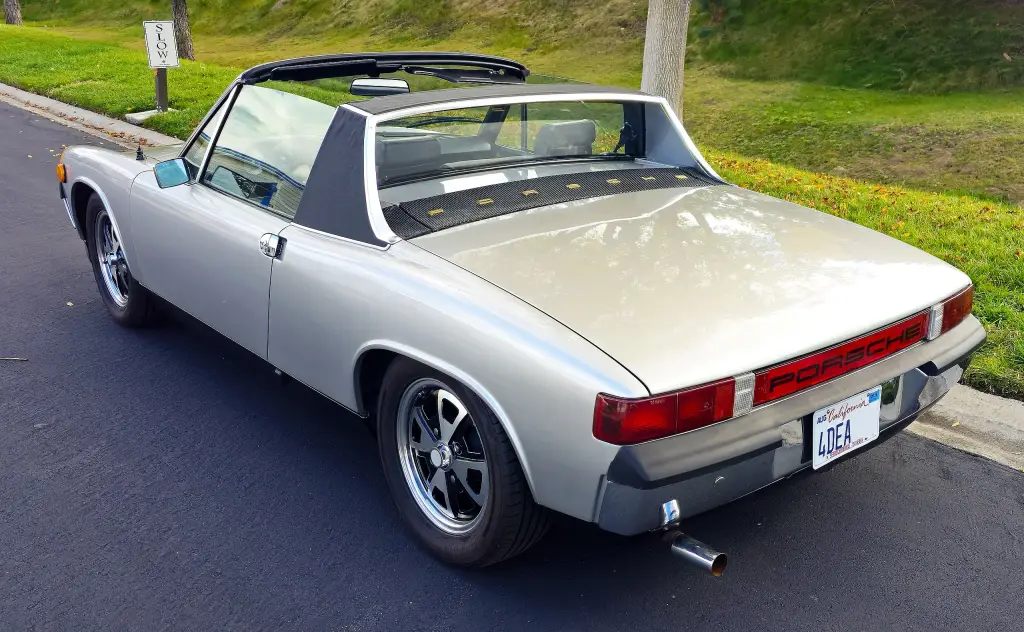
The Porsche 914, also called the VW-Porsche 914, is a mid-engined sports car designed and marketed by Volkswagen and Porsche together from 1969 to 1976. It was a targa-topped two-seater with a flat-four or flat-six engine, and it became Porsche’s best-selling model of its time.
Porsche 914 at a glance
| Makers | Volkswagen and Porsche joint venture |
|---|---|
| Production | 1969–1976 |
| Body | targa-topped two-seat roadster |
| Layout | mid-engine, rear-wheel drive |
| 914/4 engine | 1.7-litre fuel-injected VW Type 4 flat-four, 80 bhp |
| From 1973 | 2.0-litre fuel-injected flat-four, 100 bhp |
| From 1974 | 1.8-litre flat-four, 85 bhp, Bosch L-Jetronic |
| 914/6 engine | 2.0-litre air-cooled Type 901/3 flat-six, 110 bhp |
| Gearbox | five-speed transaxle based on the 1969 911 |
| Assembly | Karmann, plus Porsche final assembly |
| Award | Motor Trend Import Car of the Year, 1970 |
| Built | over 118,000 of the 914/4; 3,351 of the 914/6 |
History of the Porsche 914
By the late 1960s both partners needed a new model. Porsche wanted a replacement for its entry-level 912 and Volkswagen a sporting coupé to top its range in place of the Type 34 Karmann Ghia. Volkswagen’s development work was largely handled by Porsche under an agreement going back to Porsche’s founding, and the 914 became the last project contracted under it. Ferdinand Piéch, head of research and development at Porsche, ran the project.
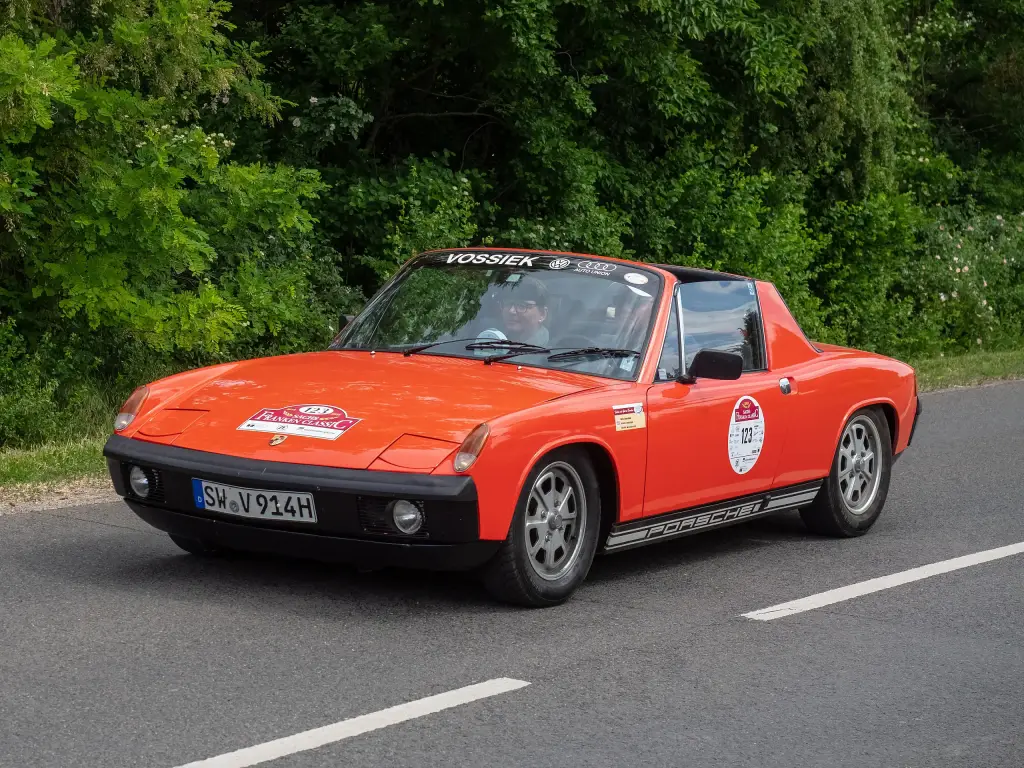
The origin of the shape has been debated. Gugelot Design showed a proposed sports coupé built with Bayer technology to several makers in 1966 and 1967, but later sources reject the idea that the 914 came from it and credit Porsche’s own body engineer Heinrich Klie. The plan was to sell the four-cylinder car as a Volkswagen and the six-cylinder as a Porsche, but Porsche judged that sharing one body in America was risky and persuaded Volkswagen to sell both versions as Porsches in North America. The first prototype was presented on 1 March 1968.
Development was thrown off course by the death of Volkswagen chairman Heinrich Nordhoff on 12 April 1968. His successor Kurt Lotz had no link to the Porsche family, and the verbal agreement fell apart: Lotz held that Volkswagen owned the model and would not share it unless Porsche paid towards the tooling. The price concept collapsed before series production, the chassis became much more expensive, and the 914/6 ended up costing only a little less than a 911T.
The four-cylinder cars used Volkswagen’s fuel-injected 1.7-litre Type 4 flat-four of 80 bhp. The 914/6 took the 2.0-litre air-cooled Type 901/3 flat-six of the 1967–1969 911T, with revised pistons lowering the compression ratio to 8.6:1, iron cylinder barrels, milder camshafts, smaller 27 mm venturis in the Weber 40IDT3C carburettors and a smaller exhaust, for 110 bhp. It also had lower gearing, larger brakes, five-stud wheels and the ignition switch on the left of the steering wheel. All engines sat in front of an adapted 1969 911 transaxle; Karmann built the rolling chassis.
The 914/6 was dropped in 1972 after 3,351 cars, replaced for 1973 by a 100 bhp 2.0-litre fuel-injected flat-four. For 1974 the 1.7-litre unit gave way to an 85 bhp 1.8-litre with Bosch L-Jetronic for American emission control. Model-year changes were mostly cosmetic and safety-related: chrome or painted bumpers from 1970 to 1972, a crease on the rear bumper in early 1970, front bumper guards in 1973 and rear guards in 1974. The 914/4 outsold the 911 by a wide margin with over 118,000 cars, and production ended in 1976, when the 2.0-litre flat-four moved to the 912E and the 924 arrived the following year.
Design and features
- Mid-engine layout: the engine sits in front of the rear axle, as in the 550 and 718 racers.
- Joint development: a Volkswagen project engineered by Porsche and built by Karmann.
- Targa roof: an open two-seater with a fixed roll bar.
- Two engine families: Volkswagen flat-four or Porsche flat-six, with very different characters.
Porsche 914 versions
- 914/4 1.7 (1969–1973): 80 bhp Volkswagen flat-four, the volume model.
- 914/6 (1969–1972): 110 bhp Porsche flat-six, 3,351 built.
- 914 2.0 (1973–1976): 100 bhp fuel-injected flat-four replacing the six.
- 914 1.8 (1974–1976): 85 bhp with L-Jetronic for the United States.
The 914 replaced the Porsche 912 in the range and shared its flat-six with the Porsche 911. More cars are in the Porsche collection.
Sources
- Porsche 914, English Wikipedia: development, engines, model years, production