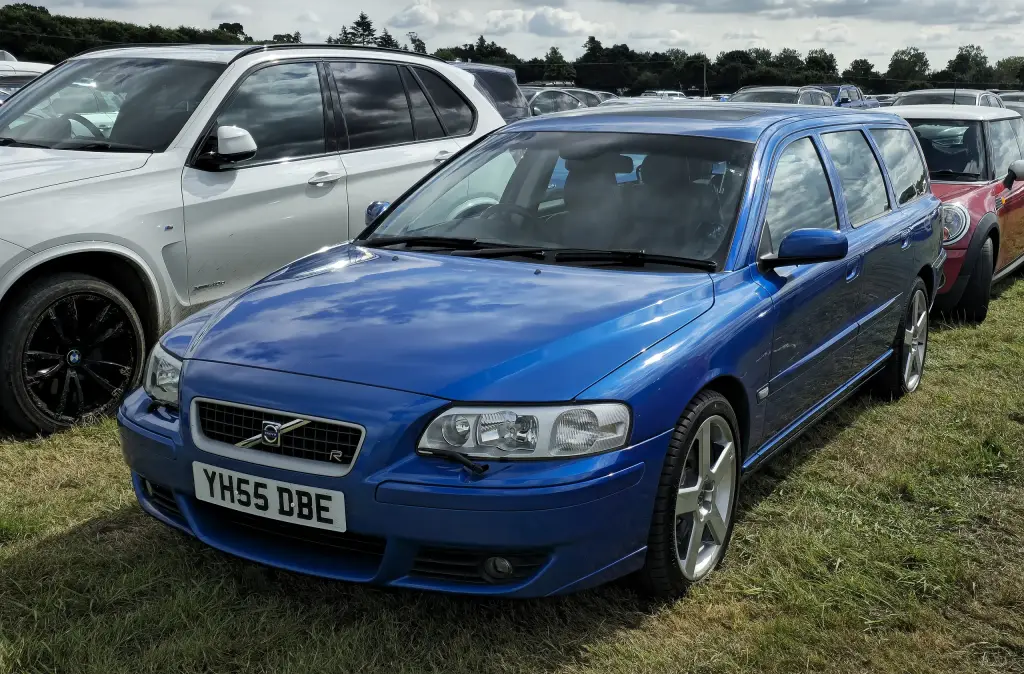
The Volvo V70 was an executive estate built from 1996 to 2016 over three generations. Its name combines V for versatility with 70 for platform size, and it grew out of the 850 estate before becoming the wagon of the S60 and then the S80 generations.
Volvo V70 at a glance
| Production | 1996–2016 |
|---|---|
| First generation | 1996–2000, P80 platform |
| Second generation | 2000–2007, P2 platform |
| Third generation | 2007–2016, P3 platform |
| Crossover | V70 XC from September 1997, renamed XC70 in 2003 |
| Saloon sisters | Volvo S70, then S60, then S80 |
| Changes over the 850 | 1,800 according to Volvo |
| Safety additions | SIPS-BAG II and WHIPS in 1999 |
| End of production | 25 April 2016, with the XC70 following on 13 May |
History of the Volvo V70
The first-generation V70 debuted in November 1996 as an improved development of the Volvo 850 estate. Its design became more rounded, doing away with the 850’s square edges: a completely revised front end, fully painted bumpers and side trim and clear indicator lenses all round, while most of the interior was redesigned with new seats, door panels and dashboard. Volvo counted 1,800 changes. Standard equipment improved sharply, with remote central locking, heated and electrically adjustable mirrors, front and side airbags, ABS and electric windows on every car, and the T5 and R as the high-performance models.

In September 1997 Volvo added a crossover version called the V70 XC or V70 Cross Country. Trim levels and equipment varied by market: in the United States badging denoted the engine and equipment level, while in Europe engines and options could be chosen individually. An optional third row raised capacity from five to seven seats at the cost of underfloor storage, and some markets had a diesel V70 TDI or special 2.0-litre petrol models for countries with heavy taxes above two litres.
1999 and 2000 updates
The 1999 cars had a redesigned grille badge, square XC-style roof rails, dual-stage front airbag deployment, the second-generation SIPS side airbag with greater volume, WHIPS whiplash protection as standard and drive-by-wire throttles on turbo petrol models. ABS went from three to four channels, the traction control became STC, all-wheel-drive cars received thicker rear discs and redesigned calipers, and the four-speed automatics gained adaptive shift logic. For 2000 a five-speed automatic arrived for non-turbo front-wheel-drive cars and the V70 R AWD, the 10-valve engine was replaced by a detuned 20-valve unit, and the 2.0-litre V70 XC was dropped.
Later generations
The second generation debuted in spring 2000 on the P2 platform, again with an AWD version and a crossover that was renamed XC70 for 2003, while the saloon became the S60. The third generation arrived in February 2007 on the P3 platform with the S80 as its saloon sister. Production of the V70 ended on 25 April 2016, with the XC70 continuing until 13 May.
Design and features
- Three generations: P80, P2 and P3 platforms over twenty years.
- Rounded 850: the first V70 was a heavily revised 850 estate.
- Safety upgrades: SIPS-BAG II, WHIPS and STC in 1999.
- Cross Country: the raised V70 XC became the XC70.
- Seven seats: an optional third row in the first generation.
Volvo V70 versions
- V70 (1996): first generation, front- or all-wheel drive.
- V70 XC (1997): raised crossover version.
- V70 R: high-performance estate with all-wheel drive.
- V70 TDI and Bi-Fuel: diesel and gas versions for some markets.
- XC70 (2003): the renamed crossover, built until May 2016.
The V70 was the estate version of the Volvo S70 and later the Volvo S80, and it developed from the Volvo 850 estate. More cars are in the Volvo collection.
Sources
- Volvo V70, English Wikipedia: generations, 1999 and 2000 updates, XC70, end of production