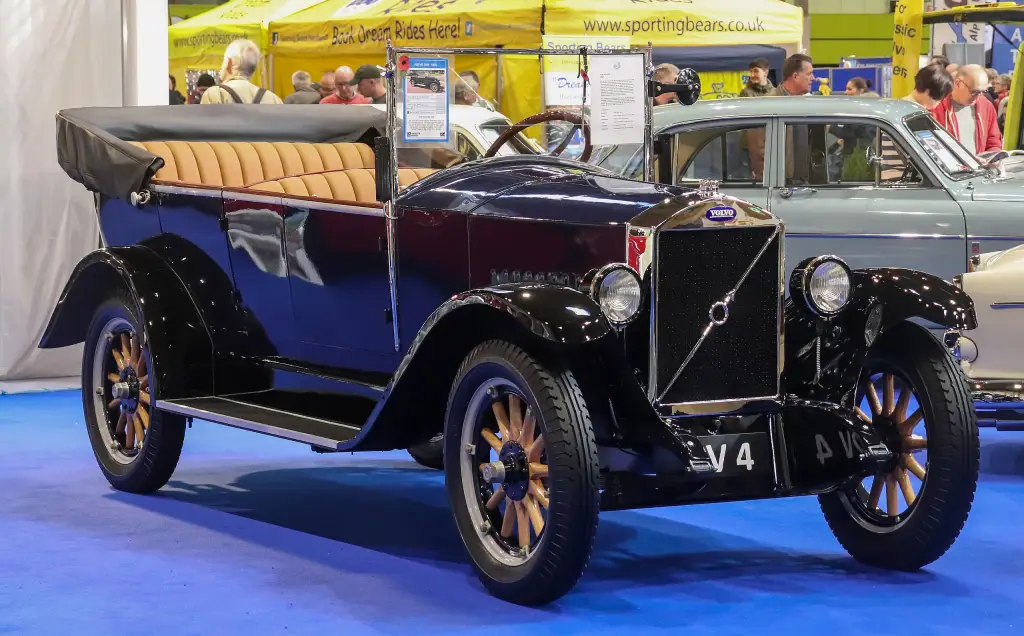
The Volvo ÖV4 was the first car built by Volvo. Its name stood for Öppen Vagn 4 cylindrar, Swedish for open carriage with four cylinders, and it went on sale in 1927 alongside the covered PV4.
Volvo ÖV4 at a glance
| Production | 1927–1929 |
|---|---|
| Name | Öppen Vagn 4 cylindrar, open carriage, four cylinders |
| Nickname | Jakob, the name of one of the pre-series cars |
| Engine | 1,944 cc four-cylinder side-valve |
| Power | 28 hp at 2,000 rpm |
| Torque | 100 Nm |
| Gearbox | three forward speeds, one reverse |
| Speed | 60 km/h recommended, 90 km/h maximum |
| Weight | 1,170 kg |
| Built | 302 ÖV4, 694 PV4 and 996 cars in total |
History of the Volvo ÖV4
Ten pre-series ÖV4 cars were assembled in Stockholm at AB Galco, Hälsingegatan 41, where Gustaf Larson worked at the time. One of them, finished on 25 July 1926 and named Jakob after that day’s name day, gave the model the nickname by which it is still often called. Only one of the ten pre-series cars survived, and it is kept at the Volvo Museum in Gothenburg.
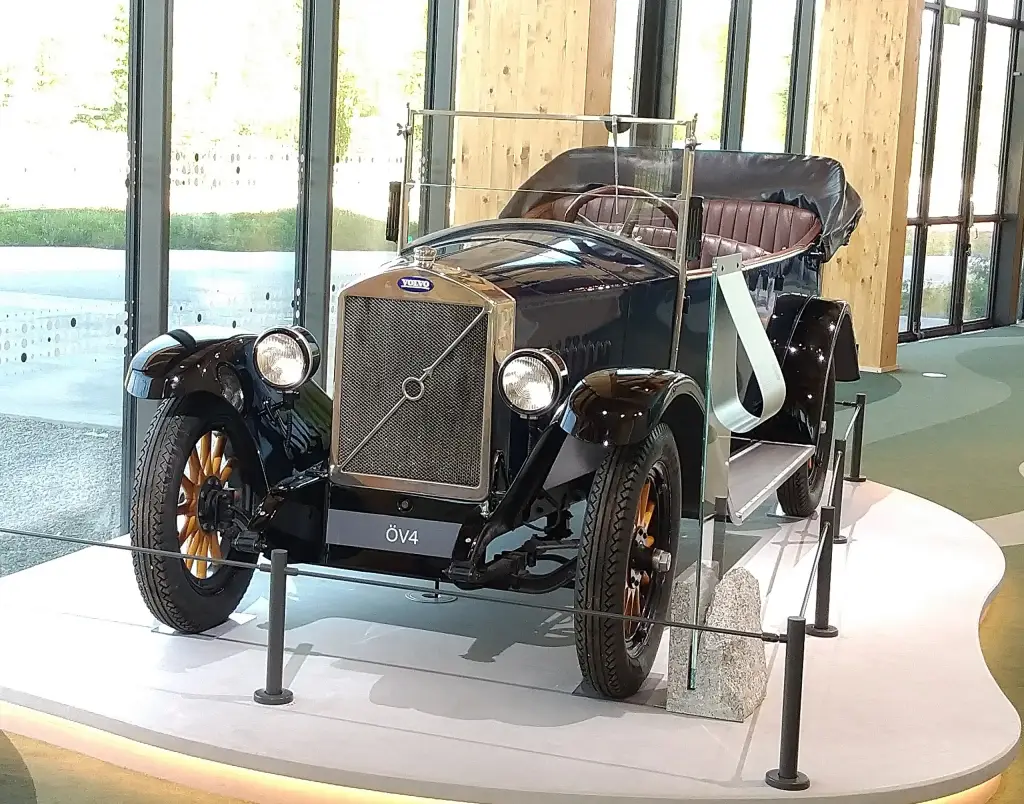
The engine was designed by Gustav Larson and the main chassis components by Jan G. Smith, a designer who had spent many years in the American car industry and returned to Sweden in 1924. Many of Smith’s drawings and the technical papers he collected in America are held by the National Museum of Science and Technology in Stockholm.
The launch that went backwards
When the first series car was about to drive out of the factory, the engineer Eric Carlberg put it into first gear and the car went backwards, because the differential in the rear axle had been fitted the wrong way round. The mistake delayed the introduction by a day, and the official launch date was set at 14 April 1927, the day Volvo officially calls its own birthday, although the company had been founded as a subsidiary of SKF on 10 August 1926.
PV4 and the trucks
The open cabriolet did not suit the Swedish climate, and the covered PV4 with a Weymann body was introduced in the summer of 1927. The design was considered ungainly, and Helmer MasOlle, who had been inspired by his own Voisin C5 when he drew the ÖV4, was reportedly furious about it. By 1928 a more balanced design appeared with a longer bonnet and thinner pillars, and the oval rear window gave way to a rectangular one. Between 1927 and 1929 Volvo built 996 cars: 694 PV4 and 302 ÖV4, including 27 bare chassis and 70 ÖV4 TV light pickups for Telegrafverket, the royal telecommunications company, which had a small convertible top behind the front seats and a cargo area behind it.
Design and features
- The first Volvo: the car that started the company in 1927.
- Four-cylinder side-valve: 1,944 cc and 28 hp through a three-speed gearbox.
- Open body: an open carriage in a Swedish climate, soon joined by the covered PV4.
- ÖV4 TV: 70 light pickups for the Swedish telecommunications authority.
- Surviving prototype: one of the ten 1926 cars is in the Volvo Museum.
Volvo ÖV4 versions
- ÖV4: the open tourer, 302 built.
- PV4 (1927): covered Weymann-bodied version, 694 built.
- PV4 Special: 251 of the covered cars.
- ÖV4 TV: 70 small pickups for Telegrafverket.
- Bare chassis: 27 sold without bodies.
The ÖV4 was followed by the Volvo PV36 Carioca and eventually by the Volvo PV444. More cars are in the Volvo collection.
Sources
- Volvo ÖV 4, English Wikipedia: origin, prototypes, launch story, PV4, production, data