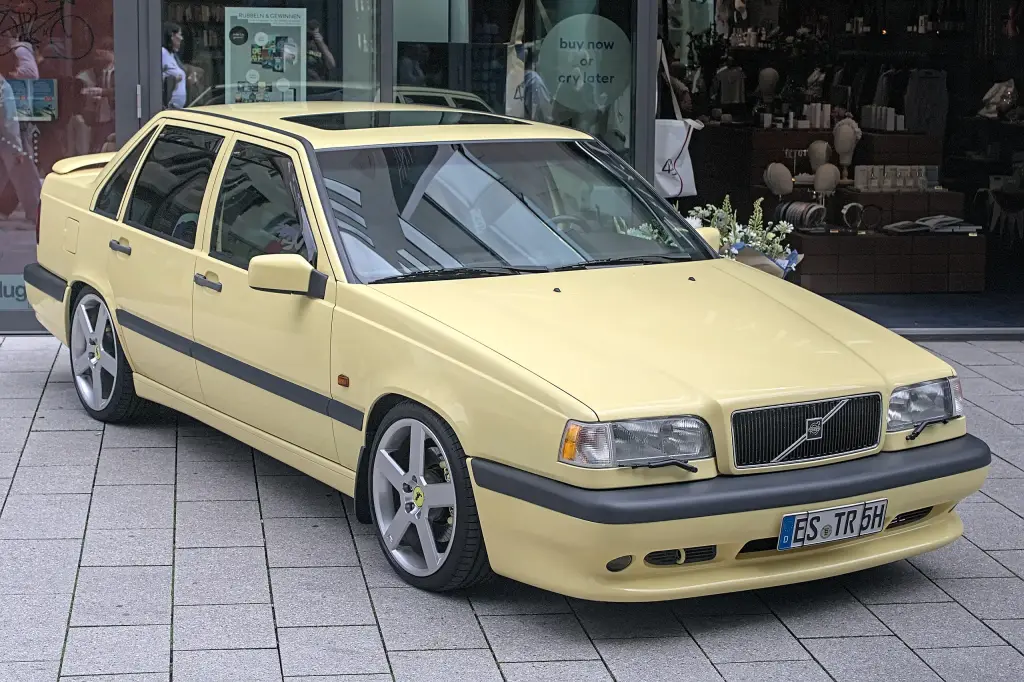
The Volvo 850 was a compact executive car made from 1991 to 1997. It broke with Volvo tradition by driving the front wheels through a transverse five-cylinder engine, and it introduced the Delta-link rear axle and the Side Impact Protection System. Saloon came first, estate in 1993.
Volvo 850 at a glance
| Production | 1991–1997 |
|---|---|
| Design | Jan Wilsgaard |
| Bodies | four-door saloon (1991), five-door estate (1993) |
| Layout | transverse five-cylinder, front-wheel drive |
| Innovations | Delta-link rear axle, SIPS, self-adjusting front seat belts |
| Engines | 2.0 and 2.5-litre 20-valve, 2.4 10-valve, turbo, TDI, Bi-Fuel CNG |
| T5 power | 222 hp (225 PS) |
| T-5R power | 243 hp, 0–60 mph in 5.8–6.0 s |
| Turning circle | 10.2 m |
| Successors | Volvo S70 and V70 |
History of the Volvo 850
Work on what became the 800 series began in 1978 as Project Galaxy, the programme that also produced the 400 Series, the modular engine family and new manufacturing methods. It was the most expensive industrial project in Swedish history at the time. The 850 went on show in June 1991 with the slogan “a dynamic car with four unique innovations”: the transverse five-cylinder engine, the Delta-link rear axle, SIPS, and self-adjusting seatbelt reels for the front seats.
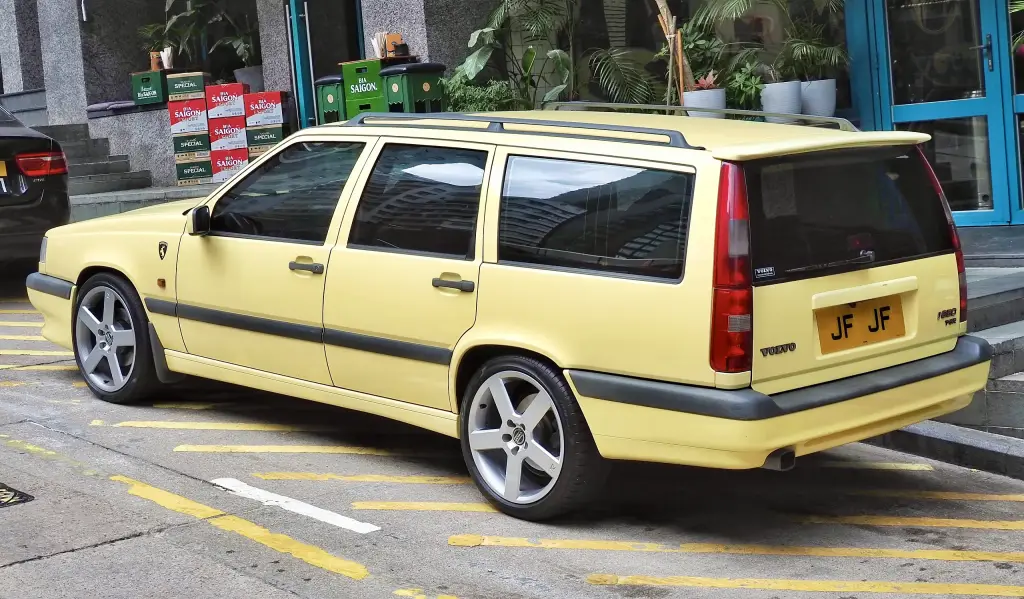
At first only the saloon was offered, as the 850 GLT with a choice of 2.5 or 2.0-litre 20-valve engines. In 1992 the car reached the United States as a 1993 model, Volvo’s first front-wheel-drive car there. The range soon included a CNG Bi-Fuel version and a diesel 850 TDI, with five-speed manual or four-speed automatic gearboxes. The estate went on sale in February 1993.
Chassis and packaging
The Delta-link semi-independent rear suspension used bushings that compress under load, giving passive rear steering, and Volvo held a US patent for the idea. The tight 10.2 m turning circle made the car very manoeuvrable. Mounting the five-cylinder engine transversely gave the saloon 2.80 cubic metres of interior space, more than a 2004 Mercedes-Benz E-Class despite compact exterior dimensions.
A facelift for 1994 brought new bumpers, headlamps and indicators outside and new switchgear inside; that year the estate won Japan’s Good Design Grand Prize. In August 1994 came the 850 Turbo with 225 PS, a 2.4-litre 10-valve engine and the T5, which reached 60 mph in 7.1 seconds. Volvo switched to five-bolt hubs, made ABS standard everywhere and fitted a new air-conditioning system.
Safety firsts and the T-5R
From 1995 the 850 offered the SIPS-Bag side airbag, making it the first mass-produced car in the world with side-impact airbags; they became standard across Volvo’s range in 1996. The 1995 850 T-5R used a specially calibrated B5234T5 engine with more boost for 243 hp and 340 Nm, Pirelli P-Zero tyres, a drag coefficient of 0.29 and a top speed limited to 244.9 km/h; the tuning was co-developed with Porsche. A Platinum edition of 1,400 cars followed for the United States in 1996, and the Turbo was rebadged T-5 for 1997. The 850 was replaced by the S70 and V70.
Design and features
- Transverse five: a compact layout that maximised interior space.
- Delta-link axle: semi-independent rear suspension with passive rear steering.
- SIPS: side impact protection, later with the world’s first production side airbags.
- T-5R: 243 hp, Porsche-assisted tuning and Pirelli P-Zero tyres.
- Estate practicality: the wagon arrived in 1993 and quickly became the icon.
Volvo 850 versions
- 850 GLT (1991): launch saloon with 2.0 or 2.5-litre 20-valve engines.
- 850 estate (1993): five-door wagon, Good Design Grand Prize winner.
- 850 Turbo and T5 (1994): 225 PS turbocharged models.
- 850 T-5R (1995–1996): 243 hp limited edition in cream yellow and other colours.
- 850 TDI and Bi-Fuel: diesel and CNG versions.
The 850 was replaced by the Volvo S70 and V70, and its estate body carried the same practical idea as the Volvo 240 wagon. More cars are in the Volvo collection.
Sources
- Volvo 850, English Wikipedia: development, models, engines, safety, T-5R