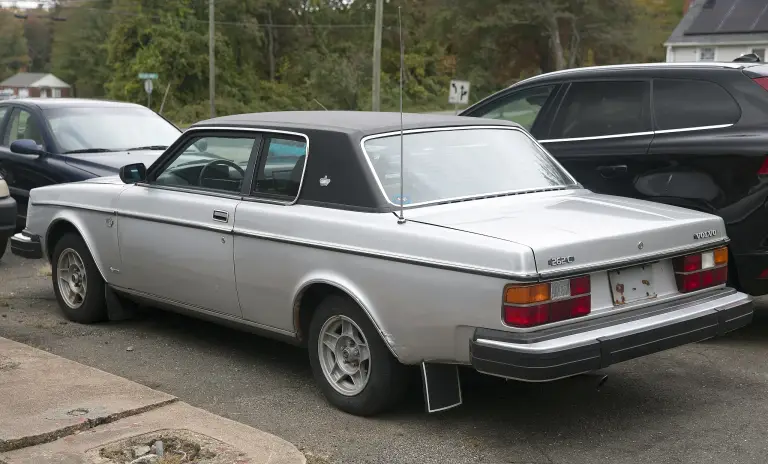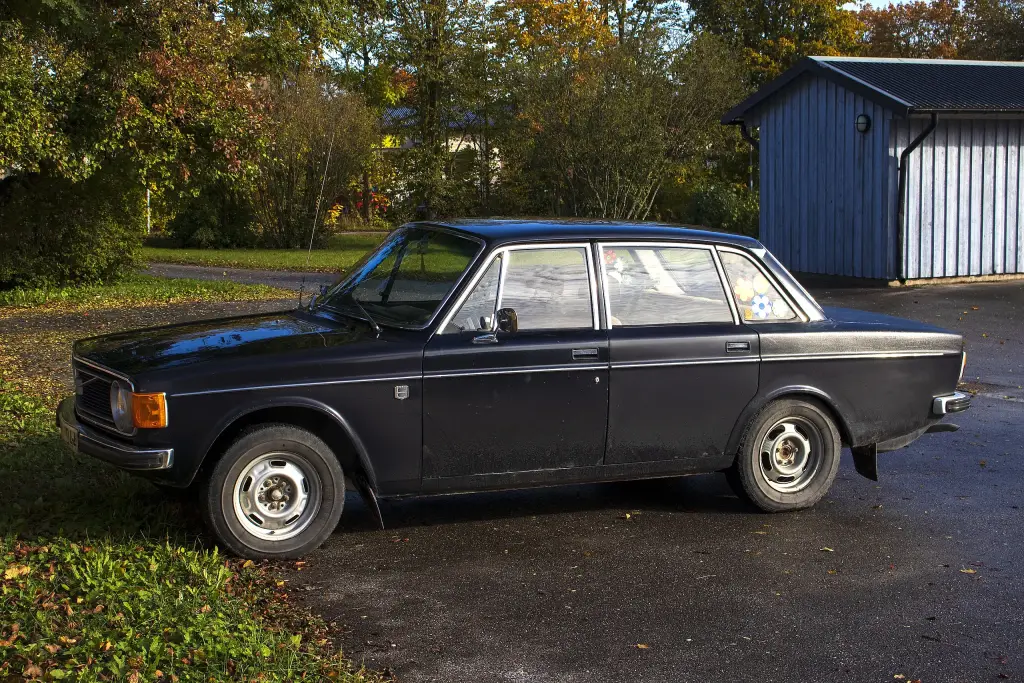
The Volvo 140 Series was built from 1966 to 1974 as a two-door saloon (142), a four-door saloon (144) and a five-door estate (145). It replaced the Amazon with a deliberately boxy shape and introduced the three-digit naming system that Volvo kept for the rest of the century.
Volvo 140 Series at a glance
| Production | 1966–1974 |
|---|---|
| Body styles | 142 two-door saloon, 144 four-door saloon, 145 estate |
| Assembly | Torslandaverken, Gothenburg |
| First model | 144, built from late summer 1966 as a 1967 model |
| Naming | first digit series, second cylinders, third doors |
| Engines | 1.8-litre B18, 2.0-litre B20 from 1969 |
| Injection | B20E with Bosch D-Jetronic from 1971 |
| Brakes | disc brakes on all four wheels |
| Built | 412,986 two-doors, 523,808 four-doors, 268,317 estates |
| Predecessor | Volvo Amazon |
| Successor | Volvo 240 |
Based on one source, the English Wikipedia article on the 140 Series.
History of the Volvo 140 Series
Volvo began building the 144 at Torslandaverken in the late summer of 1966 for the 1967 model year. It followed the Amazon but shared very little with it: the body was a new rectilinear design, the front grille was a stylised split, and the car used disc brakes on all four wheels. Swedish magazine Teknikens Värld named it car of the year in 1966. The basic shape proved so sound that it carried on, restyled, into the 200 Series of the 1990s.
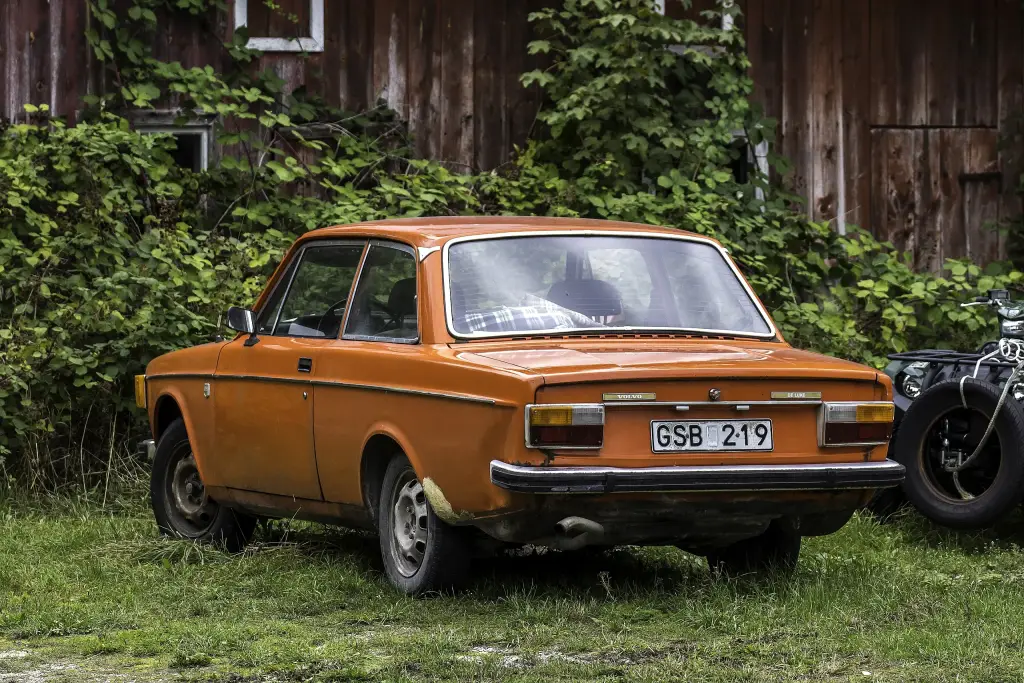
The three-digit name explained the car: the first digit was the series, the second the number of cylinders and the third the number of doors, so a 144 was a first-series, four-cylinder, four-door saloon. The standard 144 used the 1.8-litre B18A engine of the base Amazon, while the 144S took the more powerful B18B from the 123GT and 1800S.
Model updates
For 1969 Volvo enlarged the B18 to the 2.0-litre B20 and replaced the generator with an alternator; the six-cylinder 164 appeared the same year. A flow-through ventilation system and an electrically heated rear window arrived for 1970, and in 1971 came the black grille with the diagonal Volvo bar, a new instrument console and the B20E, a high-compression engine with Bosch D-Jetronic injection sold as the E or the more luxurious GL.
Flush door handles and a revised dashboard followed in 1972. The 1973 facelift brought a new plastic grille, larger indicators, a completely revised tail and a new padded dashboard with round dials; the S badge was dropped and the range became L, DL and GL. For 1974 the injection engines switched from D-Jetronic to mechanical K-Jetronic, the fuel tank was moved close to the rear axle for protection in a collision, and larger bumpers were fitted. The 140 then became the 240 for 1975.
Odd corners of the story
Around a thousand Volvo 144s were ordered by North Korea after Sweden established diplomatic relations in 1973; they were delivered but apparently never paid for, and the debt was still outstanding decades later. The 145 Express, a high-roof version of the estate, was produced as a replacement for the Duett van.
Design and features
- Three-digit names: series, cylinders and doors in one number, a Volvo convention from 1966 onwards.
- Boxy body: a clean, upright shape that was carried over almost unchanged into the 200 Series.
- Four-wheel disc brakes: standard on a mid-size family car of the mid-1960s.
- Safety work: collapsing steering column, padded dashboard and a protected fuel tank by 1974.
- Three body styles: two-door, four-door and the estate that made Volvo’s reputation for load space.
Volvo 140 Series versions
- 142: two-door saloon, 412,986 built.
- 144 and 144S: four-door saloon with the B18A or the twin-carburettor B18B.
- 145: five-door estate, 268,317 built.
- 145 Express: high-roof van version that replaced the Duett.
- GL and later DL: upmarket trim with overdrive and, from 1971, fuel injection.
The 140 grew into the six-cylinder Volvo 164 and was replaced by the Volvo 200 Series. More cars are in the Volvo collection.
Sources
- Volvo 140 Series, English Wikipedia: production, models, yearly changes, numbers built