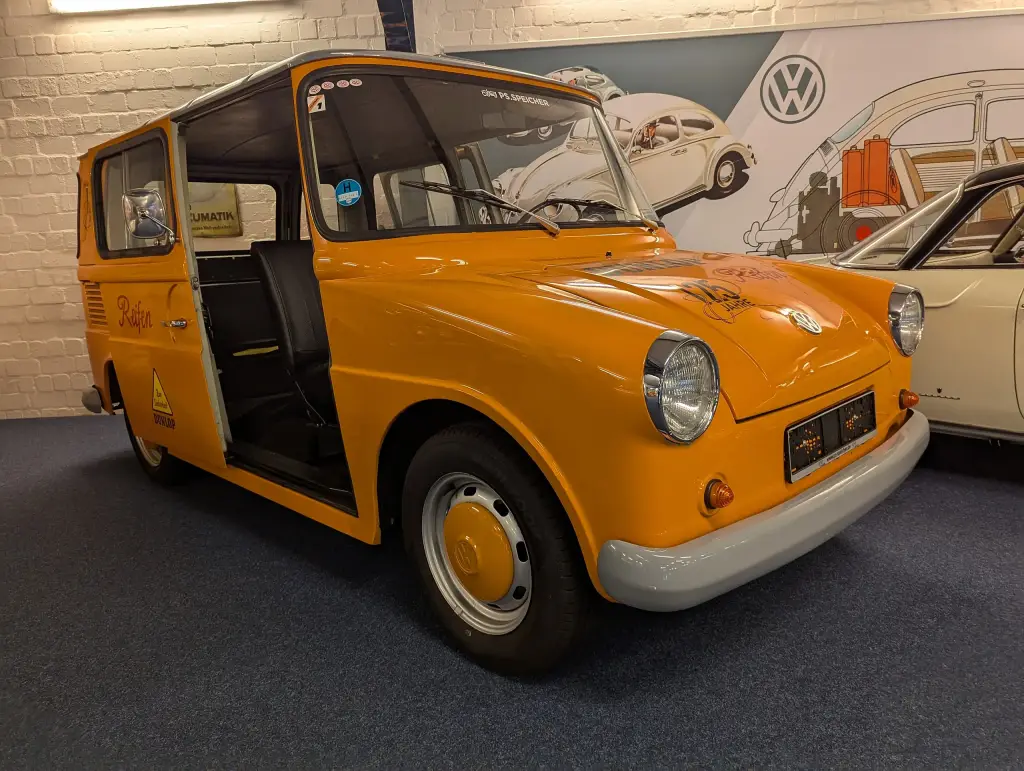
The Volkswagen Type 147 Kleinlieferwagen, informally known as the Fridolin, was a panel van produced by Volkswagen Commercial Vehicles from 1964 until 1974, mainly for the state-owned Deutsche Bundespost. Its mechanical parts came from the Beetle, its headlights from the VW 1500 and its scaled-down tailgate from the Transporter, while the body was based on the Karmann Ghia. Because of its badly proportioned shape it was affectionately called Fridolin, and the nickname outlived the official name.
Volkswagen Fridolin at a glance
| Official name | Volkswagen Type 147 Kleinlieferwagen |
|---|---|
| Nickname | Fridolin |
| Producer | Volkswagen Commercial Vehicles, built by Franz Knobel & Sohn (later Westfalia-Werke) |
| Production | 1964 – July 1974 |
| Main customer | Deutsche Bundespost |
| Body basis | Karmann Ghia (Type 14), after the Beetle cabriolet (Type 15) |
| Mechanicals | engine, transmission and axles from the Beetle Type 1 |
| Headlights | from the Volkswagen 1500 |
| Tailgate | scaled-down unit from the Transporter (Type 2) |
| Engine | flat four, 1,192 cm³, 25 kW (34 hp) |
| Dimensions | 3,970 mm long, 1,950 mm high, 2,400 mm wheelbase |
| Built | 6,139; about 200 preserved |
History of the Volkswagen Fridolin
In February 1962 the German postal service asked Volkswagen to design a van for its needs. To keep costs down, Volkswagen started from the Karmann-built Beetle cabriolet, the Type 15, because of its strong construction, and later moved to the wider Karmann Ghia, the Type 14, as the basis. The engine, transmission and axles came from the Beetle Type 1, the headlights from the Volkswagen 1500 and a scaled-down tailgate from the Transporter Type 2: the result was a van assembled from parts of four different models. It was agreed that Franz Knobel & Sohn, later known as Westfalia-Werke, would build the vehicles for Volkswagen, and several prototypes were made before production started in 1964.
Most of the vans went to the Deutsche Bundespost, but Swiss post offices bought an upgraded version with a more powerful 1.3-litre engine, disc brakes and a block heater, and Lufthansa used the van on the apron at airports. The official name was Volkswagen Type 147 Kleinlieferwagen, small van, but its funny and badly proportioned shape earned it the nickname Fridolin.
Production ran from 1964 to July 1974 and came to 6,139 vehicles, of which roughly 200 are preserved today. The van was 3,970 mm long, 1,950 mm high and stood on a 2,400 mm wheelbase, with a 1,192 cm³ flat four of 25 kW (34 hp) behind the rear axle. Its shape, with a narrow track and a tall body, made it unmistakable on German streets and gave it the place in Volkswagen history that its small production numbers would not otherwise have earned.
Design and features
- Built for the post office: commissioned by the Deutsche Bundespost in 1962 and used mainly by it.
- Four parents: Karmann Ghia body, Beetle mechanicals, 1500 headlights and a Transporter tailgate.
- Westfalia production: assembled by Franz Knobel & Sohn, later Westfalia-Werke.
- Small numbers: 6,139 built in ten years, with about 200 still in existence.
- A nickname that stuck: the official Type 147 is almost always called the Fridolin.
Volkswagen Fridolin versions
- Deutsche Bundespost van: the standard 1.2-litre vehicle.
- Swiss Post version: 1.3-litre engine, disc brakes and a block heater.
- Lufthansa vehicles: vans used on the airport apron.
The Fridolin borrowed its engine from the Beetle, its body basis from the Karmann Ghia and its tailgate from the Type 2. More cars are in the Volkswagen collection.
Sources
- Volkswagen Type 147 Kleinlieferwagen, English Wikipedia: origins, parts sources, production, dimensions