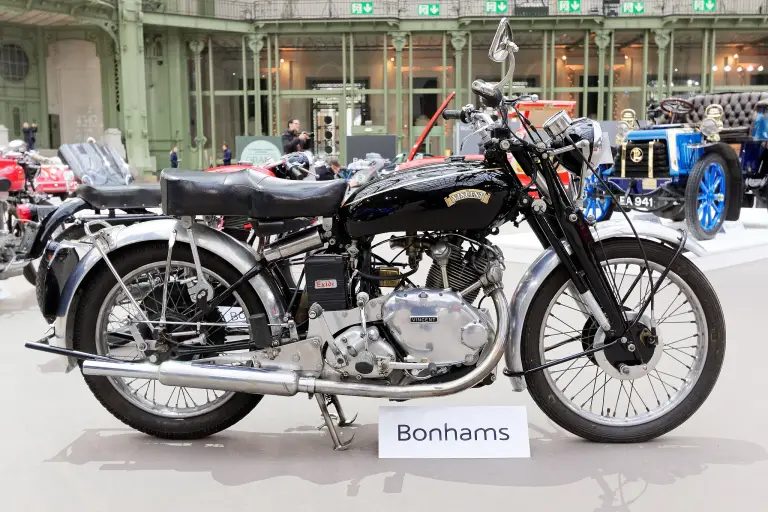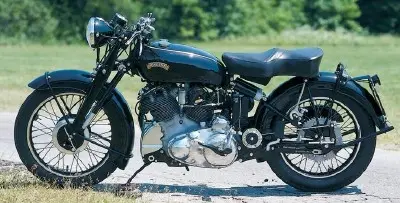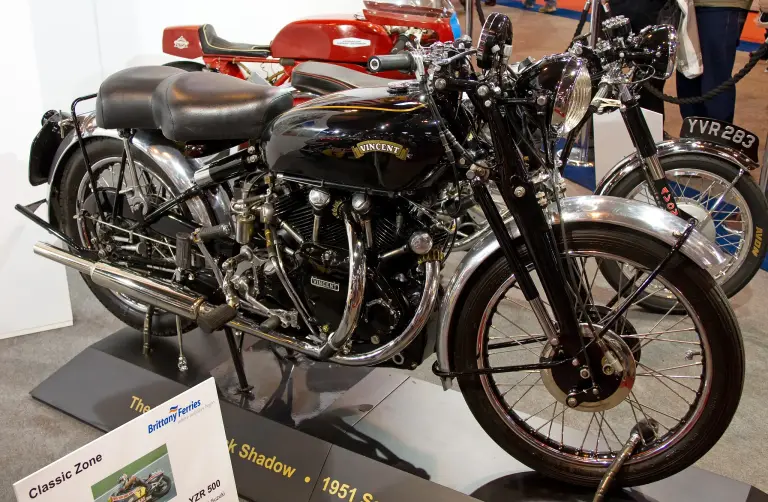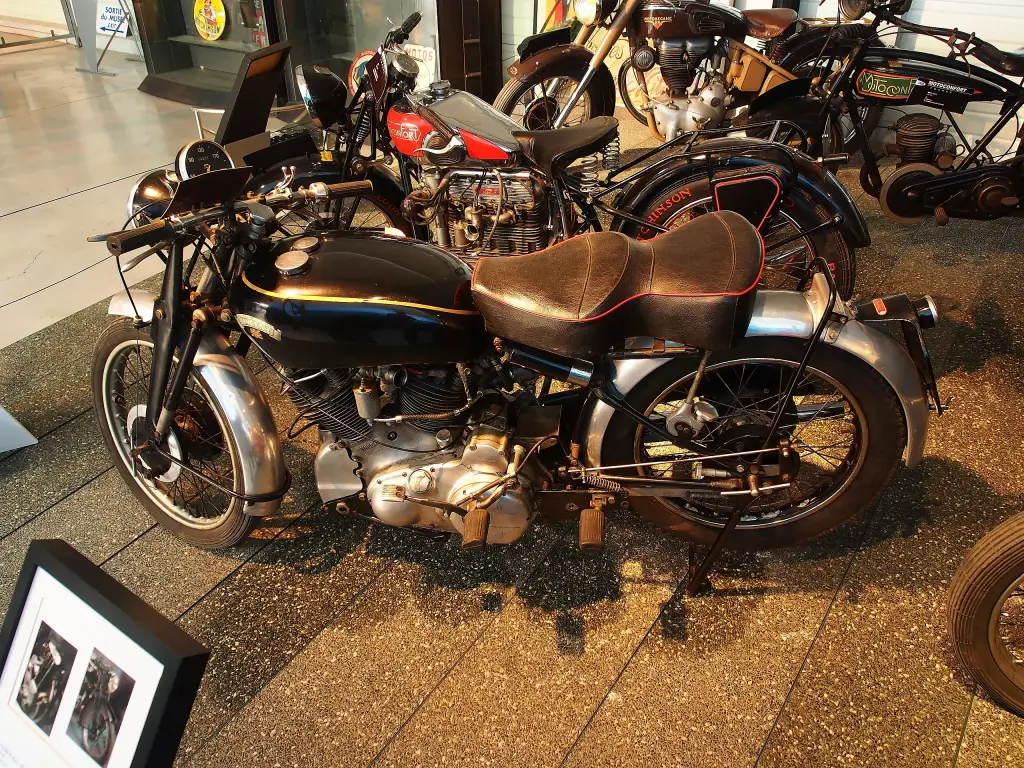
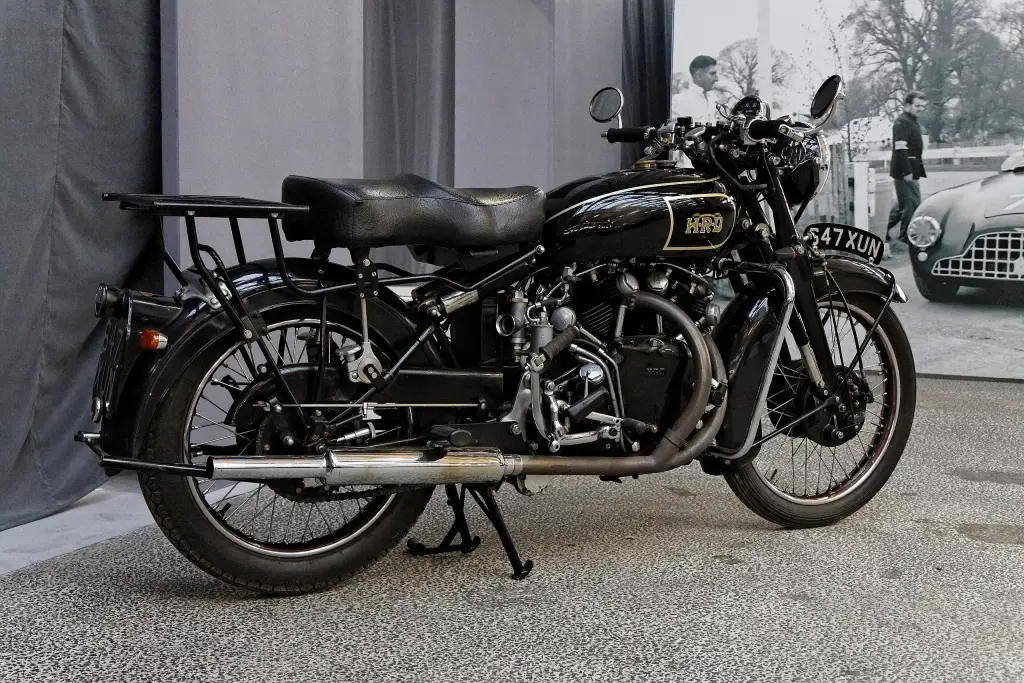
The Vincent Rapide was the standard motorcycle built around Vincent’s 998 cc V-twin. It debuted in 1936 and was built until 1939, production resumed in 1946 and ended in 1955, and four major versions were made, labelled Series A to D. With 45 bhp and a claimed 110 mph, the Rapide was advertised as the world’s fastest production motorcycle.
Vincent Rapide at a glance
| Maker | Vincent H.R.D., Stevenage, Hertfordshire |
|---|---|
| Production | 1936–1939 and 1946–1955 |
| Series | A, B, C and D (D was never an official factory designation) |
| Engine | 998 cc air-cooled V-twin, OHV, two high camshafts |
| V angle | 47° in Series A, 50° from Series B |
| Bore × stroke | 84 × 90 mm |
| Power | 45 hp (34 kW) at 5,500 rpm in Series A |
| Top speed | 110 mph (177 km/h) |
| Compression ratio | 6.8:1 in Series A |
| Carburettors | two Amal 1 1/16 in |
| Gearbox | Burman four-speed in Series A, Vincent unit construction from Series B |
| Price at launch | £142 |
Based on one source: the English Wikipedia article on the Rapide.
History of the Vincent Rapide
The drawing that made a V-twin
In 1936 designer Phil Irving noticed two drawings of the Vincent HRD engine lying on top of each other in a “V” formation. The 23½° rearward set of the engine’s idler would allow a one-litre 47° V-twin to be built with the same cylinders, heads and valve gear as the Vincent single, and the new crankcase could be made on the existing jigs. A few weeks later the first Vincent thousand had been built, with Meteor upper engine parts on a new crankcase, and it went into a frame originally made for a record attempt by Eric Fernihough.
Series A (1936–1939)
The Series A Rapide was the first production Vincent with the V-twin. Its frame was a lengthened version of the brazed-lug steel-tube diamond frame used by the Comet, with the cantilever rear suspension Philip Vincent had patented and the same Brampton girder fork as the singles. The larger engine took the space of the oil tank, so the petrol tank had two fillers, one for petrol and one for oil. Brakes were dual 7 in single-leading-shoe drums. The engine had an 84 × 90 mm bore and stroke for 998 cc, two Amal 1 1/16 in carburettors, dry-sump lubrication and a 6.8:1 compression ratio, giving 45 hp at 5,500 rpm and 110 mph. The separate Burman four-speed gearbox could not really cope with the V-twin’s output, and riders were advised not to open the throttle fully until the clutch was engaged. Shown at the 1936 Olympia show, the bike was nicknamed “The Snarling Beast” for its sound and “the plumber’s nightmare” for its external pipework. It cost £142 and production ended in 1939.
Series B (1946–1949)
The radically revised Series B was designed during the war and went into production in 1946. Unit construction combined engine and gearbox in a single casing, the cylinder angle changed from 47° to 50° so the engine could be a stressed member, and the frame was reduced to a steel box-section backbone that doubled as the oil tank. Oil lines became internal, with an inline felt filter. The wheelbase shrank 1.5 in to 56.5 in, closer to contemporary 500 cc bikes. Quickly detachable wheels, a reversible rear wheel for different sprockets, reach-adjustable brake and gear pedals and a hinged rear mudguard made the Rapide practical as well as fast.
Series C and D (1948–1955)
The 1948 Series C Rapide differed from the Series B mainly in its front suspension: Vincent believed the Brampton fork had outlived its value and replaced it with the company’s own Girdraulic blade-type fork. The Series D brought further chassis changes before production ended in 1955, when Vincent stopped building motorcycles altogether.
Design and features
- 998 cc V-twin: 84 × 90 mm, overhead valves and two high camshafts, unchanged in size throughout production.
- Stressed-member engine: from Series B the engine replaced frame tubes and the backbone held the oil.
- Cantilever rear suspension: Philip Vincent’s patented system with spring boxes and damper.
- Girdraulic fork: Vincent’s own front suspension from the 1948 Series C.
- Practical details: quickly detachable wheels, reversible rear wheel and reach-adjustable controls.
Vincent Rapide versions
- Series A Rapide (1936–1939): 47° engine, diamond frame, separate Burman gearbox.
- Series B Rapide (1946–1949): unit construction, 50° engine, backbone frame, Brampton fork.
- Series C Rapide (1948–1954): Girdraulic front fork and detail improvements.
- Series D Rapide (1954–1955): the final development, with a designation the factory never officially used.
The Rapide was the basis of the Vincent Black Shadow and shared its chassis thinking with the Comet single; the firm’s history is in Vincent HRD. More machines are in the Vincent collection.
Video: Vincent Series C Rapide 1953 Vintage
Video on YouTube.
Sources
- Vincent Rapide, English Wikipedia: origin, series, specifications