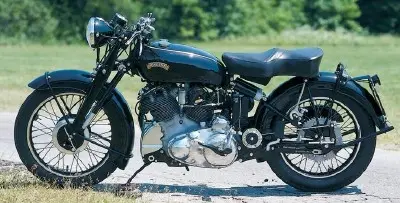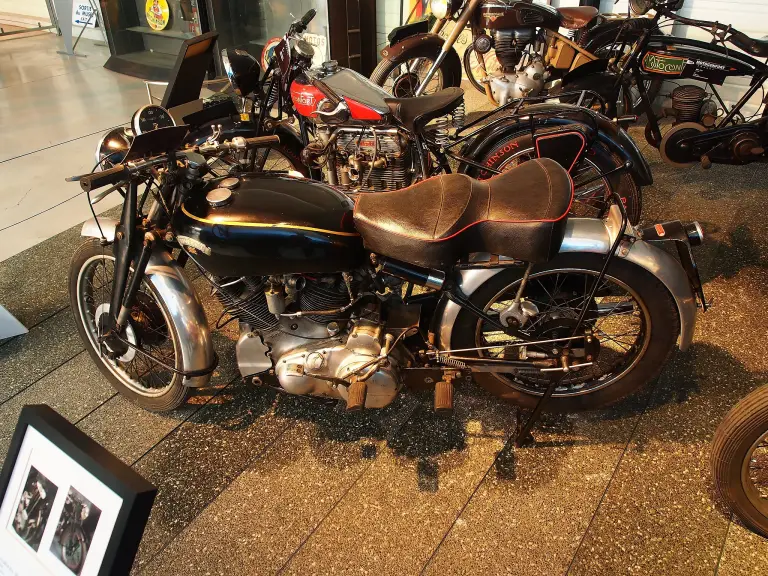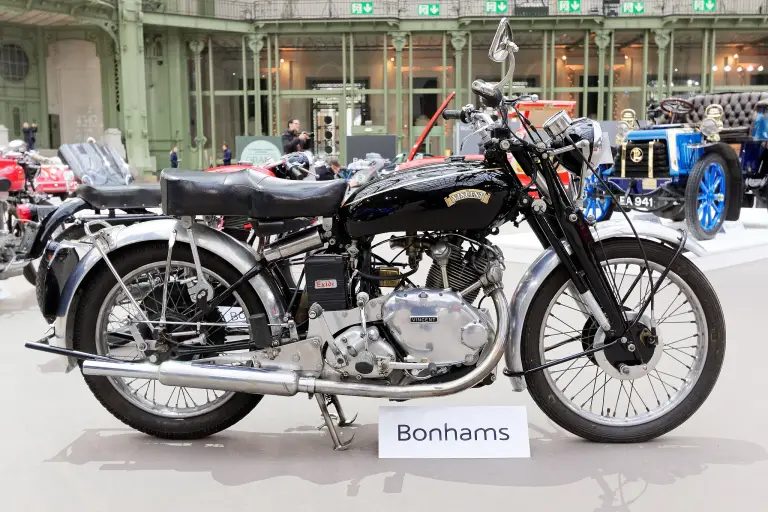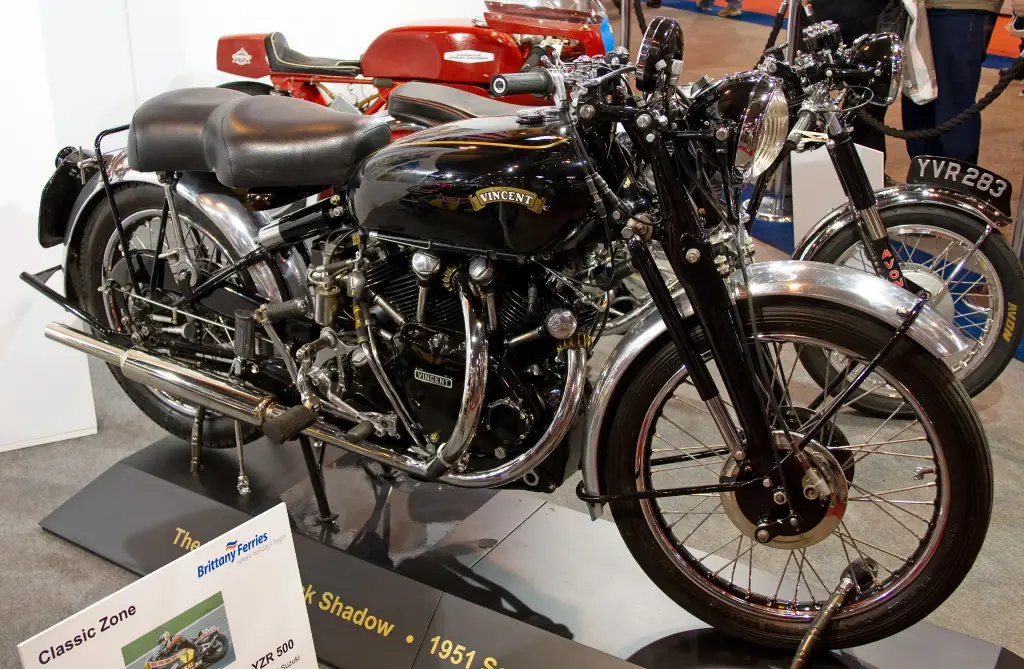
The Vincent Black Shadow was announced in February 1948 as the fastest production motorcycle in the world, with a claimed top speed of 125 mph (201 km/h). It was a tuned, hand-assembled version of the Rapide V-twin with a black engine, and it stayed in production through three series until Vincent stopped building motorcycles in 1955.
Vincent Black Shadow at a glance
| Maker | Vincent H.R.D., Stevenage, Hertfordshire |
|---|---|
| Announced | February 1948 |
| Production | 1948–1955 |
| Series | B, C and D |
| Engine | 998 cc air-cooled 50° V-twin, OHV |
| Bore × stroke | 84 × 90 mm |
| Compression ratio | 7.3:1 |
| Top speed | 125 mph (201 km/h), factory claim |
| Gearbox | four-speed, unit construction with the engine |
| Front suspension | Brampton girder (Series B), Girdraulic (Series C and D) |
| Rear suspension | cantilever with spring boxes and hydraulic damper |
| Dry weight | 458 lb (208 kg) |
Based on one source: the English Wikipedia article on the Black Shadow.
History of the Vincent Black Shadow
A faster Rapide
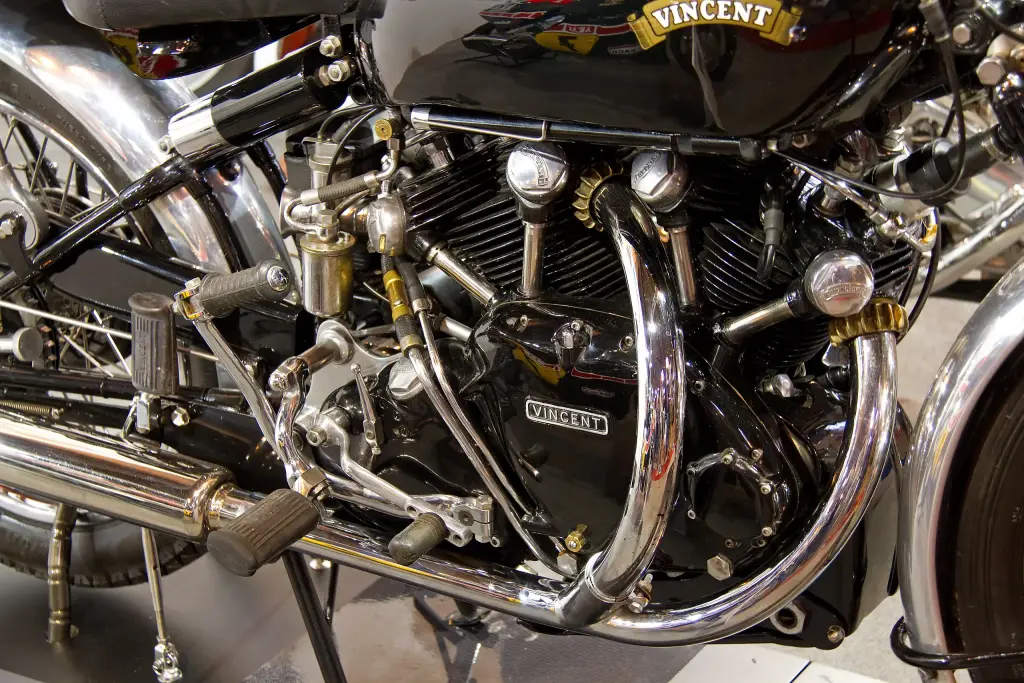
Motorcycles from the Vincent works in Great North Road, Stevenage, were already advertised as “the world’s fastest production motorcycle” on the strength of the 110 mph Rapide. In February 1948 the Black Shadow raised that claim to 125 mph. Its engines were largely built from selected Rapide parts: camshafts were standard Rapide units, MkIs in early examples and MkIIIs from 1952, but components were hand-picked for tighter tolerances and the ports were blended and polished to improve airflow.
The black engine
Founder Philip Conrad Vincent decreed that the engine itself should be black while other makers polished and chromed their machines. The finish was a “pyluminising” chromate anti-corrosion primer covered with Pinchin & Johnson black enamel and baked for two hours at 200 °F (93.3 °C). The colour suited the low-octane “Pool” petrol of the early post-war years: production Shadows ran a 7.3:1 compression ratio, higher than the Rapide’s nominal 6.8:1, on different Specialloid pistons, and used larger Amal carburettors — 29 mm Amal 289 on Series B and C, Amal 389/10 on Series D.
Frame and running gear
The engine is a stressed member of the frame, so there is no downtube cradle. Series B and C machines use an upper frame member made as a fabricated steel box that doubles as the oil tank; on the Series D it became a simple tube with brazed lugs and a separate oil tank was fitted. The rear cantilever suspension pivots from plates on the back of the transmission; the Series D redesign brought a single Armstrong spring/damper unit and 30 per cent more travel, 6 in (152 mm) in all. Series C replaced the Brampton girder fork with Vincent’s own Girdraulic blade-type fork. Brakes are dual 7 in single-leading-shoe drums front and rear, ribbed cast iron on the Shadow and not interchangeable front to rear as they were on the Rapide. Extensive use of aluminium alloy kept the complete bike at 458 lb (208 kg).
Three series and the end
Series B and C machines carry no model name in their transfers, lining or badges; only from 1955 did the Series D add the words “Black Shadow” beside the figure of Mercury. Series D bikes also moved to Lucas electrics with coil ignition and a DKX2A distributor. A Touring specification was available and a sidecar could be fitted on either side. The line continued until 1955, when Vincent stopped all motorcycle production.
Design and features
- Hand-selected engine: Rapide parts chosen for tighter tolerances, with blended and polished ports.
- Black crankcases and barrels: baked enamel over a chromate primer, a Vincent trademark.
- Stressed-member frame: the engine replaces the frame tubes; the Series B and C backbone doubles as the oil tank.
- Vincent rear suspension: cantilever arms and spring boxes, with hydraulic damping when most rivals still used rigid frames.
- Girdraulic front fork: Vincent’s blade-type girder with a hydraulic damper, fitted from Series C.
Vincent Black Shadow versions
- Series B (1948–1949): Brampton girder fork, box-section upper frame member holding oil.
- Series C (1949–1954): Girdraulic fork, curved seat-stay lugs, Amal 289 carburettors.
- Series D (1954–1955): tubular upper frame member, separate oil tank, Armstrong spring/damper, Lucas coil ignition, “Black Shadow” transfers.
- Touring specification: a softer touring build, able to take a sidecar on either side.
The Black Shadow grew out of the Vincent Rapide and shared its engine with the Vincent Comet single in spirit; the story of the firm is told in Vincent HRD. More British motorcycles are in the Vincent collection.
Sources
- Vincent Black Shadow, English Wikipedia: announcement, engine, frame, series differences