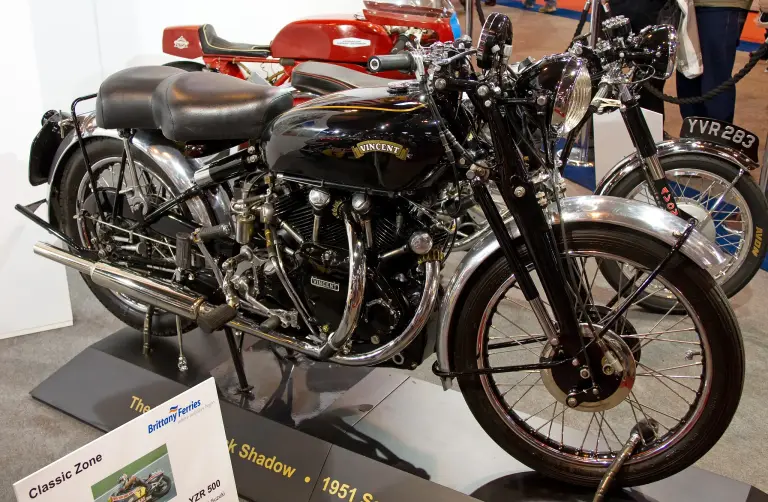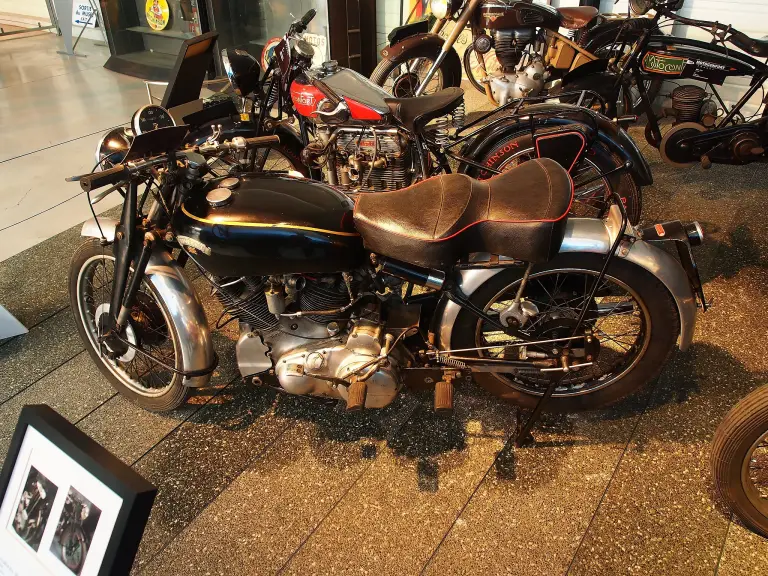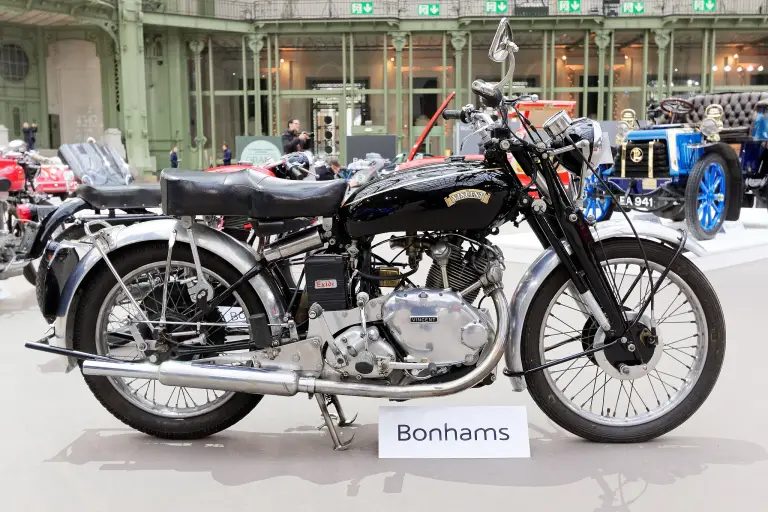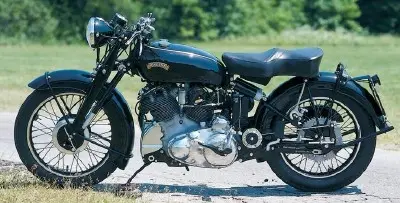
Vincent HRD was named after two men: Howard Raymond Davies, who founded HRD in the 1920s, and Philip Vincent, who bought the HRD trademark in 1928 and built motorcycles under it in Stevenage until 1955. The firm’s machines were noted for design innovation, engineering excellence and high performance, and its Black Shadow was at one time the fastest production motorcycle in the world.
Vincent HRD at a glance
| Founded as HRD | Howard Raymond Davies, partnership with E J Massey in 1924 |
|---|---|
| HRD liquidated | January 1928 |
| Bought by Philip Vincent | 1928, for £450 |
| Company name | Vincent HRD Co., Ltd, then Vincent Engineers (Stevenage) Ltd from 1952 |
| Works | Great North Road, Stevenage, Hertfordshire |
| First Vincent-HRD engine | J.A.P. single, later some Rudge-Python units |
| Own engines from | 1934–1936: 500 cc single and 1,000 cc V-twin |
| Best-known models | Series A Rapide, Black Shadow, Rapide, Comet |
| Also built | the Vincent Bantam three-wheeled delivery van, 1932–1936 |
| HRD dropped from the name | 1950 |
| Production ended | 1955 |
History of the Vincent HRD
Howard Davies and HRD
HRD was founded by Howard Raymond Davies, a Royal Flying Corps pilot who was shot down and captured by the Germans in 1917; legend has it that he conceived the idea of building his own motorcycle while a prisoner of war. In 1924 he entered into partnership with E J Massey and traded as HRD Motors, generally using J.A.P. engines. The motorcycles won races but the company ran at a loss and went into voluntary liquidation in January 1928. Ernest Humphries of OK-Supreme Motors bought the factory space, and the HRD name, jigs, tools, patterns and remaining components were offered for sale again.
Philip Vincent takes over
Philip Vincent had built a motorcycle of his own in 1927 and in 1928 registered a patent for his own cantilever rear suspension. Backed by family wealth from cattle ranching in Argentina, he bought the HRD trademark, goodwill and remaining components from Humphries for £450 in 1928. The company became Vincent HRD Co., Ltd and production moved to Stevenage, with the new trademark carrying “The Vincent” in very small letters above a large “HRD”. The first Vincent-HRD used a J.A.P. single in a Vincent-designed cantilever frame; some early bikes used Rudge-Python engines.
Phil Irving and the firm’s own engines
After a disastrous 1934 Isle of Man TT, where all three entries retired with engine trouble, Phil Vincent and Phil Irving decided to build their own engines. Irving, who had joined Vincent in late 1931, designed an overhead-valve 500 cc single in 1934 called the Meteor. From 1934 two new engines were developed, a 500 cc single and a 1,000 cc V-twin, and production grew from 1936. The 1936 Series A Rapide was the first production Vincent with the V-twin. Vincent also experimented widely: the 1932 Vincent Bantam was a 293 cc Villiers-engined three-wheeled delivery van costing £57-10-0, built until 1936, and the firm tried amphibious vehicles and cars as well.
War, America and the end
During the war Vincent primarily made munitions, though its engines were tried in boats and portable pumps and the firm developed an opposed-piston two-stroke for air-dropped lifeboats that never entered service. Sales were already aimed at the United States, where Eugene Aucott opened the first dealership in Philadelphia in 1944. After the war Britain needed exports, and the USA was the largest market for motorcycles, so from 1950 the HRD was dropped from the name to avoid confusion with Harley-Davidson’s “HD”. In 1948 the Black Shadow was announced as the world’s fastest production motorcycle. Financial losses, deepened by the Vincent-engined Vindian prototype built for the US market in 1949, led to the name Vincent Engineers (Stevenage) Ltd in 1952 and to the end of motorcycle production in 1955.
Design and features
- Cantilever rear suspension: patented by Philip Vincent in 1928 and used on Vincents from the first prototype.
- Stressed-member engines: from the post-war twins, the engine replaced frame tubes and the backbone doubled as an oil tank.
- Girdraulic front fork: Vincent’s own blade-type girder with hydraulic damping.
- Unit construction: engine and gearbox in a single casing on the post-war twins.
- Racing-derived valve gear: double valve guides and forked rockers to lengthen valve life.
Vincent HRD versions
- Vincent-HRD with J.A.P. engines (1928–1934): the first bikes, in a Vincent cantilever frame.
- Meteor and Comet (from 1934): the 500 cc overhead-valve single in standard and sporting form.
- Series A Rapide (1936–1939): the first Vincent V-twin, a 998 cc 47° engine.
- Post-war twins (1946–1955): Series B, C and D Rapide and Black Shadow with unit construction.
- Vincent Bantam (1932–1936): a 293 cc three-wheeled delivery van, not a motorcycle.
The best-known Vincent HRD models are described in Vincent Rapide, Vincent Black Shadow and Vincent Comet. More machines are in the Vincent collection.
Video: 1939 Vincent HRD Series A Rapide – Jay Leno’s Garage
Video on YouTube.
Sources
- Vincent Motorcycles, English Wikipedia: company history, models, engines
- Vincent Motorcycles, Italian Wikipedia: company history