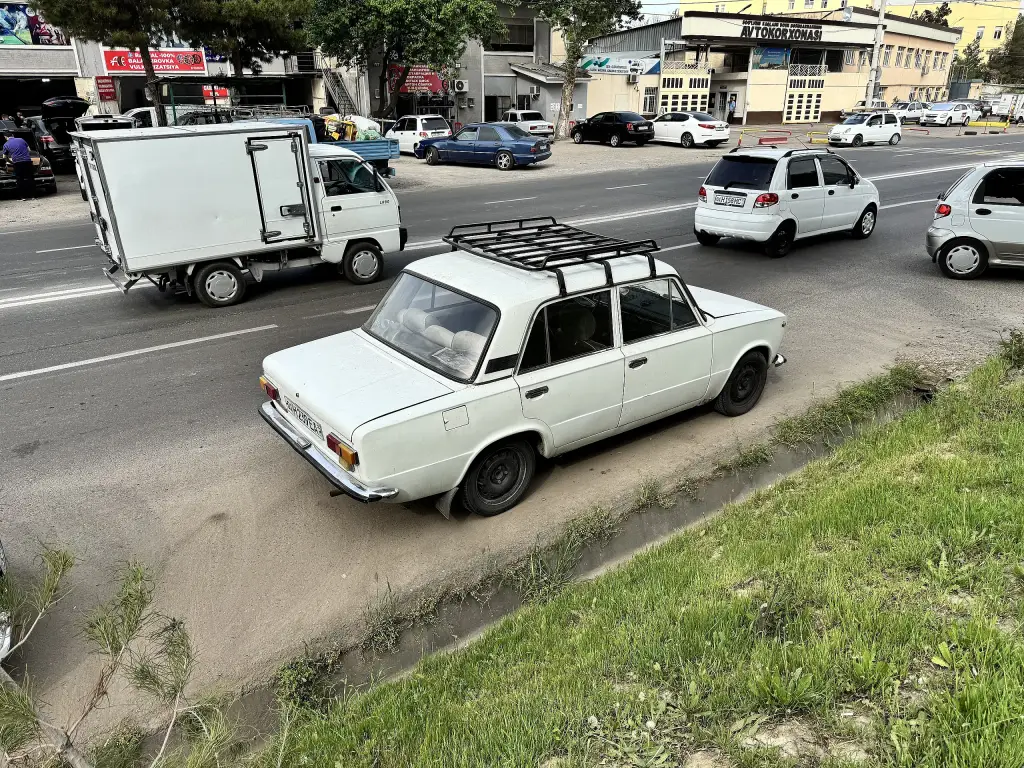
The VAZ-2101 Zhiguli was the first product of the new AvtoVAZ plant at Tolyatti. It was a licence-built Fiat 124, re-engineered with about 800 changes for Soviet roads and climate, and it became the basis of the whole classic Lada range. Abroad it was sold as the Lada 1200; at home it was nicknamed Kopeyka after the smallest Soviet coin.
VAZ-2101 at a glance
| Maker | AvtoVAZ, Tolyatti, Soviet Union |
|---|---|
| Production | 1970–1988 |
| Based on | Fiat 124, built under licence |
| Domestic names | VAZ-2101 Zhiguli, nicknamed Kopeyka |
| Export names | Lada 1200, Lada 1300, Lada 1200S |
| Body | 4-door saloon; 5-door estate as VAZ-2102 |
| Engine | 1,198 cc SOHC inline-four |
| Drive | rear-wheel drive with a live rear axle |
| Weight | 945 kg, 90 kg more than the Fiat 124 |
| Changes from the Fiat | about 800 modifications |
| UK sales | from May 1974, priced at £979 |
| Estate | VAZ-2102 from 1972 to 1986, over 660,000 built |
The VAZ-2102 estate is described in the same English Wikipedia article as the VAZ-2101.
History of the VAZ-2101
Development
The Fiat 124 had won the 1967 European Car of the Year, but it was too light and delicate for Soviet conditions. VAZ engineers raised the suspension, added aluminium brake drums at the rear and replaced the Fiat engine with a new overhead-camshaft design made by NAMI that was never used in a Fiat. The bodyshell was built from thicker, heavier steel with reinforcement in key chassis areas after cracking appeared during durability testing. Inside Fiat the car was known as the 124R, the R standing for Russian. A special anti-freeze, Tosol A40, was developed for it, and Fiat required a nationwide service network as part of the agreement.
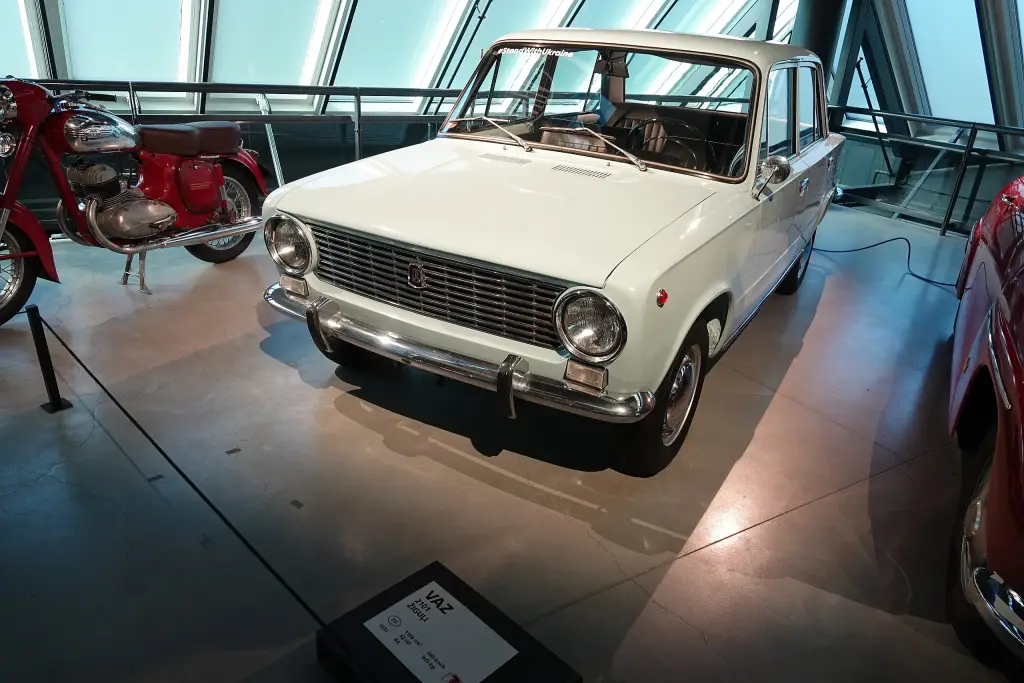
In all, about 800 modifications separated the VAZ-2101 from the Fiat 124, including the rear brakes, suspension, carburettor and many other parts. Early cars carried a starting handle in case the battery went flat in Siberian conditions, along with a manual auxiliary fuel pump; both were later dropped. Exports began on 21 February 1971 to Yugoslavia, followed on 30 July by 32 cars sent to Finland, Holland and Belgium. After a competition in the magazine Za Rulyom drew 1,812 entries, the export name Lada was chosen in September 1971, and the cars were sold abroad as the Lada 1200.
Production and export
The first year brought 22,000 cars, and capacity reached 660,000 by 1973. The one-millionth car was sold on 21 December 1973 and the one-and-a-half-millionth in 1974. Sales to Cuba began in 1971 and to Canada in 1978, but none went to the United States. Under the Fiat agreement VAZ could not sell the car in Italy or in markets where it would compete with the 124, yet exports to Western Europe began as early as autumn 1971. It reached Britain in May 1974 at £979 and stayed on sale there until the Riva arrived in 1983. Although the newer VAZ-2105, 2104 and 2107 largely replaced it in the West in the early 1980s, the 2101 remained in production for the domestic market until 1988. One weakness was the crankshaft, which wore too fast; around 1980 the part was out of stock for a long period and the problem took about two years to solve.
The VAZ-2102 estate
The estate version, based on the Fiat 124 Familiare, was called the VAZ-2102 and went into production on 27 April 1972. It shared the saloon’s mechanical layout and gave the range a practical body style for families and small businesses. The 2102 was replaced by the VAZ-2104 in 1985, and over 660,000 were built by the end of production in 1986.
Design and features
- Re-engineered for Soviet roads: thicker steel, a reinforced chassis and raised suspension, all tested on rough gravel.
- Own engine: a 1.2-litre overhead-camshaft four of Soviet design instead of the Fiat unit.
- Simpler brakes: aluminium drum brakes at the rear in place of the Fiat’s discs.
- Cold-weather equipment: a starting handle, an auxiliary fuel pump and the new Tosol A40 antifreeze.
- Simple mechanics: rear-wheel drive, a live rear axle and a four-speed gearbox that could be serviced almost anywhere.
VAZ-2101 versions
- VAZ-2101 saloon (1970–1988): the standard four-door car with the 1.2-litre engine.
- VAZ-2102 estate (1972–1986): the five-door wagon on the same platform.
- Lada 1200, 1300 and 1200S: export designations used in Western markets until 1989.
- Later classics: the modernised VAZ-2105, 2104 and 2107 replaced the 2101 in export markets in the early 1980s.
The more powerful VAZ-2103 was developed from the same platform, and the VAZ-2106 continued the line into the 2000s. More classic Ladas are in the VAZ collection.
Video: Latvian VAZ 2101
Video on YouTube.
Sources
- VAZ-2101, English Wikipedia: development, production, exports, estate