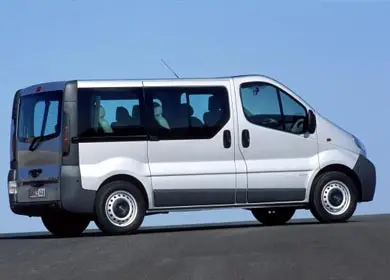
The Vauxhall Movano is the British name for Opel’s large van, a version of the Renault Master sold since 1998. It filled the gap left at the top of Vauxhall’s commercial range after the Bedford Blitz, and it has always been designed and built by Renault.
Vauxhall Movano at a glance
| Maker | Vauxhall (Opel Movano on the continent) |
|---|---|
| Production | since November 1998 |
| Based on | Renault Master |
| Built at | Batilly, France, by SOVAB |
| First generation | Movano A, 1998–2010 |
| Second generation | Movano B, 2010–2021 |
| Bodies | panel van, crew van, chassis cab and combi |
| Engines | diesel only in Britain |
| 2003 facelift | new front, 2.5 and 3.0 common-rail diesels, Tec-Shift gearbox |
| Predecessor | Bedford Blitz |
Written from the German article on the Opel Movano and the English article on the Renault Master it is based on. No free photograph of a Vauxhall-badged Movano was available.
History of the Vauxhall Movano
The first Movano went into production in November 1998, 24 years after the Blitz range ended and eleven years after the Opel Bedford Blitz disappeared from Germany. It was developed by Opel together with Renault and Nissan and was the same vehicle as the second-generation Renault Master, built at the SOVAB plant in Batilly in north-eastern France alongside its Renault sister. From early 2002 the Nissan Interstar joined it as another version of the same van.
The Movano A was facelifted in October 2003 with a completely redesigned front and a lightly modified rear. The range was expanded with two new common-rail turbodiesels, a 2.5-litre of 101 PS and a 3.0-litre of 136 PS, while the 114 PS 2.5 DTI carried on under the CDTI name; a five-speed manual was joined by an automated manual called Tec-Shift. In autumn 2006 the 2.5-litre common-rail engine was offered in 120 and 146 PS forms, the 114 PS unit was dropped and the 136 PS 3.0 CDTI was replaced by a 145 PS 2.5 CDTI. Production of the Movano A ended in December 2009.
The Movano B was developed completely anew with Renault and Renault-Nissan and built from February 2010 as an Opel and Vauxhall, the sister of the third-generation Renault Master and the Nissan NV400. Panel vans came in four lengths and three heights, some with front-wheel drive and some with rear-wheel drive, and the engine was a 2.3-litre common-rail turbodiesel in 100, 125 and 150 PS forms with a six-speed manual. A recall followed in December 2010 over rear-axle problems and insufficient seat-belt anchorage, and revised 2.3 diesels arrived in May 2012, up to nine per cent more economical, with Bluetooth and USB becoming standard. A light facelift in summer 2014 brought new infotainment and standard ESP, and a larger facelift was presented on 15 May 2019 with a new front, LED daytime running lights, a new dashboard, a 180 PS top engine, electric power steering and Euro 6d-TEMP engines; the panel van and double cab were then sold as the Movano Cargo.
Design and features
- Renault engineering: every Movano has been designed and built by Renault.
- French build: all generations came from the SOVAB plant at Batilly.
- Wide range: panel van, crew van, chassis cab and combi bodies.
- Shared with Nissan: the same van was sold as the Nissan Interstar and NV400.
Vauxhall Movano versions
- Movano A (1998–2010): the first generation, facelifted in 2003.
- Movano B (2010–2021): the second generation with 2.3 diesel engines.
- Movano Cargo: the panel van and double cab after the 2019 facelift.
- Combi: the passenger version with up to nine seats.
The Movano sits above the Vivaro in Vauxhall’s van range, and it replaced the role of the Arena and its predecessors at the top of the range. More cars are in the Vauxhall collection.
Sources
- Renault Master, English Wikipedia: Movano generations, Renault design and build
- Opel Movano, German Wikipedia: Movano A and B, facelifts, engines