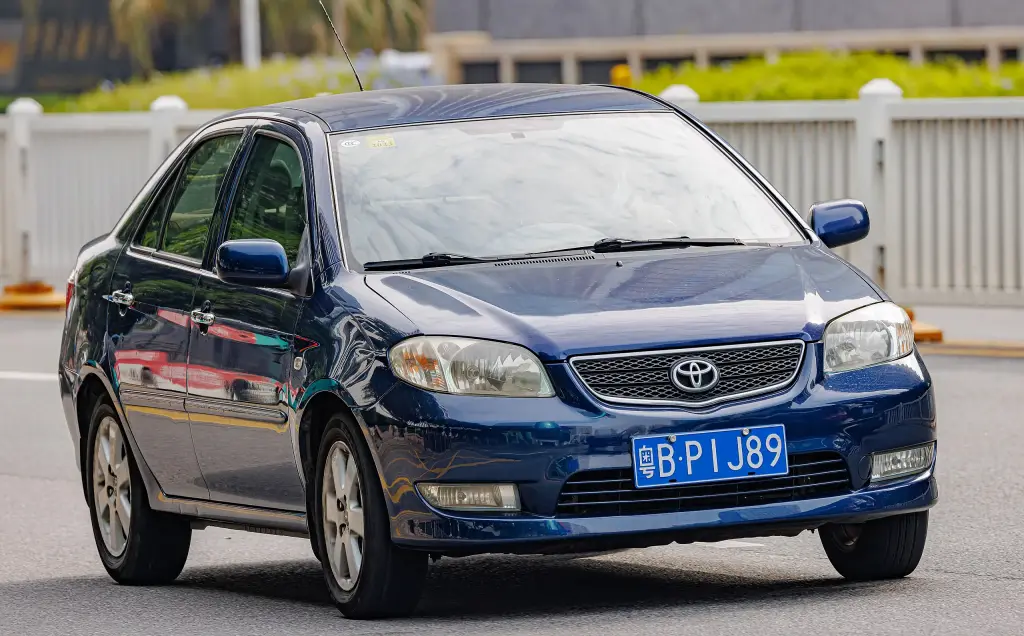
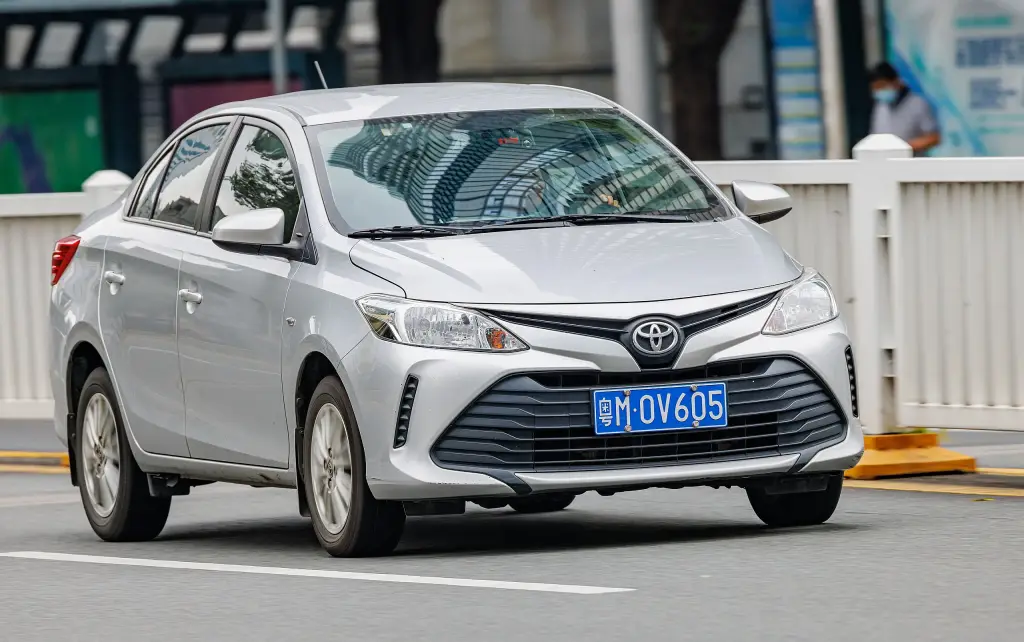
The Toyota Vios is a nameplate used for subcompact saloons built mainly for Southeast Asia, China and Taiwan since 2002. It sits below the Corolla and replaced the Tercel-based Soluna, which had filled the subcompact saloon class in the region.
Toyota Vios at a glance
| Maker | Toyota |
|---|---|
| Production | Since 2002 |
| Markets | Southeast Asia, China, Taiwan |
| Class | Subcompact saloon |
| First generation | XP40, 2002 |
| Engines | 1.3-litre 2NZ-FE and 1.5-litre 1NZ-FE |
| Platform | Echo, then Vitz/Yaris platforms |
| Also sold as | Yaris sedan and Belta outside the region |
| Taxi version | Toyota Limo in Indonesia |
| Name | From the Latin vio, “to go forward” |
Based on one source: the English Wikipedia article on the Toyota Vios.
History of the Toyota Vios
First generation (XP40; 2002)
The Vios was previewed as a prototype called the Toyota T-1, shown at Auto China in Beijing in June 2002. It was based on the Echo, which was sold in China as the Xiali 2000, and Toyota quoted a drag coefficient of 0.29. Assembly in China began in October 2002 at Tianjin FAW Toyota, and the car was also built at Toyota’s Gateway plant in Thailand as a cooperative project between Thai engineers and Japanese designers. It was adapted from the Platz with modified body panels and some design cues from the E120 Corolla, and like the Vitz and Platz it had its instrument panel mounted at the top centre of the dashboard. Thailand, Sri Lanka, Indonesia, Singapore, Brunei, Malaysia and Taiwan received a 1.5-litre 1NZ-FE with VVT-i, the Philippines had both the 1.5 and a 1.3-litre 2NZ-FE, and China used 1.3-litre 8A-FE and 1.5-litre 5A-FE engines. Trims in Southeast Asia were J, E, G and S, while China had DLX, GL, GLX and GLXi.
Markets and the Limo
In China the Vios was built from 2004 to 2008, with the 5A-FE replaced in 2006 by the 2SZ-FE and 3SZ-VE engines. Indonesia imported its cars from Thailand in E and G grades, the E with a five-speed manual and 14-inch alloys, the G with manual or automatic, ABS, 15-inch wheels and a digital speedometer. Malaysia sold E and G trims with 15-inch alloys. The Philippines introduced the Vios in June 2003 in E and G grades, the E with the 1.3-litre engine, analogue gauges and 14-inch wheels, the G with the 1.5-litre engine, fog lamps, power mirrors, an alarm and digital gauges; a basic J grade followed in June 2004, and an S sport version in 2007. In Indonesia a stripped taxi version was sold as the Toyota Limo through three generations.
Later generations
The second-generation Vios of 2007 was sold in Japan as the Belta and elsewhere as the Yaris sedan, sharing its platform with the XP90 Vitz. The third generation of 2013 used the XP150 Yaris platform and was marketed outside Southeast Asia, China and Taiwan as the Yaris sedan; a major 2017 refresh gave it the same styling as the Yaris hatchback and brought local production in Brazil, India and Pakistan. In Thailand the 2017 car was sold as the Yaris Ativ with a 1.2-litre engine, while the 1.5-litre Vios continued alongside it until 2022. The fourth generation arrived in Thailand in 2022 as the Yaris Ativ, designed and engineered by Daihatsu on its DNGA platform. The Vios is the best-selling car in the Philippines and has been used in one-make race series in Malaysia, the Philippines and Thailand.
Design and features
- Regional speciality: a subcompact saloon built for Southeast Asia, China and Taiwan.
- Soluna replacement: took over from the Tercel-based Soluna in the region.
- Yaris family: shared its platforms with the Vitz and Yaris hatchbacks.
- Best-seller: the top-selling car in the Philippines.
Toyota Vios versions
- XP40 (2002): first generation with 1.3 and 1.5-litre engines.
- J grade (2004): basic version in the Philippines.
- Limo: no-frills taxi version in Indonesia.
- Second generation (2007): sold as the Belta and Yaris sedan.
- Third generation (2013): XP150 platform, refreshed in 2017.
- Fourth generation (2022): Yaris Ativ on the Daihatsu DNGA platform.
The Vios replaced the Soluna and shares its platform with the Yaris, sitting below the Corolla. More cars are in the Toyota collection.
Sources
- Toyota Vios, English Wikipedia: generations, engines, markets