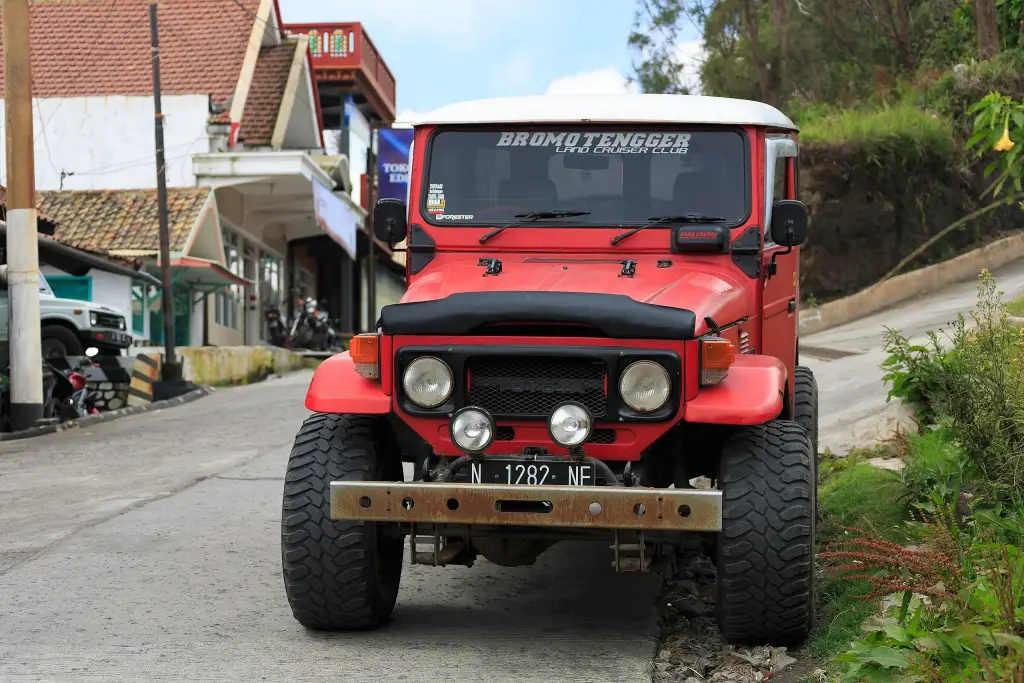
The Toyota Land Cruiser J40 is the series of 40-series Land Cruisers built from 1960 until 2001. It used traditional body-on-frame construction, and most were two-door models slightly larger than a Jeep CJ.
Toyota Land Cruiser (J40) at a glance
| Maker | Toyota |
|---|---|
| Production | 1960–2001 |
| Class | Four-wheel-drive utility vehicle |
| Construction | Body on frame |
| Wheelbases | Short J40/41/42, medium J43/44/46, long J45/47 |
| Transfer case | Two-speed |
| First diesel | HJ45 with 3.6-litre six, 1972 |
| Front disc brakes | From 1976 |
| Power steering | Optional from 1979 |
| Brazilian version | Bandeirante, until 2001 |
Based on one source: the English Wikipedia article on the Land Cruiser J40.
History of the Toyota Land Cruiser (J40)
Launch and layout
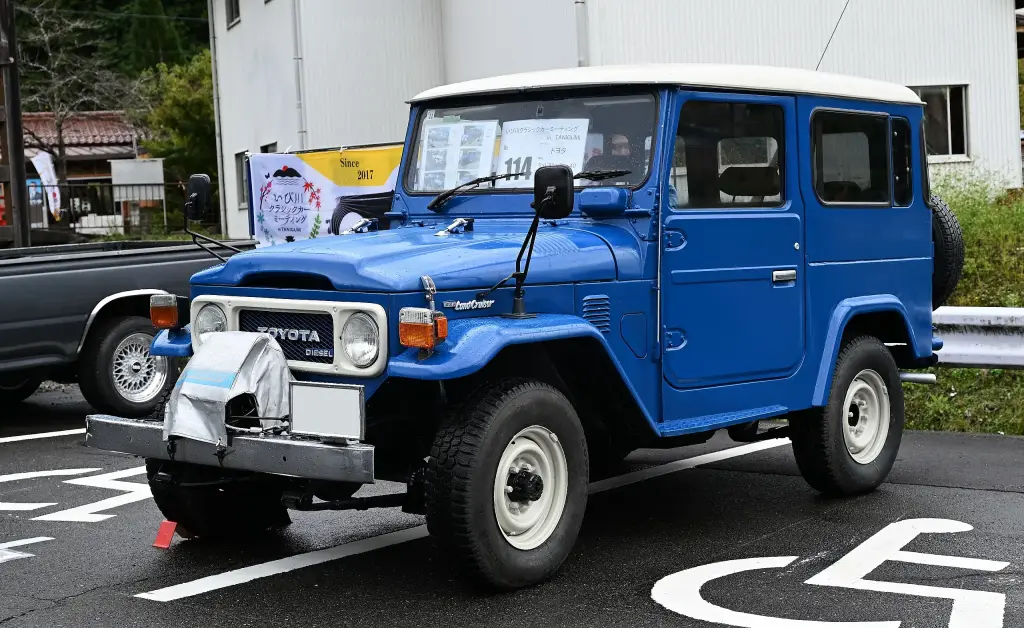
The J40 series was launched in 1960 with wheelbases of 2,285, 2,430 and 2,650 mm, and unlike earlier models it had a two-speed transfer case for easier low-speed work on steep ground. The J40/41/42 was the two-door short-wheelbase car with a soft or hard top; the J43/44/46 was a rare two-door medium-wheelbase version; and the J45/47 was the long-wheelbase model, offered as a two-door hardtop, three-door hardtop, four-door station wagon and two-door pickup. The four-door station wagon was the shortest-lived member, replaced by the FJ55 in 1967. A longer 2,950 mm wheelbase joined the range in 1963 with the FJ45-B pickup and cab-chassis.
Development through the years
A 3.6-litre six-cylinder H diesel arrived in 1972 with the HJ45, and 1974 brought the BJ40/43 with a 3.0-litre four-cylinder B diesel, plus a factory roll bar as standard in the United States. American cars gained rear barn doors in 1975, front disc brakes came in 1976, and front door vent windows were removed in 1977. In 1979 power steering, on F models only, and air conditioning became options, and American gear ratios changed from 4.11 to 3.70 for better highway cruising; cars from 1979 also had square grille bezels. The HJ47 of 1980 used a 4.0-litre six-cylinder diesel, and the BJ42/46 and BJ45 a 3.4-litre four. Disc brakes reached Australia in 1981.
The Bandeirante
Production of the J40 ended in most markets in 1984, replaced by the J70, but it continued in Brazil as the Bandeirante. Brazilian production began in November 1962 with the FJ25, switched to locally produced Mercedes-Benz diesel engines in December 1962, moved to the FJ40 body in 1968 and lasted until 2001. From 1989 the Bandeirante had square headlamps instead of round ones, and in 1994 the Mercedes-Benz OM-364 engine was replaced by Toyota’s 14B diesel. A five-speed gearbox became available in 1993. The Bandeirante’s rear doors were full-width, like a Land Rover’s, rather than Toyota’s two-wing arrangement.
Design and features
- Body on frame: traditional separate chassis and body construction.
- Three wheelbases: short, medium and long, plus a pickup and station wagon.
- Two-speed transfer: a low range for steep terrain, new for this generation.
- Bandeirante: Brazilian production with Mercedes-Benz diesels until 2001.
Toyota Land Cruiser (J40) versions
- J40/41/42 (1960): short-wheelbase two-door.
- J43/44/46: rare medium-wheelbase version.
- J45/47: long-wheelbase pickup, cab-chassis and station wagon.
- HJ45 (1972): 3.6-litre six-cylinder diesel.
- BJ40/43 (1974): 3.0-litre four-cylinder diesel.
- Bandeirante: Brazilian version, built until 2001.
The J40 is the classic member of the Land Cruiser family and inspired the FJ Cruiser. Its Brazilian Bandeirante version is covered in the Land Cruiser article, and more cars are in the Toyota collection.
Sources
- Toyota Land Cruiser (J40), English Wikipedia: timeline, models, Bandeirante