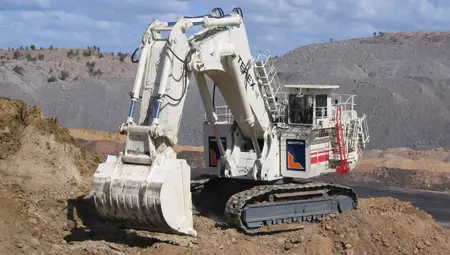
Terex O&K was the name of the mining excavator business that Terex acquired from the German company Orenstein & Koppel in 1998. Its best-known product was the RH 400, presented as the largest hydraulic excavator in the world, and the range also included smaller mining shovels such as the RH 200.
Terex O&K at a glance
| Model in video | RH 200 |
|---|---|
| Type | mining shovel |
| Brand | Terex O&K |
| O&K founded | 1 April 1876, Berlin |
| O&K founders | Benno Orenstein and Arthur Koppel |
| First tracked steam shovel | 1922 |
| First fully hydraulic excavator | 1961, according to the French Wikipedia |
| Mining business bought by Terex | 1998 |
| Flagship | RH 400, the largest hydraulic excavator |
| Sold to Bucyrus | 2010 |
| Bucyrus to Caterpillar | 2011 |
| Mining plant | Dortmund |
No Wikipedia article covers the RH 200 or the Terex O&K period as such; the page is based on the O&K articles in four languages and the English article on Terex. The model is identified from the video.
History of the Terex O&K
Orenstein & Koppel was founded in Berlin on 1 April 1876 by Benno Orenstein and Arthur Koppel. It began with narrow-gauge railway equipment, then built locomotives and wagons, and diversified into construction machinery, escalators, lifts and heavy equipment. By 1913 it had a dozen factories, almost a hundred branches and about 15,000 employees. The company built its first tracked steam shovel in 1922, switched to diesel power in 1926, and in 1961 was described as the first European maker of a fully hydraulic excavator.
After the Second World War O&K resumed as a German company and concentrated increasingly on construction machines. It left the railway business in 1981, sold its escalator division to Kone in 1996, and in 1998 the Krupp group, then the majority owner, broke up what remained. The Dortmund mining equipment works, which built large hydraulic excavators, went to Terex; the Berlin-Spandau works for construction excavators went to New Holland, part of the Fiat group.
The Dortmund business traded as Terex O&K and continued the RH range of mining excavators and shovels. The RH 400, the world’s largest hydraulic excavator, became its flagship and was later produced as the Caterpillar 6090. In 2010 Terex sold the mining business to Bucyrus International, and Bucyrus itself was taken over by Caterpillar in 2011, so the Terex O&K chapter closed after little more than a decade.
Design and features
- Mining shovels: the RH range was built for loading haul trucks in open-pit mines.
- RH 400: the flagship, described as the largest hydraulic excavator in the world.
- Dortmund works: the mining plant that Terex acquired in 1998.
- Short Terex period: the business passed to Bucyrus in 2010 and to Caterpillar in 2011.
Terex O&K versions
- RH 200: the mining shovel shown in the video.
- RH 400: the largest model of the range, later the Caterpillar 6090.
- RH series: the wider family of O&K hydraulic mining excavators.
- Terex O&K period, 1998–2010: the years when the Dortmund business belonged to Terex.
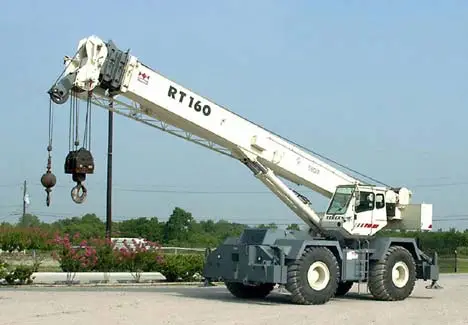
The Terex Demag cranes were the group’s other heavy German business, and the Terex RT page covers the rough-terrain cranes. More machines are in the Terex collection.
Video: O&K RH 200 Terex mining shovel
Video on YouTube.
Sources
- Orenstein & Koppel, English Wikipedia: company history and the 1998 split
- Orenstein & Koppel, German Wikipedia: founding, factories, post-war history
- Orenstein & Koppel, Italian Wikipedia: the 1998 sale of the mining business to Terex
- Orenstein & Koppel, French Wikipedia: excavator production dates