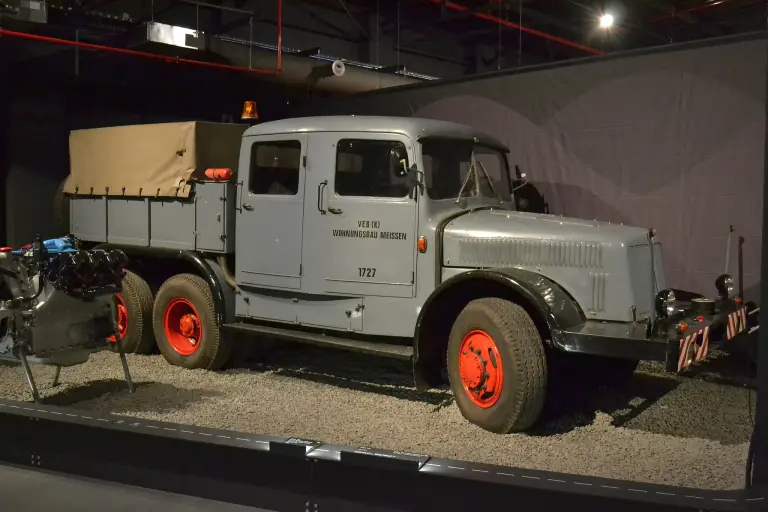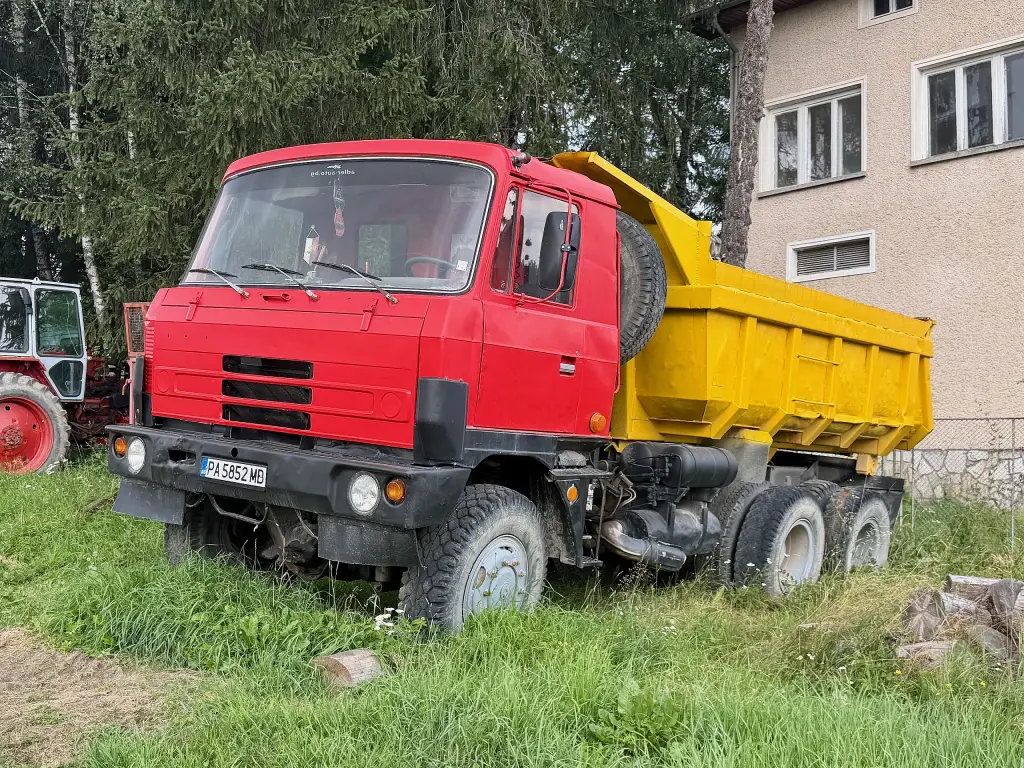
The Tatra 815 is a truck family produced by the Czech company Tatra. It uses the traditional Tatra concept of a rigid backbone tube and swinging half-axles giving independent suspension, and it is available in 4×4, 6×6, 8×8, 10×8, 10×10, 12×8 and 12×12 variants with air-cooled or liquid-cooled engines from 230 to 440 kW.
Tatra 815 at a glance
| Maker | Tatra, Kopřivnice, Czech Republic |
|---|---|
| Production | 1983–25 February 2025 |
| Predecessors | Tatra 813 and Tatra 148 |
| Layouts | 4×4, 6×6, 8×8, 10×8, 10×10, 12×8, 12×12 |
| Air-cooled engine | 12.7-litre 90-degree V8 diesel |
| Air-cooled power | 230–325 kW (308–436 hp) |
| Liquid-cooled engines | Cummins and Deutz, 260–440 kW |
| Torque | 1,400–2,100 N·m (air-cooled V8) |
| Gross weight | up to 35,500 kg |
| Dakar Rally | six wins with Karel Loprais |
| Built | 158,065 |
History of the Tatra 815
From the 157 to the 815
The 815 was designed to replace the Tatra 148, and the prototype Tatra 157 was introduced in 1970, followed by several more prototypes between 1970 and 1974, but no production resulted. Because of protests from the Czechoslovak manufacturer LIAZ, which the central planning committee had assigned to build trucks of a similar class, Tatra dropped the 157 and concentrated on a heavier class as the replacement for the 813 and 148, introduced in 1983 as the 815 series. In 1989 Tatra modernised the 815 and introduced the 815-2, which was further upgraded in 1994; three years later the new TerrN°1 cabin arrived. Another facelift followed in 2000 with a new instrument panel, new cab attachment and, for the first time, the option of liquid-cooled engines, and the latest cabin facelift came in July 2010. Emission rules in 2003 led to the all-new air-cooled V8 T3C compliant with Euro III, and the further developed T3D with SCR and Euro IV compliance appeared in 2006. Manufacturing ended on 25 February 2025 with 158,065 units made.
Design
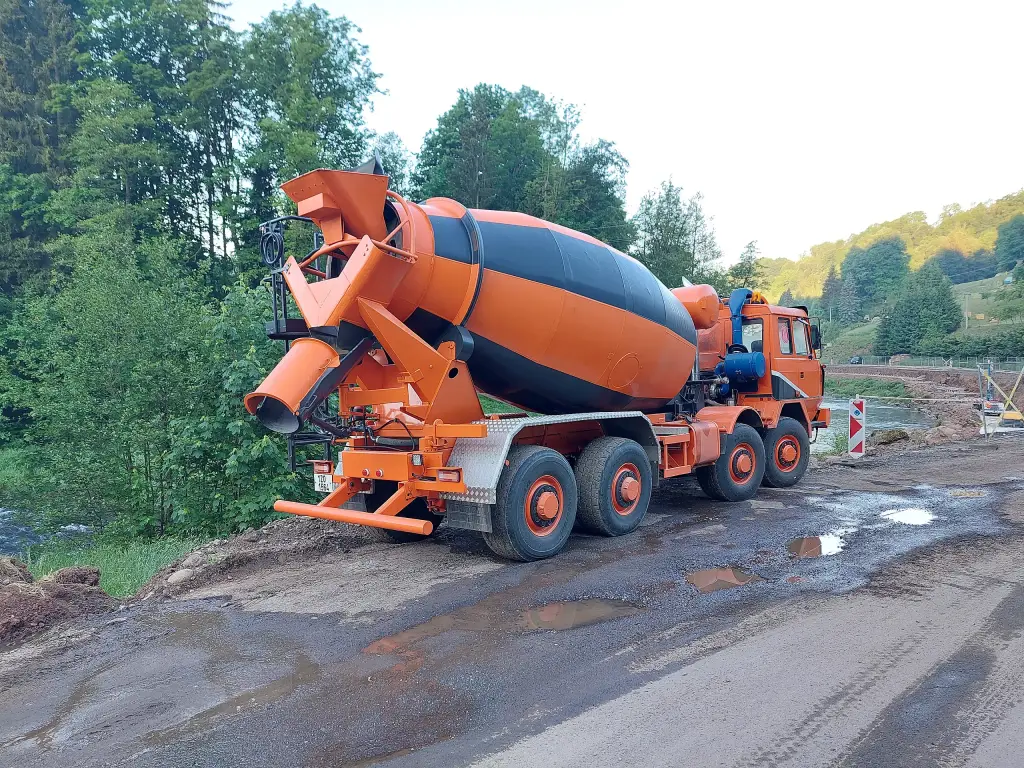
While most manufacturers derive their trucks from road applications, the 815 was purposely designed for extreme off-road conditions, and its road versions are derived from the off-road concept. The principle is a central load-carrying tube with independently suspended swinging half-axles bolted together as one whole, which gives outstanding behaviour in the most difficult terrain and higher off-road speed than a classical rigid-axle design. Tatra differentials use two opposing spiral bevel gears instead of the usual single set, with the gears part of the input shaft rather than between the output axles; locking pins can force them to rotate together. This allows the axles to swing around the drive axle without universal couplings and lets the input shaft run straight through the differential housing to a second set of swing axles, so two, three, four, five or even six axles can all be driven.
The suspension can be mechanical, with torsion bars or leaf springs for up to 8 tonnes per front axle and leaf springs for up to 11.5 tonnes per rear axle, or pneumatic with air bellows and adjustable ground clearance. The Tatra King Frame system combines an air bellows with a coil or leaf spring for rear axles of up to 16.5 tonnes. All types use telescopic shock absorbers, and some versions have stabiliser torsion bars. The air-cooled 12.7-litre 90-degree V8 diesel has a bore and stroke of 120 x 140 mm, direct injection, a Holset wastegate turbocharger, an intercooler above the engine and a mechanical in-line Bosch injection pump; its crankshaft is bolted together from individual segments. At launch the 815 could also be ordered with Tatra’s larger air-cooled V10 of 15.8 litres or V12 of 19 litres, and a V12 bi-turbo, but these disappeared when Euro I limits took effect. Water-cooled Cummins and Deutz engines of 260 to 440 kW became available later.
Rally history
The 815 and its descendant models took the Czech truck racer Karel Loprais to victory six times in the Dakar Rally, making the backbone truck one of the best-known Czechoslovak and Czech competition vehicles.
Design and features
- Backbone tube: a central load-carrying tube with swinging half-axles.
- Tatra differentials: two opposing bevel gears with locking pins.
- Many layouts: from 4×4 to 12×12, with two to six driven axles.
- Engine choice: air-cooled Tatra V8s or liquid-cooled Cummins and Deutz units.
Tatra 815 versions
- 815: the original 1983 family.
- 815-2 (1989): modernised version, upgraded in 1994.
- TerrN°1 (1997): new cabin.
- 2000 facelift: new instrument panel and optional liquid-cooled engines.
- 2010 facelift: the latest cabin.
- Euro III and IV engines: T3C and T3D air-cooled V8s.
The 815 replaced the Tatra 813 and the Tatra 148, and the heavier military Tatra 816 was developed from it. More trucks are in the Tatra collection.
Video: Tatra 815 Agro
Video by pavel_stefl on YouTube.
Sources
- Tatra 815, English Wikipedia: history, design, engines, production