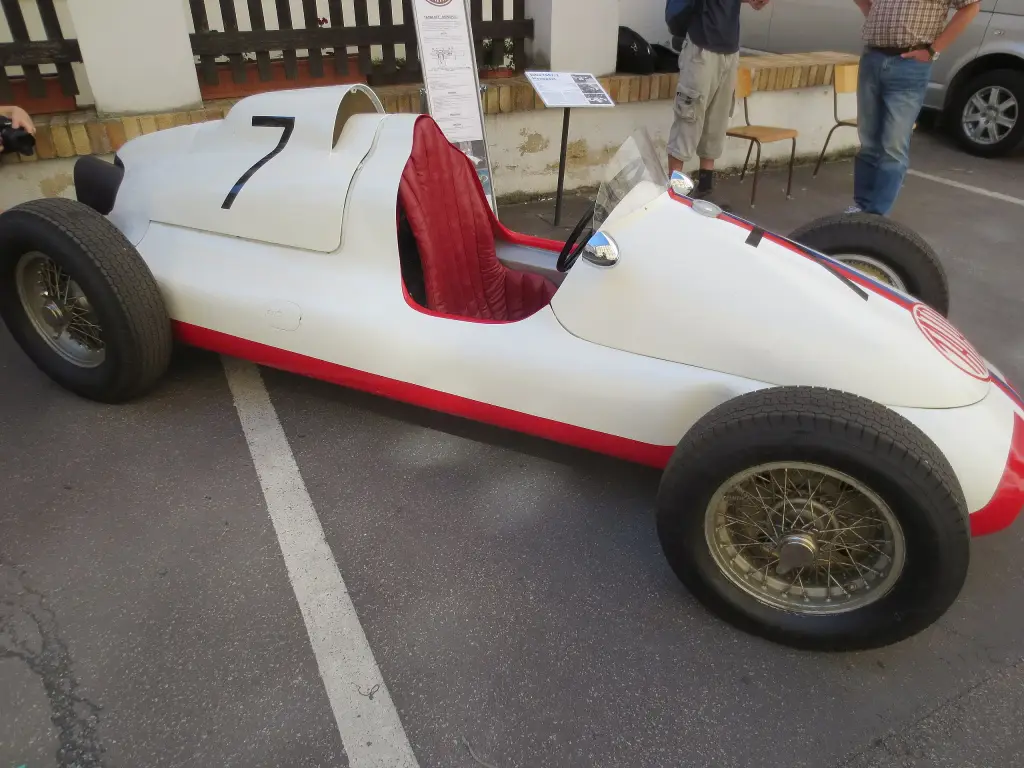
The Tatra 607 is a single-seat racing car from the Czechoslovak, today Czech, manufacturer Tatra. It was designed in 1950 as the marque’s first post-war monoposto and used an air-cooled V8 of the kind that later powered the Tatra 603 road car.
Tatra 607 Monoposto at a glance
| Maker | Tatra, Czechoslovakia |
|---|---|
| Designed | 1950 |
| Type | single-seat racing car (monoposto) |
| Engine | air-cooled V8 |
| Cooling | two exhaust ejectors instead of fans |
| Front suspension | double wishbones |
| Rear suspension | swing axle, telescopic dampers, thrust links |
| Gearbox | from the Tatra 600 Tatraplan |
| 607-2 | 1951, lower body |
| Alcohol engine | 2,472 cc, 200 PS (147 kW) |
| Built | small numbers, prototypes and replicas |
There is no English Wikipedia article on the Tatra 607; the page is based on the German article.
History of the Tatra 607 Monoposto
The 607
The Tatra 607 was designed in 1950 as the marque’s first post-war monoposto. It received an air-cooled V8 engine of the type later used in the Tatra 603 passenger car. Instead of the two fans of the road car, it had two ejectors to drive the cooling: the exhaust gases of each cylinder bank were blown into a funnel-shaped opening and then into the open air. This created a vacuum inside the engine enclosure, so air was drawn in at the front of the engine, flowed past the cylinder banks and was expelled together with the exhaust through the funnels.
The front wheels hung on double wishbones, while the rear swing axle had inclined telescopic shock absorbers and thrust links. The gearbox, mounted behind the rear axle, came from the Tatra 600 Tatraplan.
The 607-2
The Tatra 607-2 was introduced in 1951 as the successor to the 607. Its body was flatter than that of the earlier car. At first it used the predecessor’s engine with two Solex twin carburettors. Later there was a version with 2,472 cc displacement for alcohol fuel, which with a compression ratio of 12.5:1, two Weber four-barrel carburettors and larger inlet valves developed 200 PS (147 kW).
Survivors
The cars are rare: the type was built in small numbers and today the 607 and 607-2 are seen mainly in museums, at historic events and as replicas. A replica of the 1950 car is kept in the Lane Motor Museum in the United States, while original cars are displayed in the Tatra museum at Kopřivnice and at Czech historic motorsport gatherings.
Design and features
- Air-cooled V8: the racing engine that anticipated the Tatra 603’s unit.
- Exhaust ejectors: cooling driven by exhaust gas instead of fans.
- Race chassis: double wishbones at the front and a swing axle at the rear.
- Tatraplan gearbox: the road-car transmission mounted behind the rear axle.
Tatra 607 Monoposto versions
- Tatra 607: the original 1950 monoposto.
- Tatra 607-2: 1951 car with a flatter body.
- Alcohol version: 2,472 cc engine with 200 PS.
- Replicas: later copies of the 1950 car, including one in the Lane Motor Museum.
The 607’s V8 led to the engine of the Tatra 603, and the later road cars are in the Tatra collection.
Sources
- Tatra 607 Monoposto, German Wikipedia: design, cooling, 607-2