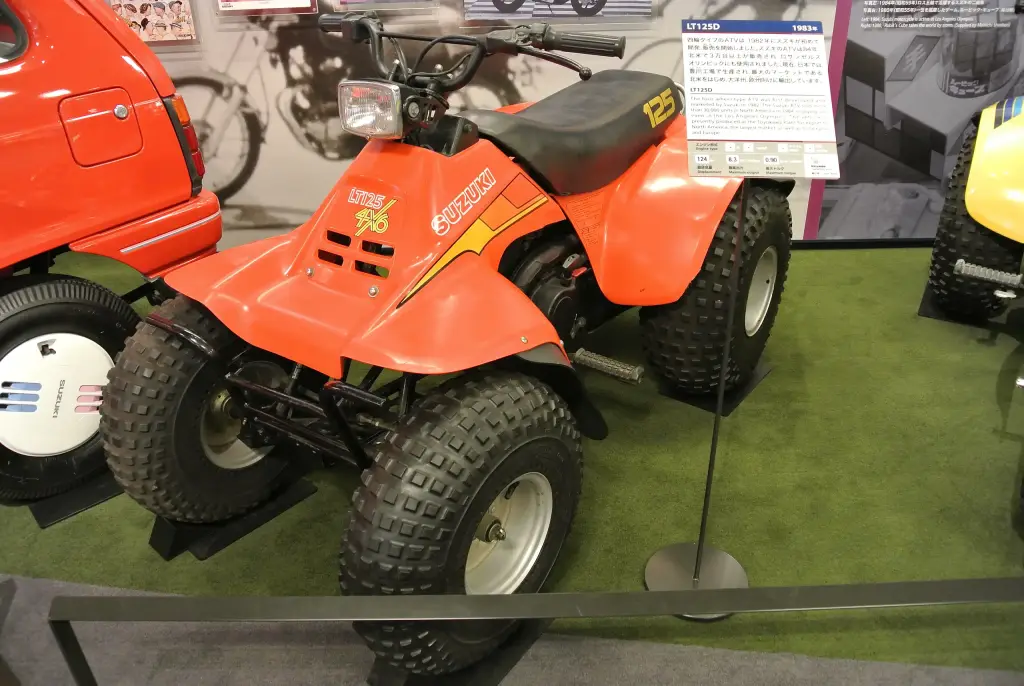
Suzuki’s ATV range has been sold under names including QuadRunner, QuadRacer, QuadSport, KingQuad and Eiger. The machine that defined the sporting end of it was the LT250R QuadRacer, a four-wheeler built from 1985 to 1992 that took on the three-wheelers and won.
Suzuki QuadRunner at a glance
| Production | 1985–1992 |
|---|---|
| Type | sport and racing ATV |
| Engine | 249 cc liquid-cooled two-stroke single |
| Dry weight | 293 lb (133 kg) in 1985–1986 |
| Front suspension | double A-arm |
| Rear drive | solid axle, chain final drive |
| Brakes | hydraulic discs front and rear |
| Gearbox | five-speed, six-speed from 1987 |
| Starting | kick start, no battery |
| Frame | aluminium swingarm, axle carrier, hubs and wheels |
| Successor family | QuadSport, KingQuad, Eiger and other Suzuki ATVs |
History of the Suzuki QuadRunner
The first high-performance four-wheeler
Before the LT250R, ATV racing was dominated by three-wheelers, and four-wheelers were heavier, less powerful and built for utility work. Suzuki’s LT250R changed that in 1985. A lightweight, fully suspended frame around a 249 cc liquid-cooled two-stroke gave it the performance of the three-wheeled racers plus the stability of an extra front wheel for high-speed corners. Suzuki nicknamed it the QuadRacer, and in 1985 it became the first high-performance four-wheeler.
Weight above all
The engineers chased weight everywhere. The swingarm, rear axle carrier, engine cases, front hubs, rear shock link and wheels were aluminium, and on the first two model years even the silencers were, something normally found only in aftermarket racing parts. The result was a dry weight of just 293 lb, lighter than most rivals and comparable with the 250 cc racing three-wheelers of the day. Other features that became standards for sport quads were double A-arm front suspension, a solid rear axle, a manual gearbox and clutch, hydraulic disc brakes at both ends, chain drive and kick starting with no battery or starter motor. There was no reverse gear.
Model years
The 1986 bike was largely unchanged apart from a Mikuni VM34SS carburettor, revised decals and a new port map. In 1987 came the biggest changes: a new frame with a wishbone down-tube, a front exhaust, a head motor mount, power valves, longer front shocks and a stronger swingarm after the early design cracked. From 1987 the engine was blue instead of silver and the gearbox had six speeds instead of five. Rear axles went from 24 to 26 splines in 1989, and the 1991–1992 cars moved the air filter and changed the rear bodywork. Production ended in 1992.
Design and features
- Sport-quad blueprint: double A-arms, disc brakes, chain drive and a manual gearbox.
- Very light: 293 lb dry in the first two years.
- Aluminium everywhere: even the early silencers were aluminium.
- No frills: kick start, no battery and no reverse gear.
Suzuki QuadRunner versions
- 1985–1986 LT250R: the lightest of the line, five-speed.
- 1987 LT250R: new frame, power valves and six-speed gearbox.
- 1988–1990 LT250R: revised counterbalancer and 26-spline axle from 1989.
- 1991–1992 LT250R: redesigned rear suspension and relocated air filter.
Suzuki’s ATV line sits alongside its off-road motorcycles such as the RM motocross bikes, and the tiny JR50 shared its engine with the LT50 quad. More Suzukis are in the Suzuki collection.
Video: 1987 Suzuki Quadrunner LT4WD
Video by xhumeka on YouTube.
Sources
- Suzuki LT250R, English Wikipedia: engineering, weight, model-year changes