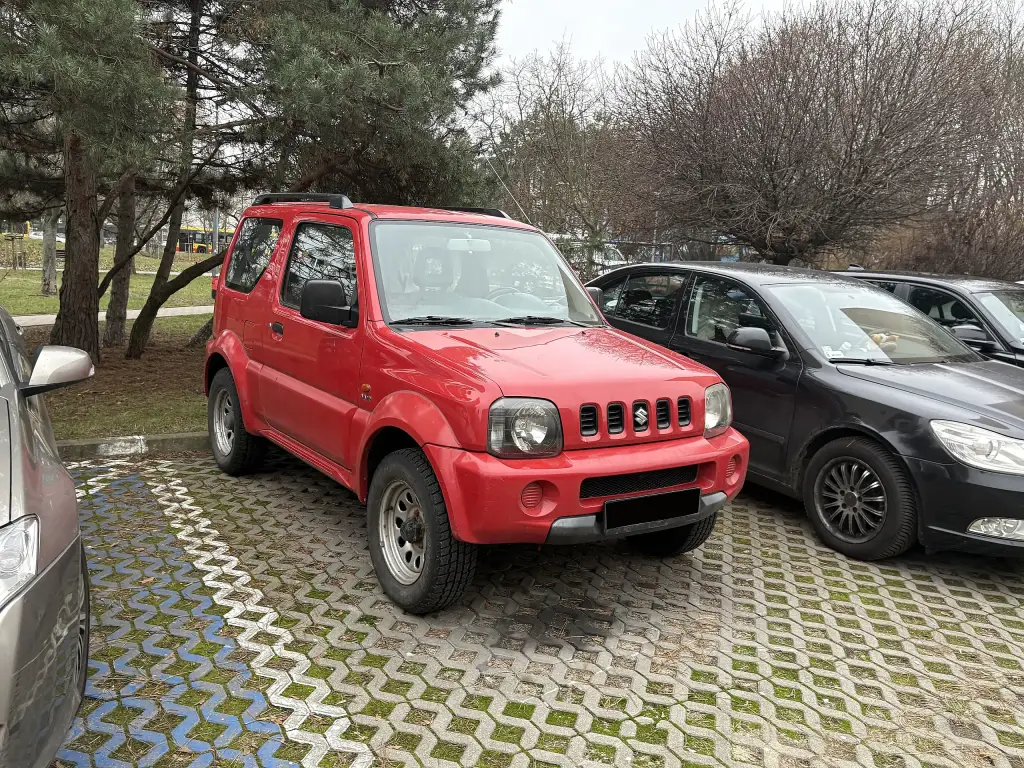
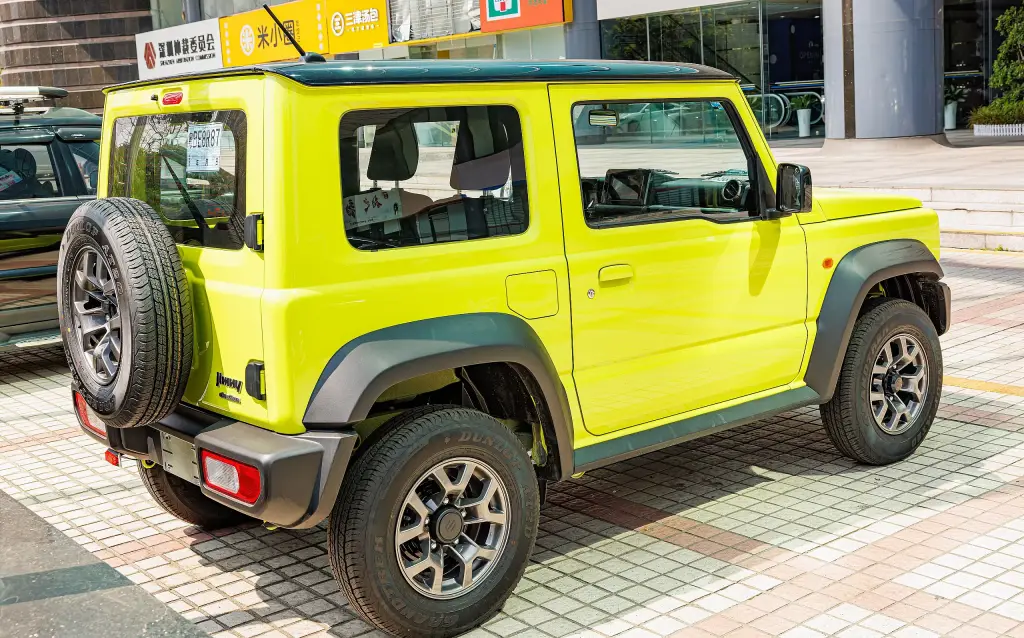
The Suzuki Jimny is a family of small four-wheel-drive off-roaders built since 1970. It began in the Japanese kei class and has stayed close to the same formula ever since: a separate body on a ladder frame, solid axles and a part-time four-wheel-drive system with a low range.
Suzuki Jimny at a glance
| Production | since 1970 |
|---|---|
| First model | LJ10, Light Jeep 10 |
| First engine | 359 cc air-cooled two-stroke twin |
| LJ20 | 1972, liquid-cooled and 3 hp more |
| LJ50 | 1975, 539 cc three-cylinder two-stroke |
| LJ80 | 800 cc four-stroke four, the last of the LJ line |
| Second generation | SJ410 1.0 and SJ413 1.3 |
| Samurai | updated SJ413, the first Suzuki sold officially in the USA |
| Third generation | 1998, G13BB then M13AA engines |
| Fourth generation | late 2018, 1.5-litre engines |
| Sales | 2.85 million in 194 countries by September 2018 |
History of the Suzuki Jimny
From the Haflinger to the HopeStar
Suzuki’s four-wheel-drive story began in the late 1960s, when the company bought a Steyr-Puch Haflinger to study with a kei-class off-roader in mind. A better chance came in 1968, when Suzuki bought the bankrupt Hope Motor Company, which had built a small off-roader called the HopeStar ON360; only about 45 existed. The first Suzuki-badged four-wheel drive was the LJ10 of 1970, with a 359 cc air-cooled two-stroke twin.
LJ and SJ
The LJ20 of 1972 went liquid-cooled to meet new emissions rules and gained 3 hp. In 1975 came the LJ50 with a 539 cc three-cylinder two-stroke and bigger differentials, aimed first at Australia. The LJ80 — also called the Jimny 8 — ended the original line with an 800 cc four-stroke four. The second generation brought the Jimny 1000/SJ410 and Jimny 1300/SJ413, and an updated SJ413 became the Samurai, the first Suzuki officially marketed in the United States. In Australia the LJ80 was the Stockman and the SJ410 to SJ413 series the Sierra.
The Jimny name everywhere
The third generation arrived in 1998 and was the first Jimny sold under the same name in every market. It used the fuel-injected G13BB engine, replaced in 2001 by the M13AA and in 2005 by a variable-valve-timing version with a light interior redesign. In late 2018 Suzuki launched the fourth generation with 1.5-litre engines for export markets, more than 100 PS for the first time, and again a stretched-wheelbase version, this time with five doors.
Why it works
Every Jimny generation has a separate body on a ladder frame, solid axles front and rear, recirculating-ball steering and a manually selected part-time four-wheel drive with high and low ranges. There is no centre differential, so four-wheel drive should only be used on slippery surfaces, but when it is engaged at least one wheel on each axle must lose grip before the vehicle does. The same layout has survived from 1970 to the present.
Design and features
- Ladder frame and solid axles: the layout of every Jimny generation.
- Part-time 4WD: manually selected, with a low range that halves the gearing.
- Leaf springs, then coils: the first two generations on leaves, the later ones on coils.
- Huge following: 2.85 million sold in 194 countries by 2018.
Suzuki Jimny versions
- LJ10 (1970): the first Suzuki four-wheel drive.
- LJ20 and LJ50: liquid cooling and a larger three-cylinder engine.
- LJ80 / Jimny 8: the four-stroke end of the LJ line.
- SJ410 and SJ413: the second generation 1.0 and 1.3.
- Samurai: the updated SJ413 sold in America.
- Third generation (1998) and fourth generation (2018): the modern Jimnys.
The Jimny shares its early engine family with the Carry, and its compact off-road role passed to the Vitara in the larger class. More Suzukis are in the Suzuki collection.
Video: Offroad-Spaß im Suzuki Jimny
Video by FOCUS online on YouTube.
Sources
- Suzuki Jimny, English Wikipedia: generations, engines, design, sales