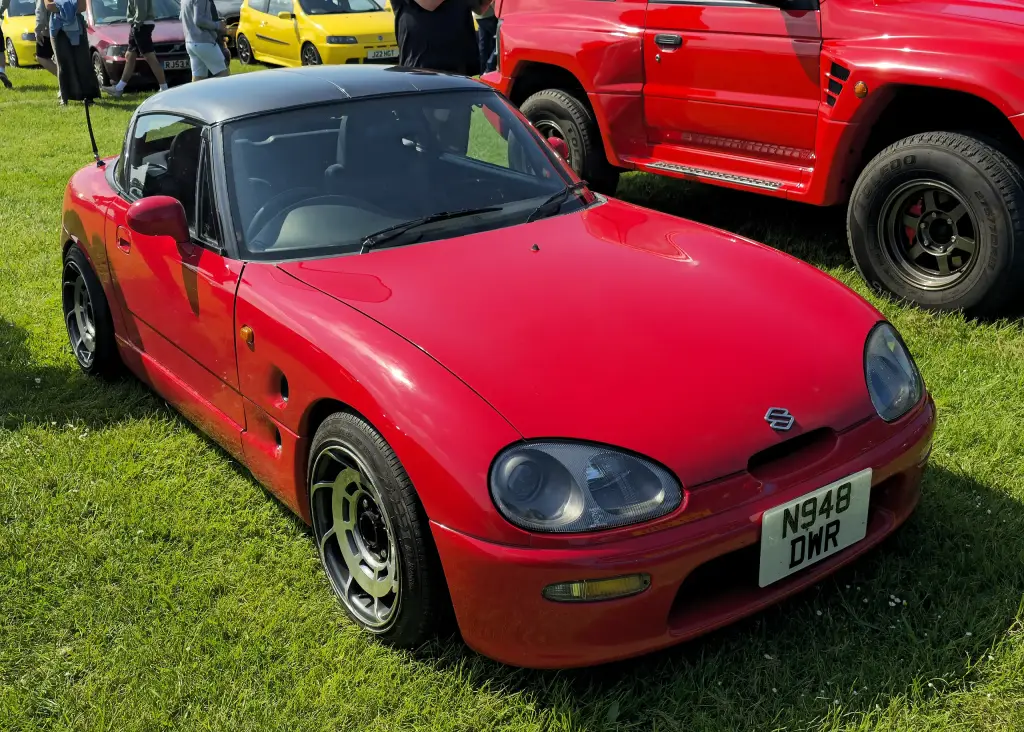
The Suzuki Cappuccino is a small two-seat roadster that Suzuki built from 1991 to 1998. It was designed to fit Japanese kei car rules, which brought lower taxes, but its clever roof and turbocharged engine made it a genuine sports car.
Suzuki Cappuccino at a glance
| Production | October 1991 – 1998 |
|---|---|
| Factory | Kosai plant, Japan |
| Body | two-seat roadster with detachable hardtop |
| Weight | 725 kg |
| Length / width | 3,295 mm / 1,395 mm |
| Engine | 657 cc turbocharged three-cylinder, DOHC 12 valves |
| Power | 64 PS at 6,500 rpm |
| Layout | front mid-engined, rear-wheel drive |
| Roof | three removable panels: coupé, T-top, targa or full convertible |
| Early code | EA11R with F6A engine |
| Later code | EA21R with K6A engine, from 1995 |
| UK price | £11,995 at the October 1993 launch |
History of the Suzuki Cappuccino
Origins
Suzuki’s plan to rebuild a sporting image began in 1987, and a project car was shown at the Tokyo Motor Show within two years. The Cappuccino was designed for Japan alone, under the kei limits of less than 3.3 m long, 1.4 m wide and 0.66 litres. It was built at Kosai from October 1991, went on sale that November and carried the internal code SX306 and the model code EA11R. In its first two years 15,113 cars were built and 13,318 of them, 88 percent, stayed in Japan.
The roof
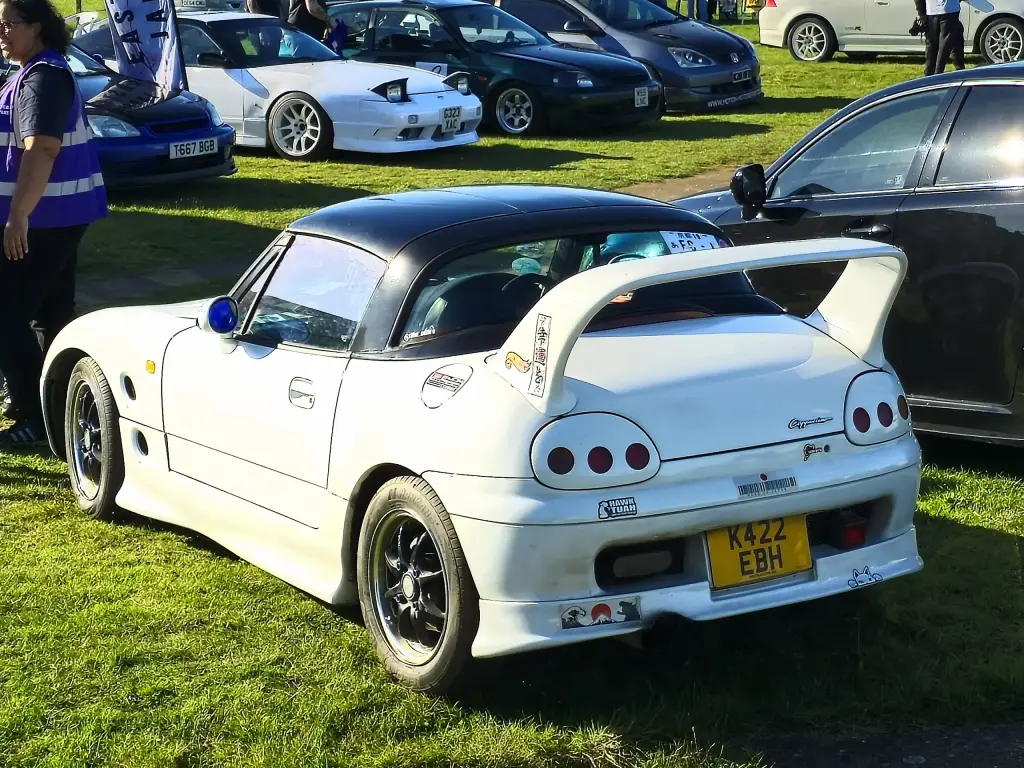
The Cappuccino’s party trick is its roof. Three removable panels allow it to be used as a closed coupé, a T-top, a targa, or, with the rear window and roll bar retracted, a full convertible. The panels stow in the boot, the rear window and roll bar disappear behind the seats, and the glass rear window has a demister. The bonnet, roof, roll bar and lower front panels are aluminium. An optional Winter package added a heavy-duty battery and special snow-shovelling wipers.
Britain and Europe
Suzuki GB began talks about a British version in 1991, and after 18 months of work 23 changes were made to meet national type approval. The car was shown at the British International Motor Show in October 1992, where it won two design awards, and went on sale in October 1993 at £11,995. The planned 1,500-car allocation was cut to 1,182, so only red and silver cars were offered in a four-to-one ratio. Between 1993 and 1995, 1,110 were registered in Britain and the rest went to Germany, France, the Netherlands and Sweden.
The revised car
Tougher European emissions rules in 1995 ended the official European sales, as rehomologation was too expensive for such a small run. The later EA21R specification arrived that year with the lighter, chain-cam K6A engine, a little more torque, lighter wheels and an optional three-speed automatic with power steering. High-specification BA versions added a driver’s airbag, four-wheel ABS and a limited-slip differential.
Design and features
- Four cars in one: coupé, T-top, targa or convertible, depending on the roof panels.
- Kei-sized sports car: 657 cc turbo, 64 PS and only 725 kg.
- Balanced layout: front mid-engine, rear drive and a claimed 50/50 weight distribution with two aboard.
- Aluminium panels: bonnet, roof, roll bar and lower front guards.
Suzuki Cappuccino versions
- EA11R (1991–1995): the original with the F6A engine.
- EA21R (1995–1998): K6A engine, optional automatic and power steering.
- BA high specification: airbag, ABS and limited-slip differential.
- UK version (1993): 23 modifications for British type approval, red or silver only.
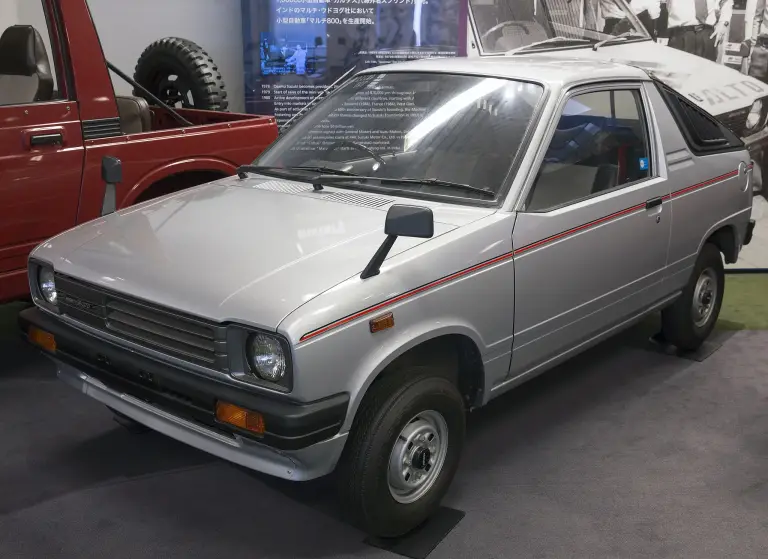
The Cappuccino was one of Japan’s sporty kei trio alongside the Honda Beat and Autozam AZ-1, and it shares its kei class with the Suzuki Alto. More Suzukis are in the Suzuki collection.
Video: Suzuki Cappuccino Hayabusa by Bob_chala
Video by Michael Roche on YouTube.
Sources
- Suzuki Cappuccino, English Wikipedia: history, engineering, UK sales