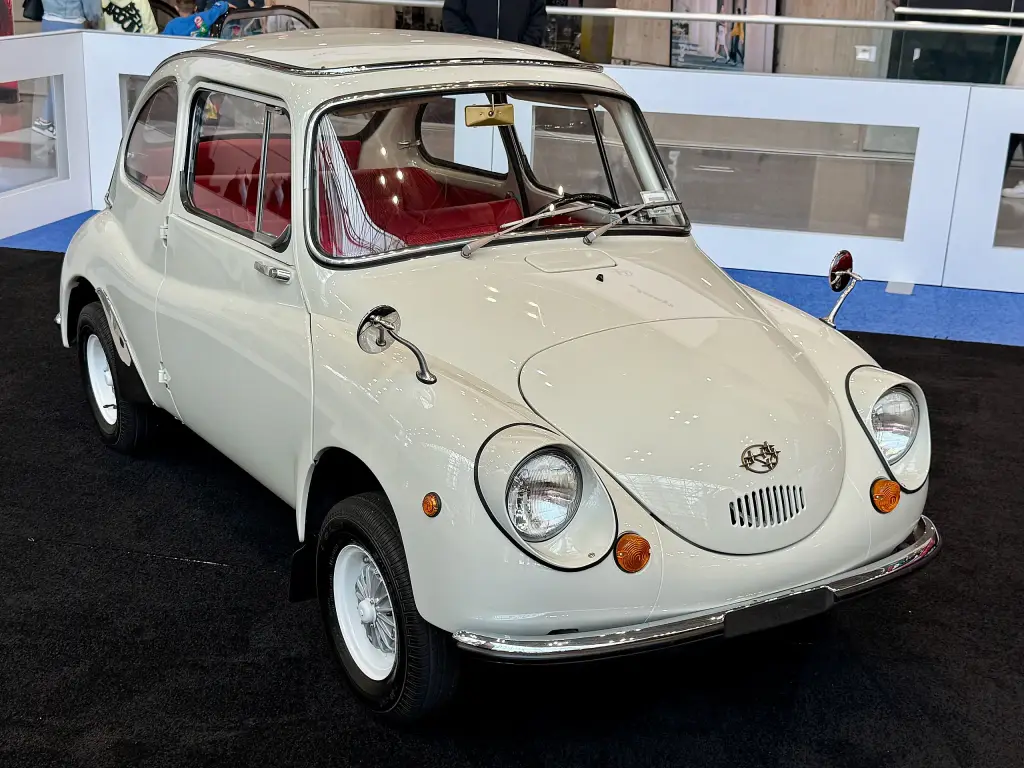
The Subaru 360 was a small rear-engined two-door car built from 1958 to 1971. It was the first mass-produced automobile of Fuji Heavy Industries, and with 392,000 built over twelve years it made the young company a car manufacturer.
Subaru 360 at a glance
| Maker | Fuji Heavy Industries, Japan |
|---|---|
| Production | 1958–1971 |
| Class | kei car |
| Engine | air-cooled two-stroke inline twin, 356 cc, mounted transversely at the rear |
| Power | 16 PS at launch; 18 PS, then 20 PS; 25 PS from August 1968 |
| Top speed | about 100 km/h |
| Kerb weight | about 450 kg |
| Body | monocoque with a fibreglass roof panel |
| Doors | rear-hinged |
| Suspension | swing axle at the rear |
| Gearbox | three-speed manual, four-speed later |
| Built | 392,000 |
Based on one source, the English Wikipedia article on the Subaru 360.
History of the Subaru 360
Fuji Heavy Industries had worked on a full-size passenger car since 1952 and built the Subaru 1500 prototype, but the plan was abandoned in 1955. In December 1955 the company decided instead to use its scooter engine line at the Mitaka plant for a 356 cc engine and to develop a four-seat light car around it. The project was called K-10; a wooden buck marked the limits of the body, the first prototype was finished in June 1957 and the production car was presented as the Subaru 360 at a press conference in Tokyo on 3 March 1958.
Design
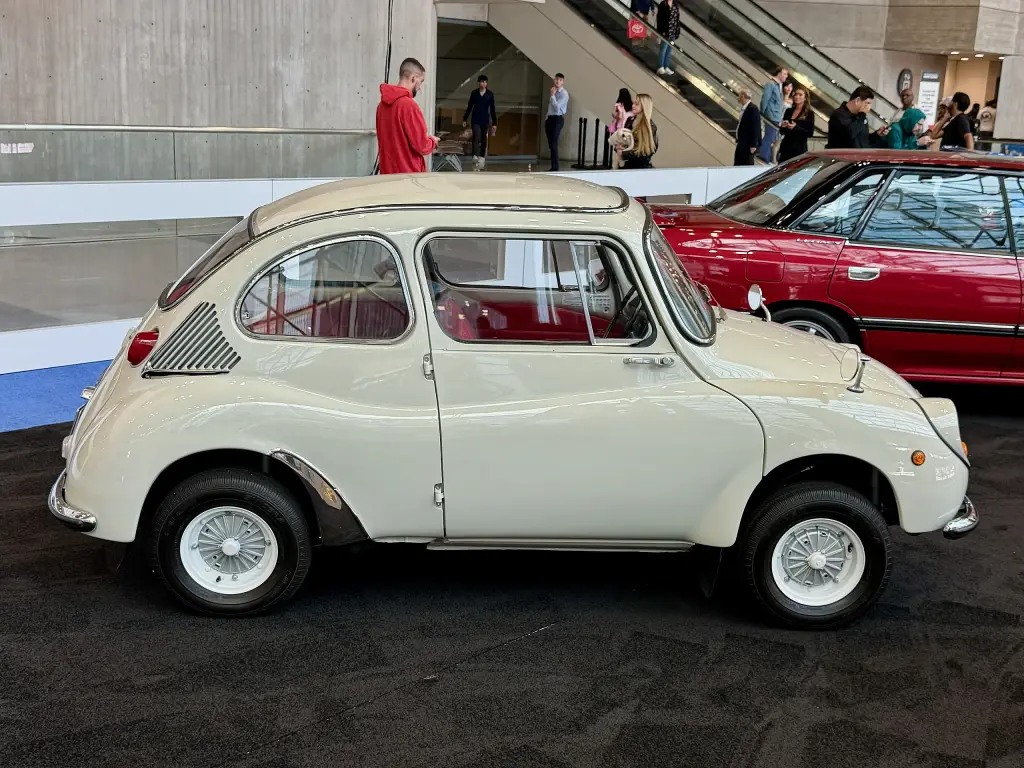
The 360 had an air-cooled two-stroke twin of 356 cc behind the rear axle, and like other small two-stroke cars it needed oil premixed with petrol; from 1964 the Subarumatic system mixed it automatically from a reservoir in the engine compartment. The controls for choke, heater and fuel cut-off sat on the floor between the driver and passenger, the fuel feed was by gravity so no pump was needed, and early cars had a full metal dashboard. Later models added a padded dash, pop-out rear quarter windows, a split front bench seat and a four-speed gearbox, and an ‘Autoclutch’ transmission without a clutch pedal was optional.
The body was a monocoque with a lightweight fibreglass roof panel, and the doors were hinged at the rear — the ‘suicide doors’ that Consumer Reports found could pull open in the wind. Many of the engineers came from the former Nakajima Aircraft company, which had become Fuji Heavy Industries.
Performance and sales
With a three-speed manual the 360 reached about 100 km/h, and because it weighed under 450 kg it was exempt from United States safety regulations. Consumer Reports measured 0–80 km/h in about 37 seconds and 9.4–6.7 litres per 100 km, against Subaru’s claim of 3.6. Power rose from 16 PS at the 1958 launch to 18 and then 20 PS; in August 1968 it went to 25 PS, and a twin-carburettor 36 PS engine was offered in the 360 Young SS from November 1968, giving 100 PS per litre.
In the United States the car was imported by Malcolm Bricklin, who advertised it as “Cheap and Ugly”; about 10,000 were sold there. At home it was nicknamed the ladybug and became one of Japan’s most popular cars before the R-2 replaced it.
Design and features
- Kei-car size: built to the Japanese light-car rules, with a 356 cc engine.
- Rear engine, rear drive: a layout Subaru later abandoned for front-wheel drive.
- Fibreglass roof: part of the weight-saving monocoque body.
- Rear-hinged doors: practical in tight parking, criticised in the American press.
- Autoclutch option: an electromagnetic clutch without a pedal.
Subaru 360 versions
- Sedan (K111): the standard two-door.
- Custom (K142): station wagon version.
- Convertible: a sedan with a roll-back fabric roof.
- Young SS (1968): twin-carburettor 36 PS engine.
- US export cars: about 10,000 sold through Malcolm Bricklin.
The 360 was replaced by the R-2 and was followed by Subaru’s first front-wheel-drive car, the Subaru 1000. More Subarus are in the Subaru collection.
Video: Subaru Vintage Garage: Subaru 360
Video by Subaru on YouTube.
Sources
- Subaru 360, English Wikipedia: development, design, performance, production