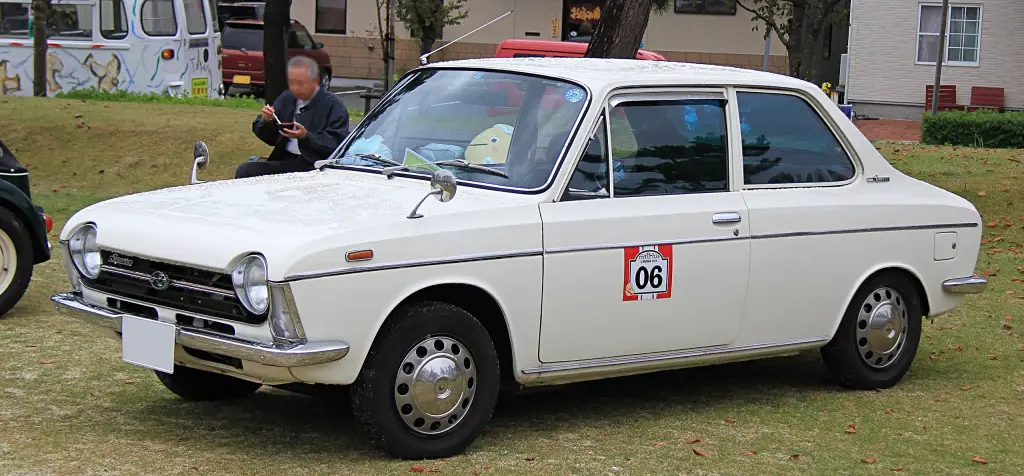
The Subaru 1000 was the first front-wheel-drive car built by Fuji Heavy Industries and the first production Subaru with a horizontally opposed engine. Introduced in 1966, it was replaced in 1969 by the FF-1, which stayed in production until 1972.
Subaru 1000 at a glance
| Maker | Fuji Heavy Industries, Japan |
|---|---|
| Production | 1000 from 1966 to 1969; FF-1 until 1972 |
| Layout | front engine, front-wheel drive |
| Engine | water-cooled flat-four, overhead valves by pushrods |
| Power | 55 PS; 67 PS in the 1000 SS of 1968 |
| Top speed | 135 km/h; 150 km/h in the 1000 SS |
| Gearbox | four-speed manual |
| Body styles | two-door sedan, four-door sedan, five-door van |
| Front brakes | inboard drums |
| Suspension | torsion bars with coil springs |
| Heating | taken directly from the radiator, no separate heater core |
| Length / wheelbase | 3,885 mm / 2,400 mm |
Based on one source, the English Wikipedia article on the Subaru 1000.
History of the Subaru 1000
Subaru had been building the rear-engined 360 and the Sambar, but by the early 1960s it wanted a car that could carry four adults comfortably and compete with the Toyota Corolla, Nissan Sunny, Mazda Familia and Mitsubishi Colt. A first attempt, the A-5 of 1962, used an air-cooled 980 cc flat-four and double wishbone front suspension; it was dropped because Fuji Heavy Industries lacked the resources to put it into production.
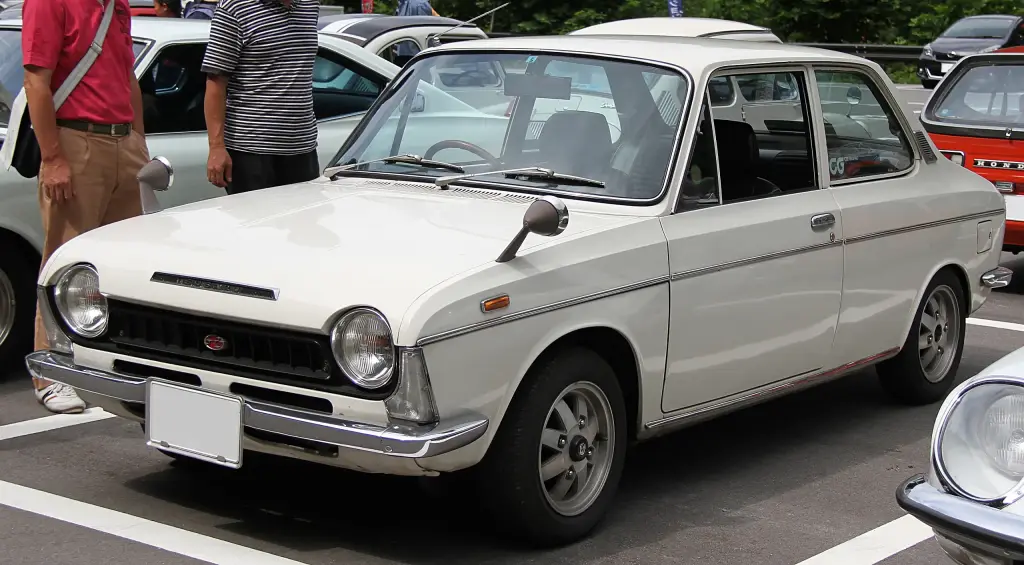
A second project, coded A-4 with a 923 cc engine, became production code A-63 and was finally introduced as the Subaru 1000. The engine was changed from air to water cooling for quietness and compactness. The car was shown at the Hilton Hotel in Tokyo on 21 October 1965 and at the Tokyo Motor Show later the same month, and went on sale in Japan in May 1966. Subaru engineers studied Porsche, Renault, DKW and Chevrolet Corvair designs and decided to combine a flat-four with front-wheel drive; the vibration problem of the driveshafts was solved with a “double offset joint” developed together with the bearing maker Toyo Bearing, now NTN.
The 1000 SS
A faster version, the 1000 SS, was shown at the 1967 Tokyo Motor Show and offered for 1968. Twin SU carburettors and a 10:1 compression ratio raised output from 55 to 67 PS and top speed from 135 to 150 km/h; the SS also had quicker steering, front disc brakes, firmer suspension and radial tyres as standard. Three-point seat belts became optional in October 1966, a two-door sedan arrived in February 1967 and a five-door light van in September 1967; in 1969 the model was renamed FF-1 and it remained on sale until 1972.
Unusual engineering
The 1000 used inboard front drum brakes to cut unsprung weight, a layout Subaru kept into the 1970s, and a hybrid suspension of torsion bars and coil springs similar to the front of the 360. There was no heater core: the heating system drew its warmth straight from the radiator. The car weighed about 500 kg and measured 3,885 mm long on a 2,400 mm wheelbase.
Design and features
- First front-wheel-drive Subaru: the model that set the pattern for the Leone, Legacy and Impreza.
- First boxer engine: a water-cooled flat-four with pushrod-operated overhead valves.
- Double offset joint: developed with NTN to stop vibration in the front driveshafts.
- Inboard front brakes: drums mounted inboard to reduce unsprung weight.
- Radiator heating: no heater core, warmth came directly from the cooling system.
Subaru 1000 versions
- 1000 (1966–1969): four-door sedan with the 55 PS engine.
- 1000 two-door (1967): model code A512.
- 1000 van (1967): five-door light van with a folding rear seat, low-powered engine only.
- 1000 SS (1968): 67 PS, front disc brakes, radial tyres.
- FF-1 (1969–1972): the renamed model, also sold as the Subaru Star.
The 1000 came after the rear-engined Subaru 360 and before the Leone, the car that brought four-wheel drive to the range. More Subarus are in the Subaru collection.
Video: In chase of a Subaru FF-1 Sports Sedan
Video by ymslab on YouTube.
Sources
- Subaru 1000, English Wikipedia: development, engines, versions, dates