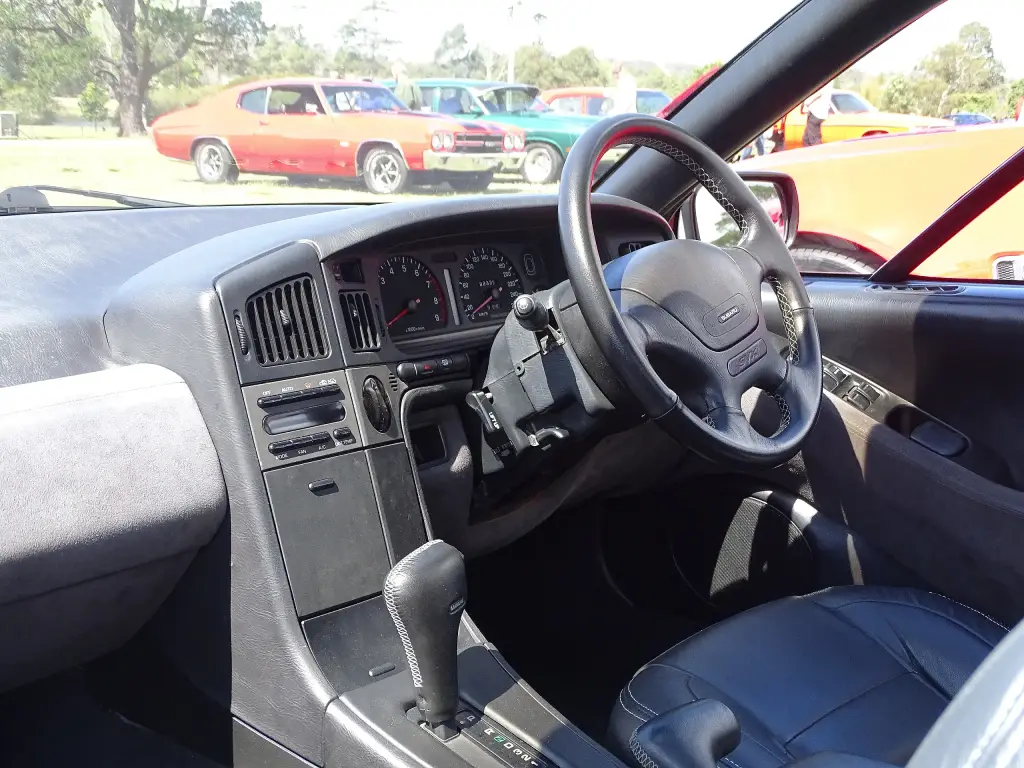
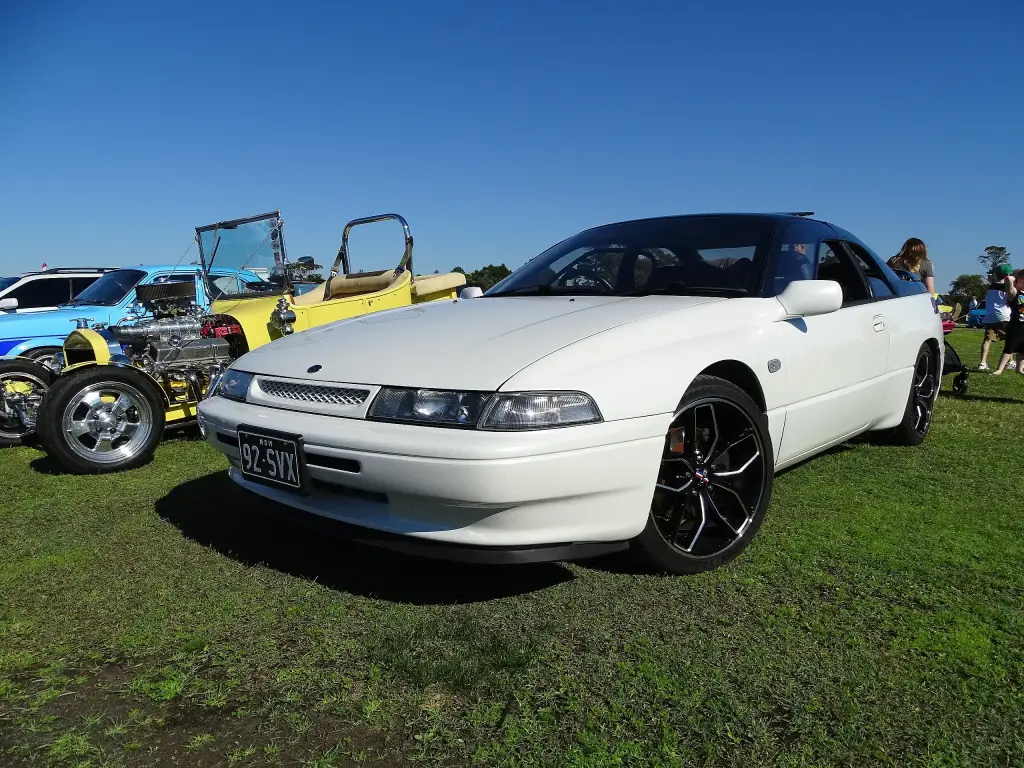
The Subaru SVX, sold in Japan as the Alcyone SVX, was a two-door coupé built from 1991 to 1996. It was Subaru’s first attempt at the luxury performance market and was famous for its window-within-a-window side glass.
Subaru SVX at a glance
| Maker | Subaru, Japan |
|---|---|
| Production | 1991–1996 |
| Class | two-door coupé |
| Designer | Giorgetto Giugiaro, ItalDesign |
| Layout | front engine, front- or all-wheel drive |
| Engine | 3.3-litre EG33 flat-six |
| Power | 231 hp at 5,400 rpm |
| Torque | 309 Nm at 4,400 rpm |
| Compression ratio | 10.1:1 |
| Gearbox | four-speed automatic only |
| Drag coefficient | 0.29, 0.285 in Europe |
| Japanese name | Alcyone SVX |
| Successor to | Subaru XT |
Based on one source, the English Wikipedia article on the Subaru SVX.
History of the Subaru SVX
The Alcyone SVX appeared as a concept at the 1989 Tokyo Motor Show with styling by Giorgetto Giugiaro of ItalDesign, and the production car kept its most distinctive feature: a window-within-a-window side glass layout. The idea came from the previous Alcyone and XT, extended here with an extra pane covering the A-pillar; Subaru called it an “aircraft-inspired glass-to-glass canopy”. Where the XT was angular, the SVX was softer, and each side window had an opening section about two-thirds of its size.
Aerodynamics
The car had a drag coefficient of 0.29, the same as the XT it replaced, while European cars reached 0.285 thanks to a larger undertray. Subaru also built the Amadeus, a shooting brake prototype in two- and four-door form, in 1991 and 1992, and considered production, but it was never made.
Engine and transmission
The only engine was the 3.3-litre EG33 flat-six, the largest engine Subaru had built for a passenger car until the 3.6-litre EZ36 of the 2008 Tribeca. It was essentially a six-cylinder version of the EJ22 from the Legacy and Impreza, with twin overhead camshafts, four valves per cylinder and a 10.1:1 compression ratio, giving 231 hp at 5,400 rpm and 309 Nm at 4,400 rpm. Because the six was more powerful than the turbocharged four of the previous Alcyone, no turbo was fitted, and because Subaru had no manual gearbox able to take the torque, the SVX came only with an automatic.
Two all-wheel-drive systems were offered. The American cars used ACT-4, an active torque split system that varied the drive to the rear wheels and never sent more than half the torque back. Cars for Japan, Europe and Brazil used VTD, variable torque distribution, which added a planetary centre differential with a mechanical 36/64 split and a clutch to suppress differential action, varying in practice between 34 and 50 per cent to the front. VTD could not run in two-wheel drive, which kept it out of the United States until long after the SVX had gone.
Early automatic gearboxes gave trouble: a defective torque converter clutch that broke up and blocked the radiators, both changed in 1993, and repeated high clutch failures because of low pump pressure. Several revisions were made and all were in place by late 1994. Japanese SVX L cars of 1991 and 1992 could be ordered with four-wheel steering.
Design and features
- Window-within-a-window: aircraft-style side glass with an opening panel inside a larger pane.
- Flat-six engine: the 3.3-litre EG33, the biggest Subaru passenger-car engine of its time.
- Two all-wheel-drive systems: ACT-4 in the United States, VTD elsewhere.
- Giugiaro styling: a concept of 1989 turned into a production car almost unchanged.
- Four-wheel steering: offered on Japanese SVX L models of 1991–1992.
Subaru SVX versions
- SVX (1991–1996): the single generation, with front- or all-wheel drive.
- Alcyone SVX: the Japanese name.
- SVX L (1991–1992): Japanese version available with four-wheel steering.
- Amadeus (1991): shooting brake prototype that was never produced.
The SVX replaced the XT and used an engine derived from the Legacy flat-four. More Subarus are in the Subaru collection.
Sources
- Subaru SVX, English Wikipedia: design, engine, transmissions, gearbox problems