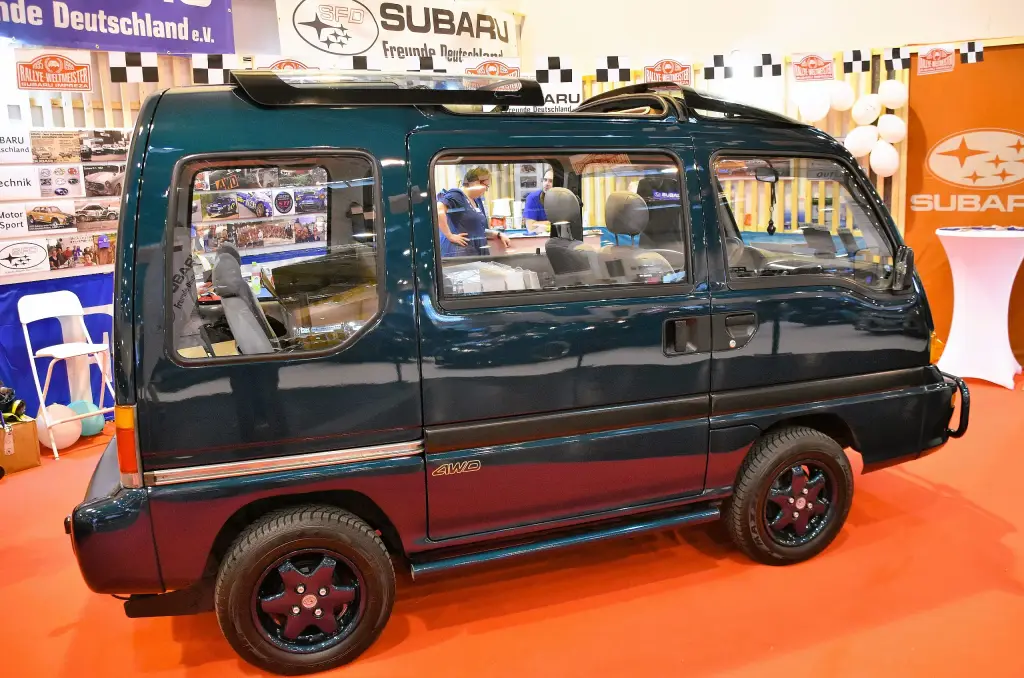
The Subaru Sumo was a cabover microvan produced from 1983 to 1998. It was known as the Domingo in Japan and the Libero in most of Europe, and it was too big and too powerful to count as a kei car.
Subaru Sumo at a glance
| Maker | Subaru, Japan |
|---|---|
| Production | 1983–1998 |
| Class | microvan, above kei rules |
| Japanese name | Domingo |
| European name | Libero, except in the UK, Iceland, Benelux and Sweden |
| Other names | Combi, Columbuss, Estratto, E10, E12 |
| Engines | 997 cc, later 1,189 cc three-cylinder EF |
| Power (Europe) | 52 PS carburetted, 54 PS injected |
| Layout | rear engine, rear-wheel drive; selectable four-wheel drive |
| Four-wheel drive | optional from launch |
| Full-time four-wheel drive | 1994, with viscous coupling and ECVT |
| Second generation | from 1993 |
Based on one source, the English Wikipedia article on the Subaru Sumo.
History of the Subaru Sumo
The Sumo shared most of its structure with the Sambar, but with longer front and rear bumpers and a larger engine borrowed from the Justy, so it no longer fitted the kei car rules on size or engine displacement. The German importer chose the name Libero in a public competition in 1984, while Sumo, used in most English-speaking markets, was meant to evoke Japan and the strength of a sumo wrestler.
First generation
The first generation was launched with optional four-wheel drive and a 997 cc three-cylinder EF engine, later enlarged to 1,189 cc, mounted in the rear as in the Sambar. Because the van was developed around a two-cylinder engine, the longer three-cylinder unit needed extra space and projected into the rear bumper, which had to be removed even for basic servicing — and the engine was exposed if the van was hit from behind. The 1,200 cc Sumo could be ordered with selectable four-wheel drive operated by a button on the gear lever; in normal driving only the rear wheels were driven, because there was no centre differential for continuous four-wheel drive. In European trim the carburetted 1.2-litre engine produced 52 PS at 4,400 rpm.
Second generation
A second generation appeared in 1993 with entirely new bodywork, following the Sambar. Fuel injection and a catalytic converter came with the 1.2-litre engine, the only one offered, and European power rose to 54 PS; Japanese cars claimed 61 PS. In 1994 Subaru added its full-time four-wheel drive with a viscous coupling, available only with the ECVT transmission, and European versions received an oil cooler to help with light towing.
Names and end of production
The nomenclature outside Japan was complicated. In Belgium the van was called the Combi, in Sweden the Columbuss, and in Taiwan the later generation was marketed as the Estratto; in some countries the names E10 and E12 were used, referring to the size of the engines. The Sumo was discontinued when the sixth-generation Sambar arrived, and its market was left to the Forester, which offered permanent four-wheel drive, a 2.5-litre boxer engine and more cargo space. In Japan the Domingo’s role passed to the seven-seat Exiga.
Design and features
- Rear engine: a van layout inherited from the Sambar.
- Justy engine: a 1.0 then 1.2-litre three-cylinder instead of a twin.
- Selectable four-wheel drive: operated by a button on the gear lever.
- Full-time four-wheel drive: added in 1994 with a viscous coupling.
- Many names: Domingo, Libero, Combi, Columbuss, Estratto, E10 and E12.
Subaru Sumo versions
- First generation (1983): 997 cc or 1,189 cc engine, rear-wheel drive or selectable four-wheel drive.
- Second generation (1993): new bodywork, injected 1.2-litre engine.
- Full-time 4WD (1994): viscous coupling with ECVT.
- Domingo: the Japanese name.
- Estratto: the Taiwanese name of the later generation.
The Sumo was derived from the Sambar and used the engine of the Justy. More Subarus are in the Subaru collection.
Video: Subaru Domingo 1985 off road
Video by Константин Константинов on YouTube.
Sources
- Subaru Sumo, English Wikipedia: layout, engines, names, generations