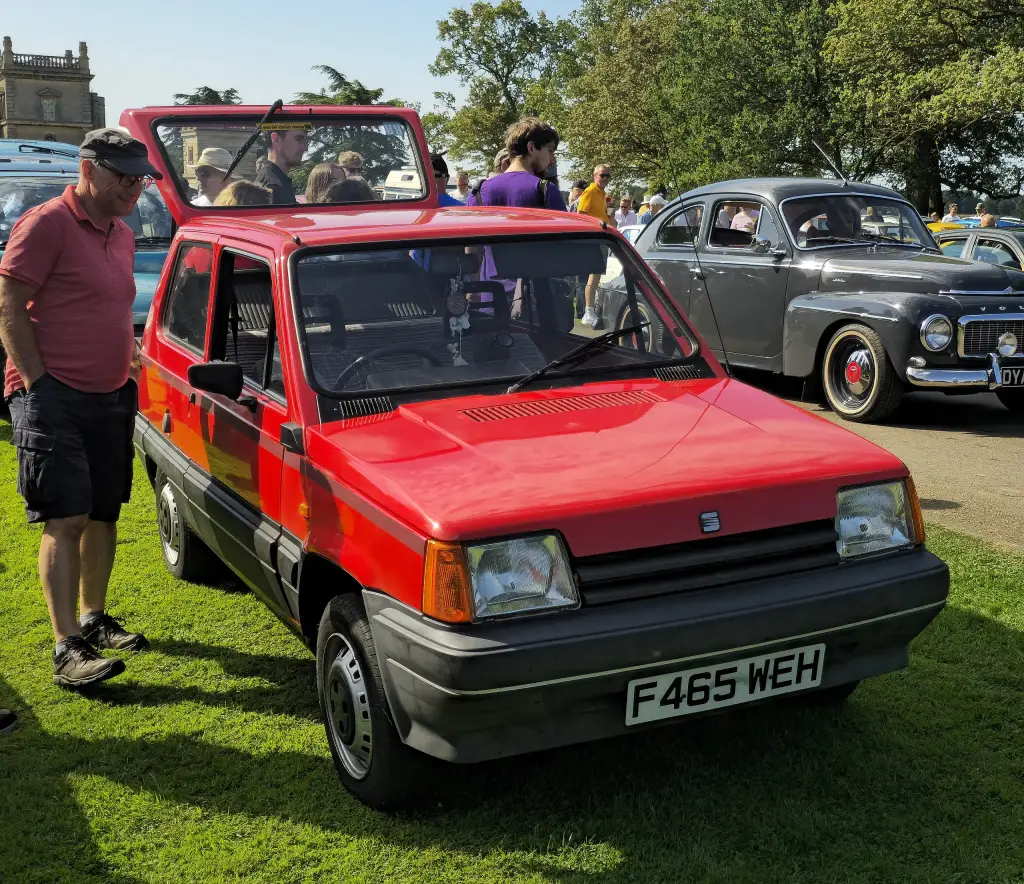
The SEAT Marbella was a badge-engineered Fiat Panda that SEAT built from 1980 to 1998, first as the SEAT Panda and from 1986 under its own name. It was the last SEAT model ever based on a Fiat, and it stayed in production long after the Panda had moved on.
SEAT Marbella at a glance
| Maker | SEAT, Landaben (Pamplona) and Zona Franca (Barcelona) |
|---|---|
| Production | 1980–1998 |
| Internal codes | 141A (Panda), 28 / 028A (Marbella) |
| Basis | Fiat Panda, badge-engineered |
| Renamed | SEAT Panda to SEAT Marbella in December 1986 |
| Engine | 903 cc four-cylinder, 40 PS |
| Small engine | 843 cc, 34 PS, no five-speed gearbox |
| Weight | about 680 kg |
| Boot | 272 l, 1,088 l with the rear seats folded |
| Van version | SEAT Terra, 1987–1996 |
| End of production | 1998, the last vehicle built at Zona Franca |
This page is based on one source, the English Wikipedia article on the SEAT Marbella, which also covers the SEAT Panda, Trans and Terra.
History of the SEAT Marbella
The SEAT Panda, 1980
The car began as the SEAT Panda, a badge-engineered Fiat Panda that entered production in Spain in 1980. It was built at SEAT’s Landaben plant in Pamplona from February 1980 until 29 April 1983, and also at Zona Franca in Barcelona. A slight restyling in 1983 brought a new grille and other minor changes, and the Marbella name was first used for the 1983 model year on a luxurious version of the Panda. Mechanically the car borrowed heavily from the Fiat parts bin, using engines and transmissions from the Fiat 127: a 903 cc four-cylinder of 40 PS was enough for a car weighing about 680 kg. A 60 PS kit to build a more powerful SEAT Panda Abarth was sold in Spain by a company called Apicsa. Shortly after launch a smaller-engined version joined the range as the Panda 35, with an 843 cc engine derived from the unit first used in the SEAT 850, given a lower compression ratio to set it apart from the 45.
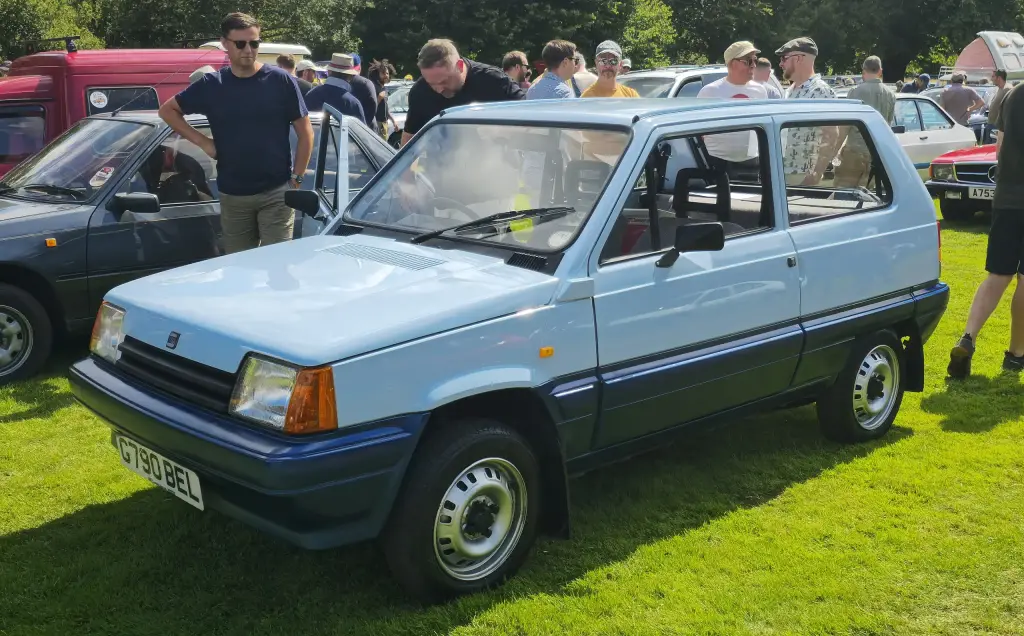
Marbella, 1986
After a second, more thorough restyling in December 1986 the car received the SEAT Marbella nameplate, and production continued at Zona Franca until 1998, when the end of the Marbella also meant the end of vehicle production in that factory. The SEAT did not get the mechanical and cosmetic changes applied to the Fiat Panda in 1986, such as the removal of the front window quarter-lights; instead it received minor changes developed in-house. The visible differences from a Panda are at the front and rear, where the lights and panels differ and the Marbella has a pronounced slope to the front panel. The boot held 272 litres, or 1,088 litres with the rear seats folded. The 843 cc version continued at 34 PS and 125 km/h and was not available with the five-speed gearbox, while the 903 cc car reached 131 km/h; that engine later gained electronic injection and shrank to 899 cc.
Editions, vans and the popemobile
Many trim levels came and went with few real changes: L, Special, XL, GL and GLX were the common ones, and special editions multiplied later in the car’s life, with Black, Red and Yellow added in September 1989 and Blue, Green, CLX and Jeans in September 1990, plus market-specific cars such as the Le Jouet series sold in France. The commercial side was covered first by the SEAT Trans, a high-roofed box van based on the Panda and available until 1986, and then by the SEAT Terra of 1987–1996, a Marbella with a large metal box behind the cab and a load rack above it. In 1982 SEAT built a popemobile at Zona Franca from a modified Panda, used by Pope John Paul II during his visit to Spain; it was an open car with a grab handle so that the Pope could stand and greet the crowds, and he entered the Camp Nou stadium in it on 17 November 1982 before a congregation of more than 121,000. At the 1991 Frankfurt show SEAT presented the Marbella Playa concept, a beach car with the new corporate grille, but the project was halted.
Design and features
- Last Fiat-based SEAT: the final model of the long licence relationship with Fiat.
- Light and simple: about 680 kg with a 903 cc engine of 40 PS.
- Commercial versions: the Trans van until 1986 and the Terra from 1987 to 1996.
- Two factories: built at Landaben in Pamplona and at Zona Franca in Barcelona.
SEAT Marbella versions
- SEAT Panda (1980–1986): the original badge-engineered car.
- Panda 35: 843 cc engine of 34 PS.
- SEAT Marbella (1986–1998): restyled and renamed version.
- SEAT Terra (1987–1996): van with a high metal box body.
- Special editions: Black, Red, Yellow, Blue, Green, CLX and Jeans.
The Marbella was replaced by the SEAT Arosa, and its van version by the SEAT Inca. More Spanish cars are in the SEAT collection.
Sources
- SEAT Marbella, English Wikipedia: history, engines, editions, vans, popemobile