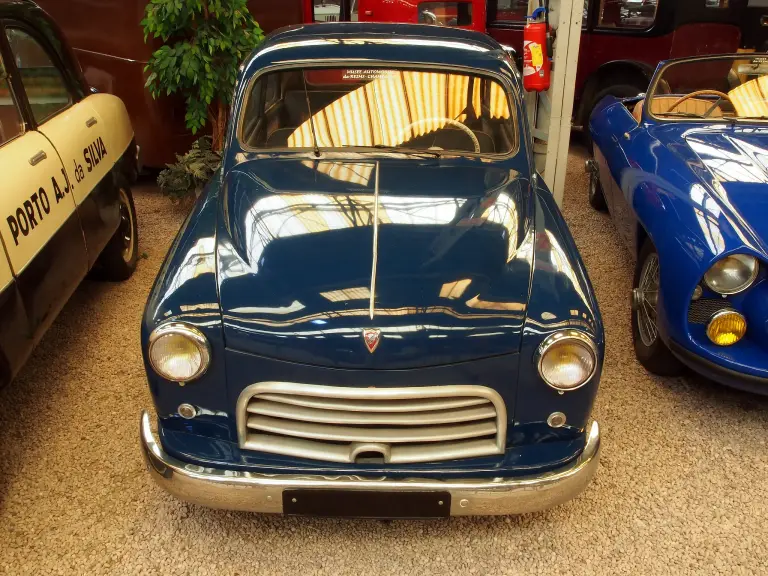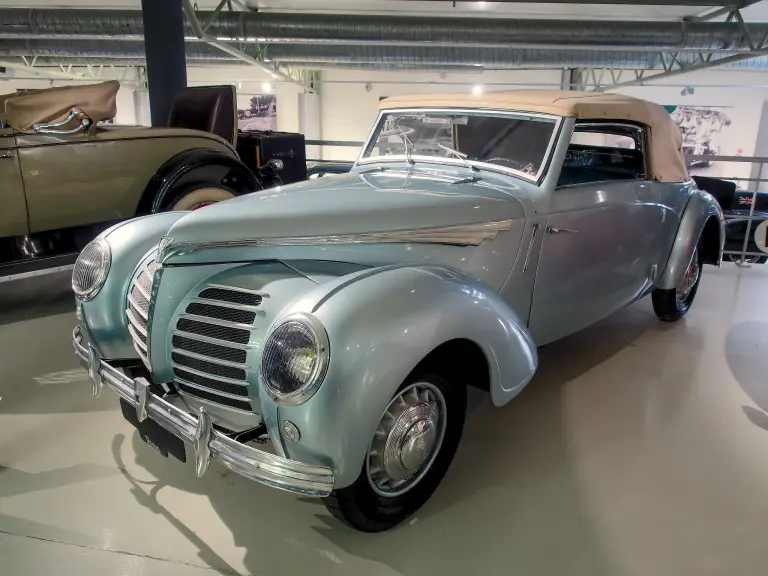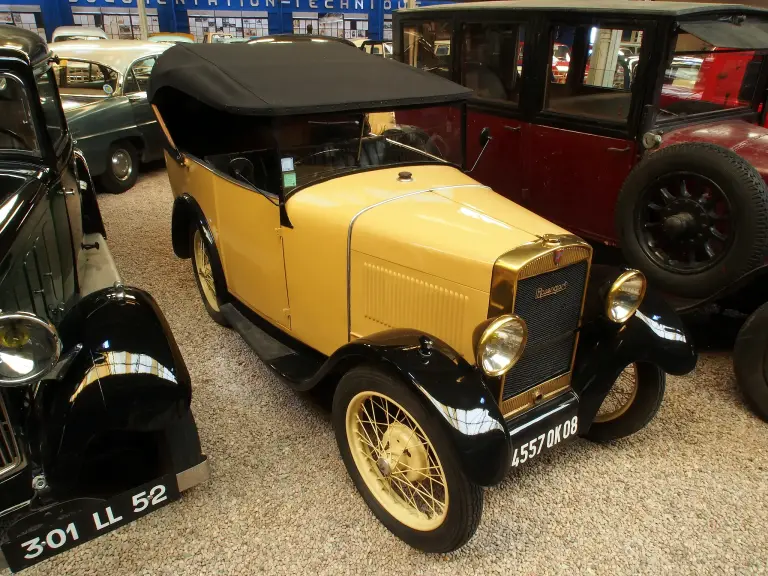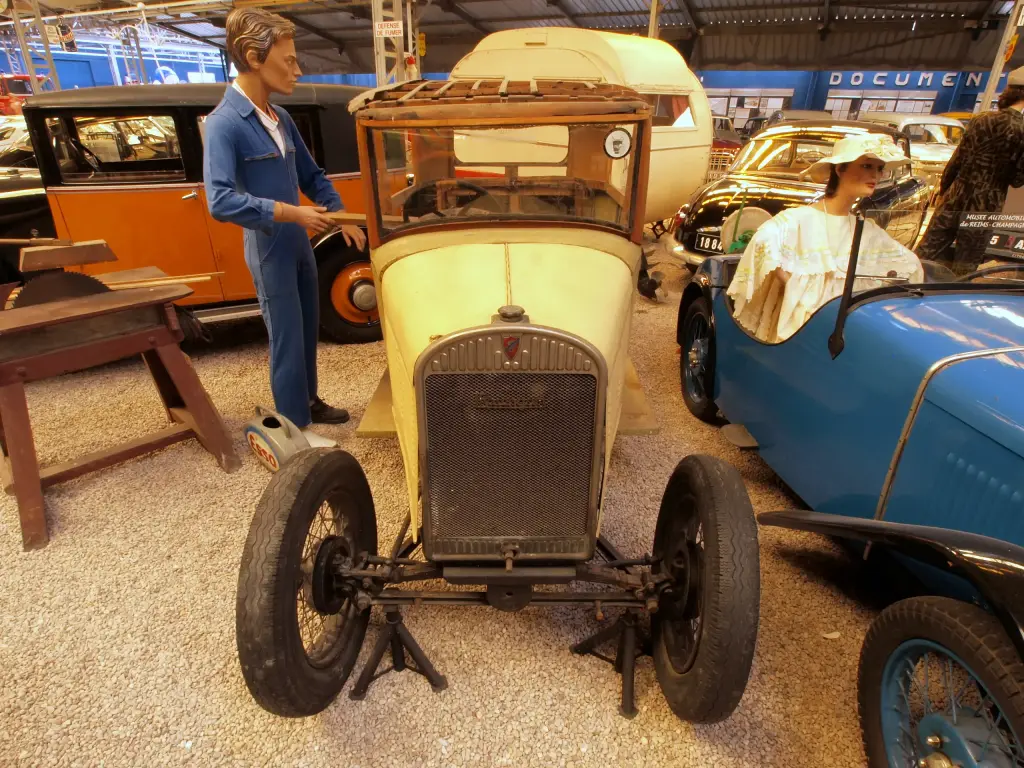
The Rosengart LR4 was the second generation of Lucien Rosengart’s small car. From 1931 it was heavily differentiated from the Austin 7 it descended from, but it kept the 747 cc engine, the three-speed gearbox and a short 2.20 m wheelbase — and versions of it were still being built in the 1950s.
Rosengart LR4 at a glance
| Maker | Automobiles L. Rosengart, Paris |
|---|---|
| Production | 1931 to the 1950s |
| Marketed as | Rosengart Cinq (five tax horsepower) |
| Engine | 747 cc four-cylinder, side valves |
| Power | 11 hp (Cinq); 18 hp (Supercinq, 1935); 19 hp (1938 LR4N2) |
| Gearbox | three-speed; four-speed in the LR4R1 |
| Wheelbase | 2.20 m; 2.35 m (LR44/47) and 2.60 m (LR45) until about 1935 |
| Size and weight (1938) | 3.53 m long, 1.27 m wide, 670 kg |
| Chassis | rigid front axle, mechanical brakes on all four wheels |
| Cooling | thermosiphon, with splash lubrication and no oil pump |
| Model codes | LR4, LR4N2, LR4R1, LR44/45/47/49, LR6, LR62/63/64, LR70 |
History of the Rosengart LR4
From the LR2 to the Cinq
From 1931 Lucien Rosengart’s small car appeared in modified form as the LR4, now heavily differentiated from its Austin origins but still using the same 747 cc engine and three-speed gearbox. It was marketed simply as the Rosengart Cinq, a reference to its five tax horsepower rating. Its robust character was demonstrated by several long-distance trials, the same argument that had sold the LR2.
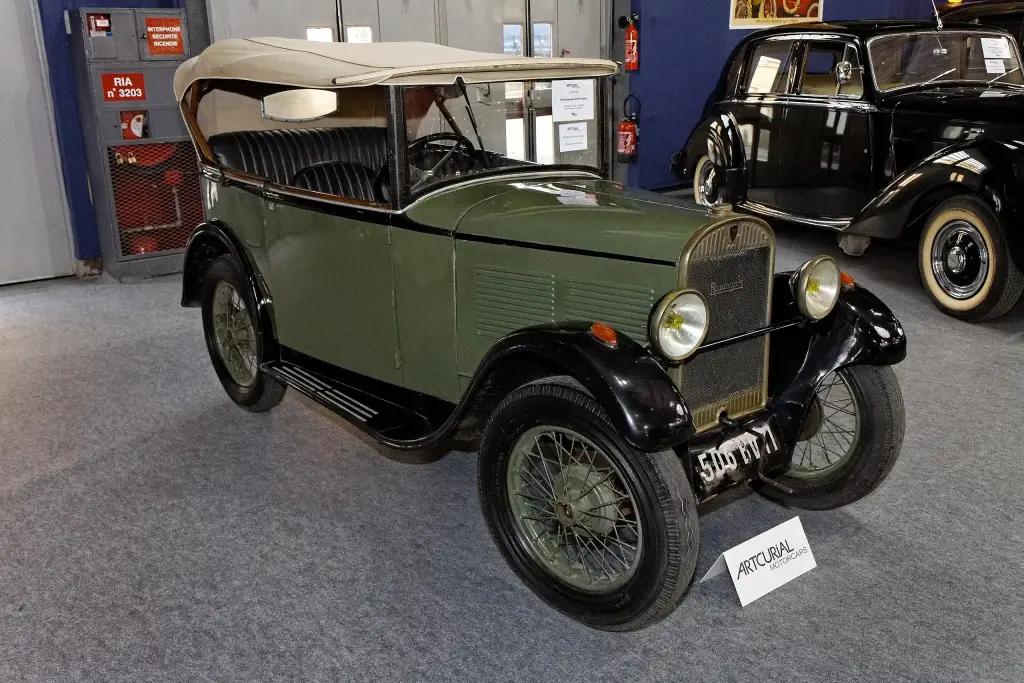
Variations on the model survived until the 1950s, always retaining the original short 2.20 m wheelbase. Until about 1935 two longer wheelbases were also available: 2.35 m on the LR44 and LR47 and 2.60 m on the LR45. Around the Cinq grew a wide family: the French list of production models adds the LR6 of 1932, the LR62, LR63 and LR64, the LR44, LR45, LR47 and LR49, and the LR70 SuperSept of 1937–1939.
The Supercinq
A further substantial upgrade took place in August 1935 with the arrival of the more powerful Supercinq. Thanks to an aluminium cylinder head and other modifications, power rose from 11 to 18 hp. The original Cinq remained on sale alongside it as a lower-cost alternative. The Supercinq was offered only on the shortest wheelbase and carried the LR4N2 model code; shortly afterwards the LR4R1 appeared, largely identical apart from a four-speed gearbox.
In 1938 the LR4N2 gained one horsepower while losing one tax horsepower, being rated at 19 hp and 4 CV. French Wikipedia gives the 1938 specification as a 747 cc side-valve four with battery-and-coil ignition, splash lubrication without an oil pump, thermosiphon cooling, a rigid front axle, a three-speed gearbox and mechanical brakes on all four wheels, measuring 3.53 m by 1.27 m and weighing 670 kg.
Why it lasted
The LR4 was cheap, simple and easy to repair, and it was still being catalogued when French buyers had moved on to more modern small cars. Its mechanical package — a long-stroke 747 cc side-valve four, a three-speed box and a beam front axle — dated from the early 1920s, which is exactly why the postwar Ariette would later be criticised for using it.
Design and features
- Different from the Austin: by 1931 the body and details were Rosengart’s own, even though the engine and gearbox were unchanged.
- Five tax horsepower: the Cinq name came straight from the French tax rating, which kept the car cheap to run.
- Aluminium head: the 1935 Supercinq raised output from 11 to 18 hp without a new engine.
- Long wheelbase options: LR44/47 and LR45 chassis widened the range into small family cars until about 1935.
- Two gearboxes: a three-speed as standard, with a four-speed in the LR4R1.
Rosengart LR4 versions
- LR4 / Cinq (1931–1934): the original five-tax-horse car with an 11 hp engine.
- LR4N2 Supercinq (1935–1939): aluminium head, 18 hp, shortest wheelbase only.
- LR4R1 (1935–1940): essentially a Supercinq with a four-speed gearbox.
- LR44, LR45, LR47, LR49: longer-wheelbase derivatives sold until about 1935.
- LR70 SuperSept (1937–1939): the largest member of the small-car family.
- 1938 LR4N2 4CV: 19 hp and a four-tax-horsepower rating.
The LR4 grew out of the Rosengart LR2 and shared the range with the larger Supertraction. Its engine was still under the bonnet of the Ariette. More cars are in the Rosengart collection.
Video: Rosengart LR4
Video on YouTube.
Sources
- Automobiles L. Rosengart, English Wikipedia: LR4, Cinq, Supercinq, wheelbases, power figures
- Rosengart, French Wikipedia: model list, 1938 specification