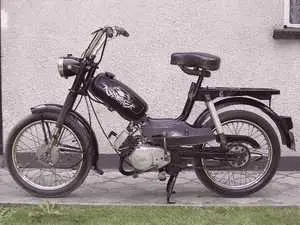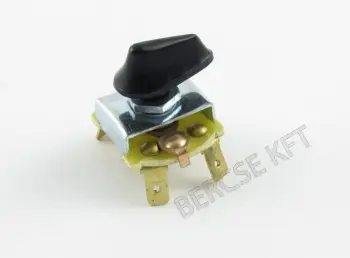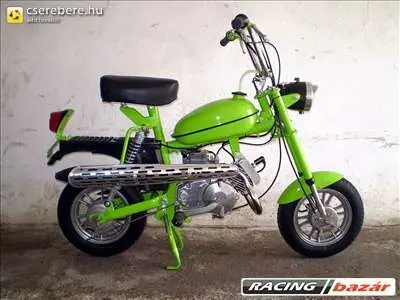
The Romet Pony was a single-seat Polish moped, or motorynka, built by the Romet works in Bydgoszcz from 1978 to 1994. Aimed mainly at young riders, it was as simple as possible to build and to use: it did 40 km/h, used 2.2 litres of mixture per 100 km, and instead of a speedometer and an electric horn it came with a bicycle bell.
Romet Pony at a glance
| Maker | Zakłady Rowerowe Romet, Bydgoszcz, Poland |
|---|---|
| Production | 1978–1994 |
| Type | single-seat moped (motorynka) |
| Models | Pony 50-M-1, 50-M-2, 50-M-3 and Pony 301 |
| Engine | Dezamet 022, then 023, then 025, two-stroke, air-cooled |
| Capacity | 49.8 cm³ |
| Power | about 1.7 hp depending on version |
| Top speed | 40 km/h |
| Fuel consumption | about 2 l/100 km (2.2 l per 100 km overall) |
| Dry weight | 46 kg |
| Equipment | bicycle bell; no speedometer or electric horn |
| Frame number | the first two digits give the year of production |
Based on one source: the Polish Wikipedia article on the Romet Pony, with company background from the Romet articles.
History of the Romet Pony
The Pony was designed for young riders and was notable for its simplicity of construction and maintenance. It was produced for sixteen years, from 1978 to 1994, and its frame number carried a useful detail: the first two digits told the owner which year the machine had been built.
The first version, the Pony 50-M-1, was built by the United Bicycle Works Romet of the time and used the Dezamet 022 engine of 49.8 cm³ made at the Dezamet metal works in Nowa Dęba. That engine worked with a two-speed manual gearbox, and gears were changed by a twistgrip on the handlebar that worked together with the clutch. The top speed was 40 km/h and fuel consumption about 2 litres per 100 km.
The Pony 50-M-2 brought a new engine, the Dezamet 023, along with a new rear lamp with its mounting, and the two leather compartments and the metal tail with its mudguard were removed in favour of a plastic tail with a compartment. The rear shock absorbers, the handlebar and the seat were changed, the handlebar became smaller, and instead of the handlebar twistgrip the gears were now changed by a lever mounted directly on the engine. Early M-2 machines still had the front mudguard mountings, rear shock absorbers and high-bridge handlebar of the M-1; these details were changed in 1981. From 1984, with small changes, the M-2 was built alongside the M-3.
The main differences between the 50-M-2 and the 50-M-3 were the engine, the frame, which gained a tube welded to the carburettor rubber under the seat, and the exhaust bend. The M-3 used the Dezamet 025 engine; at first it had the same handlebar clamp as the M-2, and later both models received a different mounting. The Pony 301 returned to the Dezamet 023 engine, and its frame was lengthened, the shape of the fuel tank changed and a different rear lamp with a new mounting fitted.
Design and features
- Built for young riders: a single-seat motorynka with the simplest possible construction.
- Deliberately basic equipment: a bicycle bell stood in for the speedometer and electric horn.
- Four versions: the 50-M-1, 50-M-2, 50-M-3 and Pony 301 over sixteen years.
- Datable frame: the first two digits of the frame number give the year of production.
Romet Pony versions
- Pony 50-M-1: Dezamet 022 engine, handlebar twistgrip gear change and leather compartments.
- Pony 50-M-2: Dezamet 023 engine, gear lever on the engine, plastic tail with compartment.
- Pony 50-M-3: Dezamet 025 engine, modified frame and exhaust bend.
- Pony 301: back to the Dezamet 023, longer frame, new tank shape and rear lamp.
The Pony was Romet’s small single-seater alongside the Komar, and its Dezamet 023 engine was shared with the Kadet. More Romet mopeds are in the Romet collection.
Sources
- Romet Pony, Polish Wikipedia: production, versions and performance
- Romet, English Wikipedia: the Bydgoszcz works and its products
- Romet, Polish Wikipedia: company background