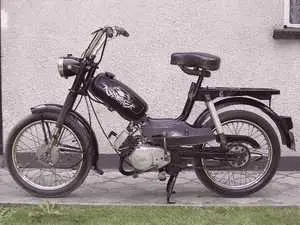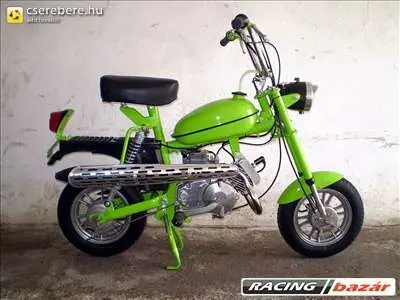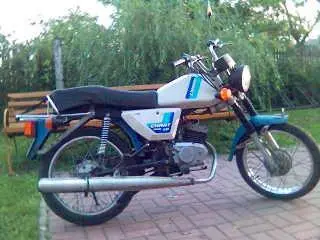
The Romet Chart 210 and 211 of 1988–1994 were the youngest, most modern and last mopeds of the original Romet family. Instead of the simplified cyclemotor layout of earlier models, the Chart was designed from scratch with motorcycle-type solutions, hydraulic suspension, turn signals and electronic ignition; its silhouette was modelled on the MZ ETZ 250.
Romet Chart at a glance
| Maker | Zakłady Rowerowe Predom-Romet, Bydgoszcz, Poland |
|---|---|
| Production | 1988–1994 |
| Models | Chart 210 and Chart 211 |
| Built | over 80,000 of the 210; about 80 of the 211 |
| Engine | Dezamet 027, single-cylinder two-stroke, air-cooled |
| Capacity | 49.8 cm³, bore 38 mm, stroke 44 mm |
| Power | 2.06 kW (2.8 hp) at 5,800 rpm |
| Torque | 3.5 Nm |
| Gearbox | three-speed, foot change |
| Ignition | contactless electronic module |
| Suspension travel | 140 mm front, 65 mm rear |
| Dry weight | about 76 kg |
| Top speed | 50 km/h (other figures over 60 km/h) |
Based on one source: the Polish Wikipedia article on the Romet Chart, with company background from the Romet articles.
History of the Romet Chart
The Chart was the last new design of the original Romet moped line. Unlike earlier machines, almost every assembly was new and made specifically for it: not only the engine and frame but most other components as well. The simplified solutions of the previous mopeds gave way to motorcycle practice, which brought the Chart close to the trend among leading makers of turning 50 cm³ machines from bicycle-like mopeds into genuine small motorcycles.
Its stylistic reference was the MZ ETZ 250, and the equipment list was unusually complete for a Polish moped: rear-view mirrors, turn signals, more effective brakes and electronic ignition. Hydraulically damped suspension gave a comfortable riding position and ride quality. A prototype was described in the magazine Motor on 25 August 1985; it differed from the production 210 in the lower parts of the front forks, metal brake and clutch levers, mudguards, engine, rear shock absorbers, speedometer drive and an uncased speedometer.
According to one of its designers the engine was meant to have four gears and more power than a Simson, but centrally planned economies forced a three-speed gearbox and a simplified, weaker engine. A version with a Simson engine was also planned, but the German firm was not interested in cooperating. The Dezamet 027 is thought to have been modelled internally, in gearbox and clutch layout, on one of the Minarelli engines.
The basic Chart 210 accounted for more than 80,000 units. About 80 of the 211 were also built, distinguished among other things by imported light-alloy cast wheels from Sachs. The Chart was reliable and good both on the road and off it, and its modernity earned it the nickname “the Polish Simson”. It was never as popular as the Ogar or the Komar, largely because of its price: by oral accounts a new one cost 350,000 złoty in 1989, against about 275,000 for a ČZ 350 motorcycle, when the average wage was 206,758 złoty. Production of the Chart, and of Polish mopeds in general, stopped in 1994 because the works could not compete in a market economy; no attempt was made to develop the design further.
Design and features
- Motorcycle practice: a new engine and frame plus most other assemblies designed specifically for the model.
- Hydraulic suspension: 140 mm of front and 65 mm of rear travel for comfort on poor roads.
- Full equipment: mirrors, turn signals, electronic ignition and a 125 mm drum brake at each end.
- MZ-inspired styling: a modern silhouette modelled on the MZ ETZ 250.
Romet Chart versions
- Chart 210: the standard model, over 80,000 built.
- Chart 211: about 80 machines with imported Sachs light-alloy cast wheels.
- 1985 prototype: metal levers, different mudguards, engine and rear shocks.
The Chart replaced the older single-seat Kadet at the top of the range, and it stood apart from the simpler Komar. More Romet mopeds are in the Romet collection.
Sources
- Romet Chart, Polish Wikipedia: design, prototypes, production numbers, price and specification
- Romet, English Wikipedia: the Bydgoszcz works and its products
- Romet, Polish Wikipedia: company background