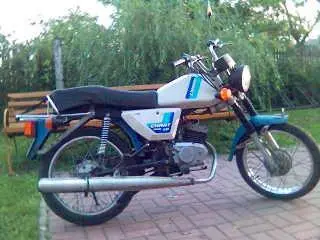
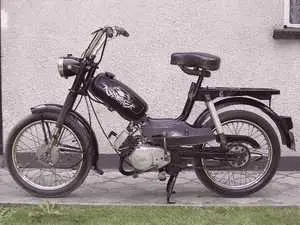
The Romet Ogar was a two-seat Polish moped of the 1980s, built in three variants: the Ogar 200, the Ogar 201 and the Ogar 205. The 200 relied on a Czechoslovak Jawa engine detuned to suit Polish rules, and when that supply ended the works returned to its own Dezamet unit for the 205.
Romet Ogar at a glance
| Maker | Zakłady Rowerowe Romet, Bydgoszcz, Poland |
|---|---|
| Production | Ogar 200 1983–1990; Ogar 205 from May 1986 to 1993 |
| Models | Ogar 200, Ogar 201 (not series-built), Ogar 205 |
| Engine, 200 | Jawa 50/223, two-stroke, 49.9 cm³ |
| Power, 200 | 2 hp (1.4 kW) at 4,500 rpm |
| Engine, 205 | Dezamet 023, two-stroke, 49.8 cm³ |
| Power, 205 | 1.7 hp (1.25 kW) at 4,800 rpm |
| Top speed | 55 km/h (200), 45 km/h (205) |
| Dry weight | 60 kg (200), 58 kg (205) |
| Fuel tank | 9 l with a 2-litre reserve (200) |
| Fuel consumption | 3 l/100 km (200), 2.4 l/100 km (205) |
Based on one source: the Polish Wikipedia article on the Romet Ogar, with company background from the Romet articles.
History of the Romet Ogar
The Ogar was created because Poland wanted two-seat mopeds and had no suitable engine of its own. The works had been building the Romet 50 T-3 with the Dezamet 019, but production of that engine was stopped, so the Ogar 200 was designed around the Czechoslovak Jawa 50/223 unit with a horizontal cylinder, and the frame and other parts were adapted to it. The engine was delivered under a contract for 40,000 units a year, which was also the average annual output of the Ogar 200, built from 1983 to 1990.
The Jawa engine was modified, colloquially “strangled”, to cut maximum power from 3.5 hp to 2 hp and torque from 4 Nm to about 3.5 Nm. The Ogar 200 had a 49.9 cm³ engine with 9.5:1 compression, a JIKOV 2917 PSb carburettor, a three-speed gearbox in an oil bath, a plate clutch, 6 V 20 W electrics, a 60 kg dry weight, a 9-litre tank with a 2-litre reserve and a top speed of 55 km/h, using 3 litres per 100 km at full speed. The improved Ogar 201 of 1985 added rear shock absorbers with oil damping, but it did not enter series production.
The Ogar 205 was the second two-seat version, built on the 50 T-3 design but adapted to the Polish two-speed Dezamet 023 engine. It had a structurally changed frame and a roomy tool box with space for spare parts such as a spark plug and bulbs, and it introduced modernised front and rear lamps with external connections. Production began in the first days of May 1986 and ended in 1993.
With the Dezamet 023, the Ogar 205 had 49.8 cm³, a 38 mm bore and 44 mm stroke, 8:1 compression, 1.7 hp at 4,800 rpm and 2.85 Nm at 2,800 rpm. It used a GM12F1 carburettor, a two-plate wet clutch, a two-speed foot-change gearbox, 6 V 20 W electrics, 17 × 2¼ inch tyres, a 58 kg dry weight, a 9-litre tank and a top speed of 45 km/h with 2.4 litres per 100 km.
Design and features
- Two seats: a genuine two-person moped, a class in demand in Poland in the 1980s.
- Jawa power: the Czechoslovak 50/223 engine, detuned from 3.5 to 2 hp.
- Two power units: the Jawa-engined 200 and the Dezamet-engined 205.
- Practical details: the 205 gained a large tool box and modernised lamps.
Romet Ogar versions
- Ogar 200 (1983–1990): Jawa 50/223 engine, three-speed gearbox, 55 km/h.
- Ogar 201 (1985): oil-damped rear shock absorbers, not series-built.
- Ogar 205 (1986–1993): Dezamet 023 engine, two-speed gearbox, new frame and lamps.
The Ogar replaced the 50 T-1 in the two-seat class, and its 205 shared the Dezamet 023 engine with the Kadet. More Romet mopeds are in the Romet collection.
Sources
- Romet Ogar, Polish Wikipedia: versions, engines, production and specifications
- Romet, English Wikipedia: the Bydgoszcz works and its products
- Romet, Polish Wikipedia: company background