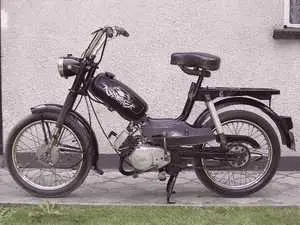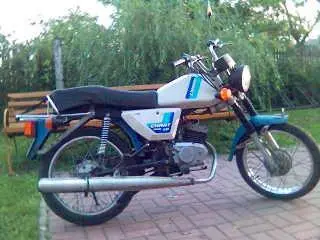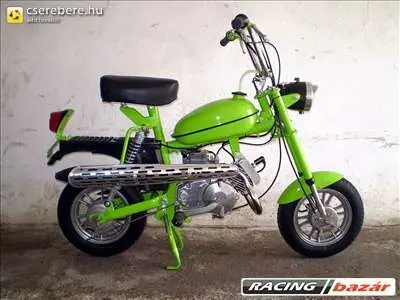
The Romet 50 T-1 was a two-person moped built by the Romet works in Bydgoszcz from 1975 to 1982. Its Dezamet 019 engine, a development of the earlier 017 unit, gave it a top speed of 55 km/h, and the long dual seat and 150 kg load rating made it one of the roomier small machines of its day.
Romet 50 T-1 at a glance
| Maker | Zakłady Rowerowe Romet, Bydgoszcz, Poland |
|---|---|
| Production | 1975–1982 |
| Type | two-seat moped (motorower) |
| Engine | Dezamet 019, single-cylinder two-stroke, air-cooled |
| Capacity | 49.8 cm³, bore 38 mm, stroke 44 mm |
| Power | 2.5 hp at 5,200 rpm |
| Torque | 0.35 kgm (3.45 Nm) at 4,500 rpm |
| Carburettor | GM13F, 13 mm throat, 0.55 mm main jet |
| Gearbox | three-speed, foot change |
| Top speed | 55 km/h |
| Dry weight | 63 kg |
| Fuel consumption | 2.8 l/100 km at 40–45 km/h |
Based on one source: the Polish Wikipedia article on the Romet 50 T-1, with company background from the Romet articles.
History of the Romet 50 T-1
The 50 T-1 appeared in 1975 as a two-seat moped, a class that was growing in Poland as buyers looked for something more substantial than a single-seat cyclemotor. It was produced at the Romet plants in Bydgoszcz until 1982.
Its engine was the Dezamet 019, a development of the 017 unit used elsewhere in the Romet range. The 019 kept the 38 mm bore and 44 mm stroke for a capacity of 49.8 cm³ but was fed by a GM13F carburettor with a 13 mm throat instead of the 12 mm of the popular GM12F, and a main jet enlarged from 0.40 to 0.55 mm. Compression was 8:1, output 2.5 hp at 5,200 rpm and torque 0.35 kgm (3.45 Nm) at 4,500 rpm. The clutch was at first a three-plate wet unit, later replaced by the two-plate type used in other Dezamet engines.
The frame was an open, welded tubular spine type, with a long two-person seat. Front suspension was a telescopic fork without damping and 70 mm of travel, the rear a telescopic swingarm with 50 mm. The wheels were 19-inch, non-interchangeable, on 2.25-19 tyres, and the drum brakes of 97 mm diameter had ribbed light-alloy drums with cast-in iron liners.
Early machines were painted orange, blue, yellow or red, and each came with a tool kit, a tyre pump and an instruction book. The electrical system was a single-wire 6 V arrangement with a 23 W flywheel magneto-generator, a two-filament 15/15 W headlamp and a 3 W tail lamp, plus a battery-fed electric horn. Dry weight was 63 kg and the permitted load 150 kg.
Design and features
- Two-person seat: a long dual seat and a 150 kg load rating set it apart from single-seat mopeds.
- Dezamet 019 engine: a larger-throat GM13F carburettor lifted output to 2.5 hp.
- Three-speed gearbox: foot-operated change with ratios of 2.19, 1.44 and 1:1.
- Thrifty running: 2.8 litres per 100 km at 40–45 km/h from a 9-litre tank.
Romet 50 T-1 versions
- Early production: three-plate wet clutch with bakelite inserts and orange, blue, yellow or red paint.
- Later production: the two-plate clutch used in other Dezamet engines.
The 50 T-1 was followed by the two-seat Ogar, built on the 50 T-3 with a Jawa engine, and it shared its three-speed layout with the single-seat Komar. More Romet mopeds are in the Romet collection.
Sources
- Romet 50 T-1, Polish Wikipedia: production, engine, chassis and dimensions
- Romet, English Wikipedia: the Bydgoszcz works and its products
- Romet, Polish Wikipedia: company background