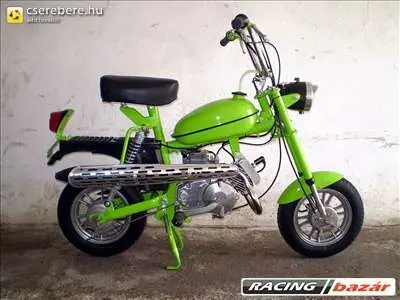
The Romet 760 Polo was the first model of the new 700 family of mopeds built by the Romet works in Bydgoszcz from 1976. Close to the 750 Pegaz, it was given a modernised body whose style was meant to recall bicycles used for polo, along with a longer handlebar and a longer tank taken from the Komar Sport.
Romet 760 Polo at a glance
| Maker | Zakłady Rowerowe Romet, Bydgoszcz, Poland |
|---|---|
| Production | from 1976 |
| Family | first of the Romet 700 series |
| Engine | Dezamet 017, two-stroke, air-cooled, 49.8 cm³ |
| Bore × stroke | 38 × 44 mm |
| Compression | 8:1 |
| Power | 1.7 hp (1.25 kW) at 4,800 rpm; 1.8 hp maximum at 5,600 rpm |
| Torque | 0.29 kgm (2.85 Nm) at 2,800 rpm |
| Gearbox | two-speed, handlebar twistgrip on the left |
| Carburettor | GM12F, 12 mm |
| Top speed | about 45 km/h as a moped class |
| Fuel consumption | about 2 l/100 km |
Based on one source: the Polish Wikipedia article on the Romet 760 Polo, with company background from the Romet articles.
History of the Romet 760 Polo
The 760 Polo opened the new 700 family of Romet mopeds in 1976. It was closely related to the 750 Pegaz but wore a modernised body whose shape was intended to refer to the bicycles used for playing polo. That gave it a new, longer handlebar and a new, longer fuel tank taken from the Komar Sport, mounted between the handlebar and the saddle. The saddle itself had a new shape with a metal backrest.
Its engine was the Dezamet 017 unit of 1.7 hp. The single-cylinder two-stroke had a 38 mm bore and a 44 mm stroke for 49.8 cm³, 8:1 compression, a rated 1.7 hp at 4,800 rpm and a maximum 1.8 hp at 5,600 rpm, with 0.29 kgm (2.85 Nm) of torque at 2,800 rpm. The cylinder was cast iron with a light-alloy head, the crankshaft and connecting-rod big end ran on rolling bearings, and the engine was started by a foot lever. A GM12F carburettor with a 12 mm bore fed a 1:25 petrol-oil mixture, and the gearbox held 0.5 litres of oil.
Drive passed from the engine to the gearbox by helical gears with a ratio of 3.32, and from the gearbox to the rear wheel by a partly enclosed 1/2 × 4.8 inch chain with 102 links and a ratio of 2.54. There were two speeds, 1.92 and 1.0, changed by a rotating grip on the left of the handlebar, and a two-plate wet clutch. Ignition was fixed at 27 degrees (3 mm) before top dead centre.
The frame was an open welded tubular spine type. The front wheel hung on a telescopic fork without damping and 50 mm of travel, the rear on a swingarm sprung by two telescopes with 60 mm of travel. The handlebar was lengthened, the saddle longitudinal with a backrest and the luggage rack extended, and covers were screwed to the middle of the frame under the tank to hide the control cables. Overall length was 1,700 mm, handlebar height 1,100 mm and saddle height 800 mm. The 97.5 mm drum brakes were operated by hand at the front and by a lever on the right at the rear. The moped was painted red, orange, light green or light blue and came with a tyre pump, a tool bag, a bicycle bell and a speedometer with an odometer.
Design and features
- New 700 family: the first model of the series that replaced the earlier generation.
- Polo-inspired style: a longer handlebar and the Komar Sport tank between bar and saddle.
- New saddle: a reshaped seat with a metal backrest.
- Simple two-speed drive: 3.32 primary gears and a 2.54 chain final drive.
Romet 760 Polo versions
- 760 Polo (from 1976): the standard model in red, orange, light green or light blue.
The 760 Polo was replaced by the Kadet in 1980, and its tank came from the Komar Sport. More Romet mopeds are in the Romet collection.
Sources
- Romet 760 Polo, Polish Wikipedia: design, engine, transmission and dimensions
- Romet, English Wikipedia: the Bydgoszcz works and its products
- Romet, Polish Wikipedia: company background