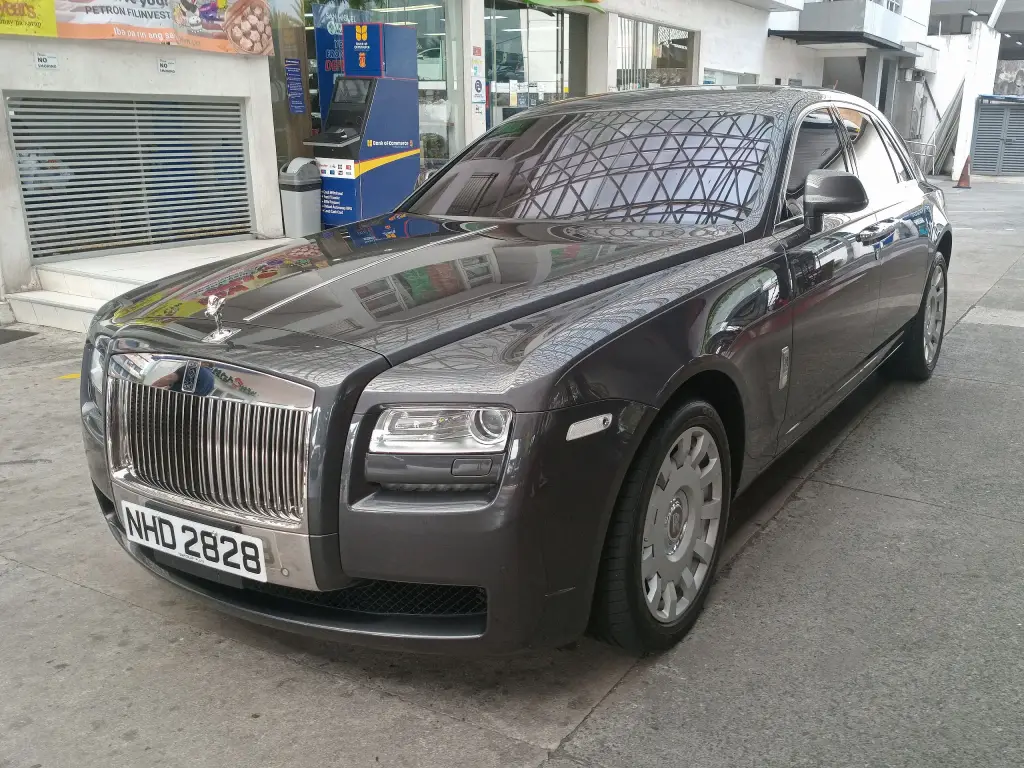
The Rolls-Royce Ghost is a full-sized luxury car made at Goodwood. The name, chosen in honour of the Silver Ghost of 1906, was announced in April 2009, the production car appeared at the Frankfurt motor show that September, and the Ghost went on sale at the end of 2009 as a smaller and less expensive Rolls-Royce than the Phantom.
Rolls-Royce Ghost at a glance
| Maker | Rolls-Royce Motor Cars, Goodwood |
|---|---|
| First generation | 2009–2020 |
| Unveiled | Frankfurt motor show, September 2009 |
| Platform | shared with the F01 BMW 7 Series |
| Engine | 6.6-litre twin-turbocharged V12 |
| Black Badge output | 603 hp (450 kW) at 5,250 rpm |
| Acceleration | 0–100 km/h in 4.8 seconds (Black Badge) |
| Top speed | 250 km/h (155 mph), limited |
| Wheelbase | 3,290 mm (129.7 in) |
| Kerb weight | 2,470 kg (5,445 lb) |
| Extended wheelbase | from 2011 |
| Second generation | revealed 1 September 2020 |
This page is based on English Wikipedia only, so the figures could not be checked against a second source.
History of the Rolls-Royce Ghost
The 200EX and the launch
The 200EX concept, shown at the Geneva motor show in March 2009, indicated the styling direction of the production car, and the Ghost’s design was virtually unaltered from it. The name was announced in April 2009 at the Auto Shanghai show and the car was unveiled at Frankfurt in September, going on sale that month; deliveries in Britain and Europe began late in 2009 and in other markets, including the United States and Asia-Pacific, from the second quarter of 2010. The Ghost Extended Wheelbase followed in 2011.
Engineering
Known during development as RR04, the Ghost was designed by Andreas Thurner and Charles Coldham and engineered by Helmut Riedl, who had led work on the Phantom. It was developed to compete with cars well below the Phantom in price, such as the Bentley Flying Spur and V12 versions of the Mercedes-Benz S-Class. It used a platform shared with the F01 BMW 7 Series, with about 20 per cent of parts common to both, but had its own wheelbase of 3,290 mm, roof height, bonnet height and track widths, and used Phantom-style air springs. It weighed 2,470 kg, shared the FlexRay electronic system with the Phantom and used BMW’s iDrive interface, through which the Spirit of Ecstasy mascot and many functions were controlled. The car was built on its own line at Goodwood, sharing the paint, wood and leather workshops with the Phantom.
Series II
Rolls-Royce introduced the updated Series II at the Geneva motor show in 2014. Visually it had re-sculpted headlights with unbroken daytime running lights, a tapered wake channel on the bonnet running back from the Spirit of Ecstasy’s wings, chrome inserts in enlarged front air intakes, subtly revised bumpers and a waft line slanted further forward, plus new wheels and colours. Inside there were redesigned front seats, re-angled rear seats, polished metal chaplets on the clock fascia and instrument dials, natural grain leather on the A and C pillars and two new veneers. Technically the Series II had redesigned front and rear struts, new steering gear, adjusted dampers, new rear hydraulic axle bearings, LED headlights, a Dynamic Driving Package and Satellite Aided Transmission, which used GPS data and the driver’s style to choose gears.
Black Badge
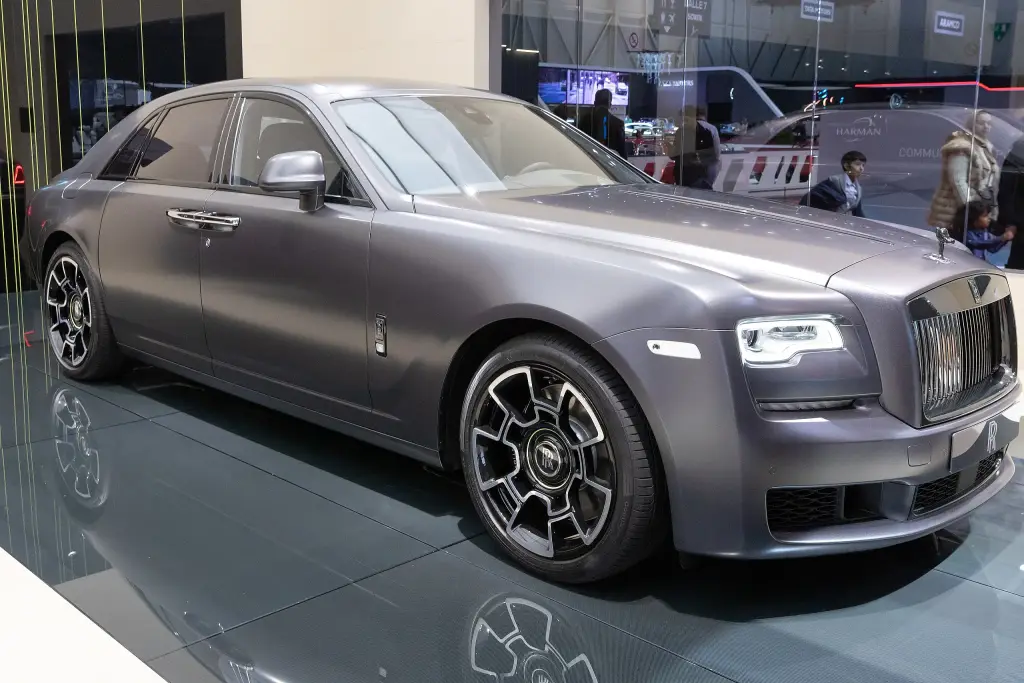
The Ghost Black Badge was the high-performance variant of the Series II. Its Spirit of Ecstasy and exhaust were finished in black rather than silver and it had its own wheel design. The 6.6-litre V12 produced 603 hp (450 kW) at 5,250 rpm and 620 lb·ft (841 N·m) between 1,650 and 5,000 rpm, giving 0–100 km/h in 4.8 seconds and a limited 250 km/h. The Black Badge treatment was later applied to the Cullinan, Wraith and Dawn as well.
The second generation
The second-generation Ghost was first seen testing on 24 January 2019 and was fully revealed on 1 September 2020. Unlike the first generation, it shares its platform with the eighth-generation Phantom and the Cullinan, and it introduced all-wheel drive, all-wheel steering, a ‘Planar’ suspension, an illuminated grille and, in place of the earlier car’s fittings, the Starlight headliner.
Design and features
- Smaller than the Phantom: conceived as a more measured, more realistic Rolls-Royce at a lower price.
- BMW-derived platform: shared with the F01 7 Series, with about 20 per cent common parts.
- Air-sprung ride: Phantom-style air springs and the Phantom’s FlexRay electronics.
- Series II updates: LED headlights, new struts and Satellite Aided Transmission from 2014.
- Black Badge: a 603 hp version with blacked-out trim and its own wheels.
Rolls-Royce Ghost versions
- Ghost Series I (2009–2014): the original car, with the 200EX-previewed styling.
- Ghost Extended Wheelbase (2011): the long-wheelbase version.
- Ghost Series II (2014–2020): re-sculpted lights, revised chassis and new interior trim.
- Ghost Black Badge: 603 hp, dark exterior detailing and unique wheels.
- Second-generation Ghost (2020): on the Phantom VIII platform, with all-wheel drive and steering.
The Ghost provided the platform for the Wraith coupé, and its place above the range was held by the Phantom VII. More cars are in the Rolls-Royce collection.
Sources
- Rolls-Royce Ghost, English Wikipedia: launch, platform, Series II, Black Badge, second generation