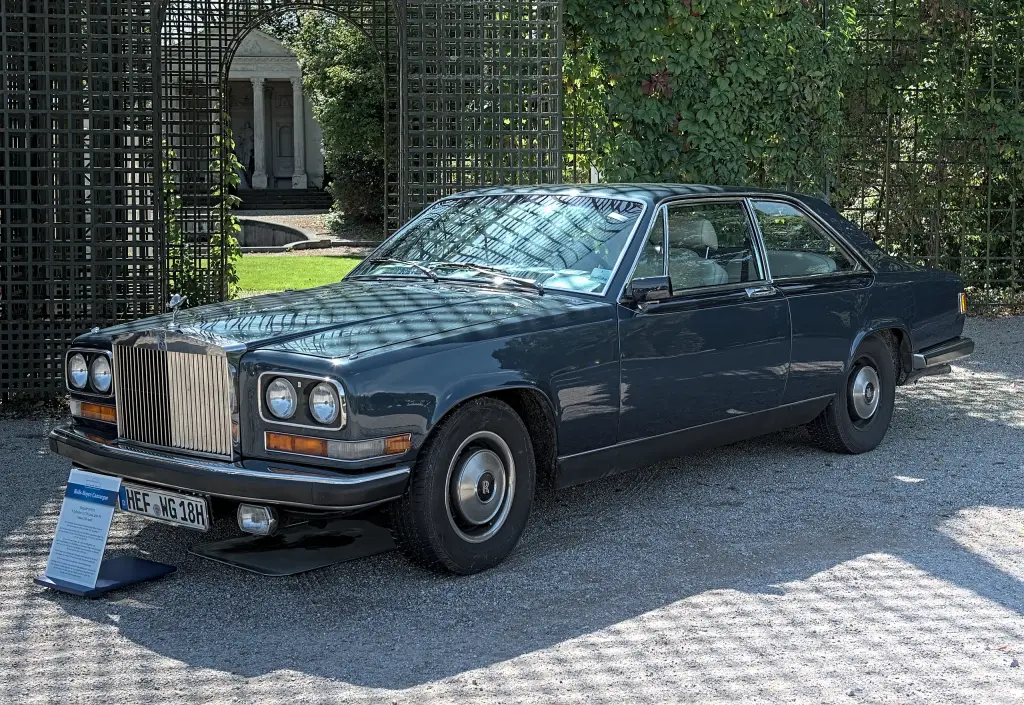
The Rolls-Royce Camargue is a two-door luxury saloon sold from 1975 to 1986. Designed by Paolo Martin at Pininfarina, it was the first post-war production Rolls-Royce not designed in-house, and at its launch it was both the flagship and the most expensive production car in the world.
Rolls-Royce Camargue at a glance
| Maker | Rolls-Royce Motors, Crewe |
|---|---|
| Production | 1975–1986 |
| Designer | Paolo Martin, Pininfarina |
| Body | two-door saloon |
| Engine | 6.75-litre V8 |
| Transmission | General Motors Turbo-Hydramatic three-speed automatic |
| Wheelbase | 3,048 mm (120 in) |
| Platform | shared with the Corniche and Silver Shadow |
| Grille | inclined at seven degrees, the first non-vertical Rolls-Royce grille |
| Climate control | automatic split-level system, a first of its kind |
| Price at launch | £29,250 in March 1975, including taxes |
| Steering | rack and pinion from February 1977 |
This page is based on English Wikipedia only, so the figures could not be checked against a second source.
History of the Rolls-Royce Camargue
A flagship from Turin
The Camargue takes its name from the coastal region in southern France. It was launched in 1975 as the Rolls-Royce flagship and, at the time, the most expensive production car in the world. It was the first post-war production Rolls-Royce not designed in-house, apart from the coachbuilt Corniche and the coachbuilt variants of models such as the Silver Wraith, Silver Cloud and Silver Shadow. At its official US launch the car had already been on sale in Britain for more than a year, and the New York Times noted that the American price was some $5,000 higher than the British one: Rolls-Royce rejected the usual practice of selling cheaper in the United States, citing the cost of safety and emissions work for the roughly 30 cars a year it expected to send there in 1976.
Design
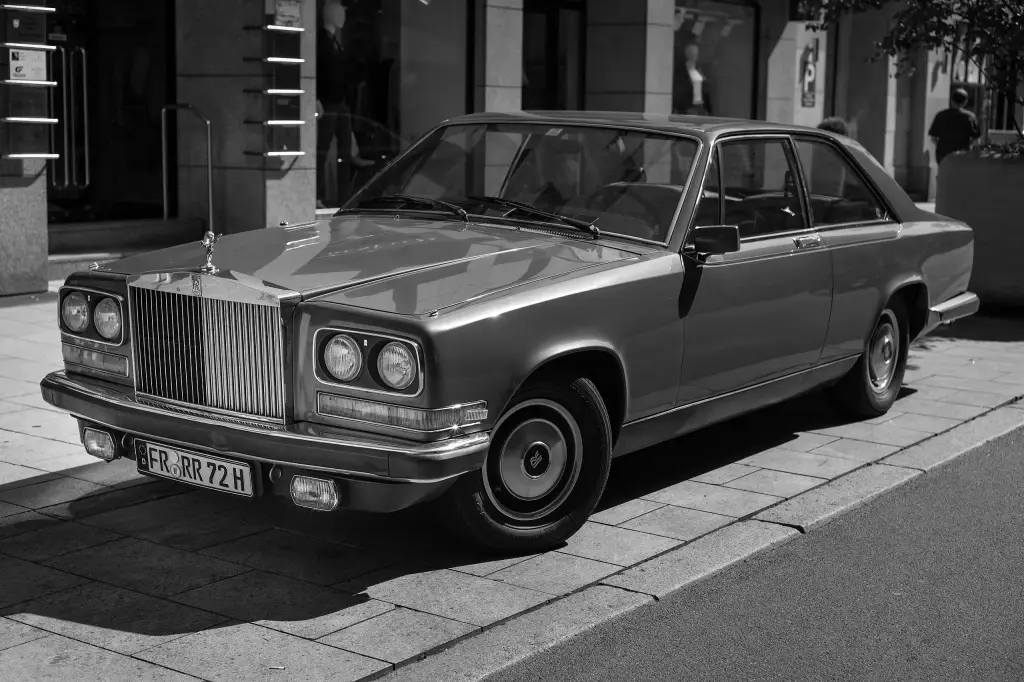
The Camargue was the first Rolls-Royce designed to metric dimensions, with a wheelbase of 3,048 mm (120 in), and the first to have an inclined rather than a perfectly vertical grille, slanted at an angle of seven degrees. At the 1975 press debut Rolls-Royce highlighted its automatic split-level climate control system, the first of its kind, whose development the company said had taken eight years. The recommended UK price at launch in March 1975 was £29,250 including taxes, and rapid currency depreciation greatly raised the price later in the 1970s.
Mechanicals
The Camargue shared its platform with the Corniche and Silver Shadow and used the same 6.75-litre V8, though slightly more powerful, with the General Motors Turbo-Hydramatic three-speed automatic. The first 65 cars used SU carburettors and the remaining carburetted cars Solex units; cars delivered in the United States used Bosch Jetronic fuel injection during the 1980s, shared with the Corniche and the Silver Spirit and Spur. From February 1977 the Camargue had the Silver Shadow II’s rack-and-pinion steering, and in 1979 it received the independent rear suspension of the Silver Spirit.
Reception
The Camargue divided opinion. Its readers placed it among the ten worst cars in a 2010 poll by The Globe and Mail, and it came 92nd in a 2008 Daily Telegraph poll of the 100 ugliest cars of all time; Autoblog called that ranking conspicuously low and added that the car was horrid however well it sold. The journalist James May disagreed, saying the Camargue was not ugly and had presence. In his 2019 study Bernard L. King argued that the Camargue was an important statement car, proving that the motor division could bring new product to market after the near ruin that followed the collapse and nationalisation of the aero division, and that its price raised much-needed revenue and acted as a halo model: US sales rose 42 per cent in 1976 to 1,230 cars, which managing director David Plastow put down to the awareness the Camargue generated.
Design and features
- Pininfarina body: Paolo Martin’s two-door design, the first post-war production Rolls-Royce not styled in-house.
- Slanted grille: inclined at seven degrees instead of standing vertical.
- Split-level climate control: an automatic system Rolls-Royce called the first of its kind.
- Metric dimensions: the first Rolls-Royce designed to metric measurements.
- Flagship price: £29,250 at launch, making it the most expensive production car in the world.
Rolls-Royce Camargue versions
- Early cars: SU carburettors on the first 65 Camargues.
- Later carburetted cars: Solex carburettors.
- US-market cars: Bosch Jetronic fuel injection during the 1980s.
- 1977 update: rack-and-pinion steering from the Silver Shadow II.
- 1979 update: independent rear suspension from the Silver Spirit.
- Convertibles: a number of cars were converted by after-market customisers.
The Camargue shared its platform with the Corniche and the Silver Shadow, and its place at the top of the range was later taken by the Phantom. More cars are in the Rolls-Royce collection.
Sources
- Rolls-Royce Camargue, English Wikipedia: design, engineering, price, reception