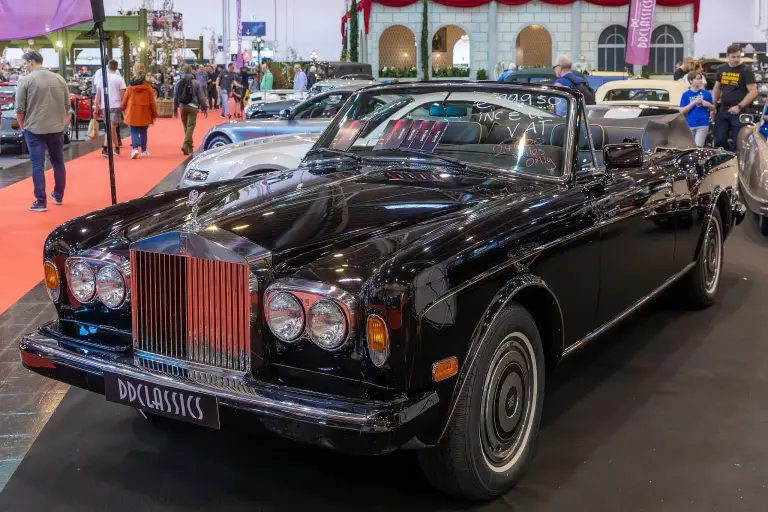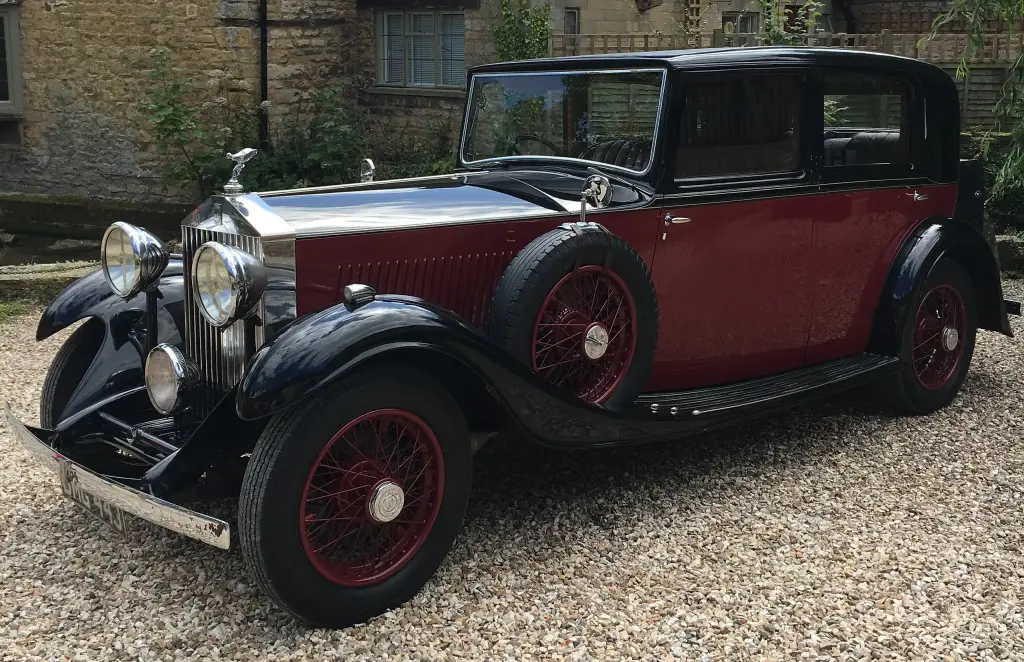
The Rolls-Royce 20/25 was the second of the company’s inter-war entry-level models. Built from 1929 to 1936, it became the most successful Rolls-Royce of the period, its 3,827 cars helping the firm survive the Great Depression, and it was replaced by the 25/30.
Rolls-Royce 20/25 at a glance
| Maker | Rolls-Royce Ltd., Derby |
|---|---|
| Production | 1929–1936 |
| Built | 3,827 |
| Engine | inline six, 3,699 cc (226 cu in) |
| Bore and stroke | 82 mm × 114 mm (3.2 in × 4.5 in) |
| RAC rating | 25.4 hp |
| Gearbox | four-speed; synchromesh on third and top from 1932 |
| Suspension | semi-elliptic leaf springs, hydraulic dampers |
| Brakes | four-wheel, mechanical servo driven from the gearbox |
| Wheelbase | 3,355 mm (11 ft 0 in) from 1930 |
| Fuel tank | 64 litres, 82 litres from 1932 |
| Top speed | 76.27 mph (122.7 km/h), Autocar test of 1935 |
This page is based on English Wikipedia only, so the figures could not be checked against a second source.
History of the Rolls-Royce 20/25
Origin
The 20/25 replaced the Rolls-Royce Twenty introduced in 1922 and aimed at the same owner-driver market. The project was code-named Goshawk and its goal was more power: the bore grew from 3.00 to 3.25 in (76.2 to 82.6 mm) while the stroke stayed at 4.5 in (114.3 mm), raising capacity by 17 per cent from 191 to 224 cu in (3,128 to 3,675 cc) and the RAC rating to 25.4 hp. The new model was shown at the 1929 Olympia Motor Show and became the company’s greatest inter-war success, with more than twice as many built as the larger Phantom II.
Engineering
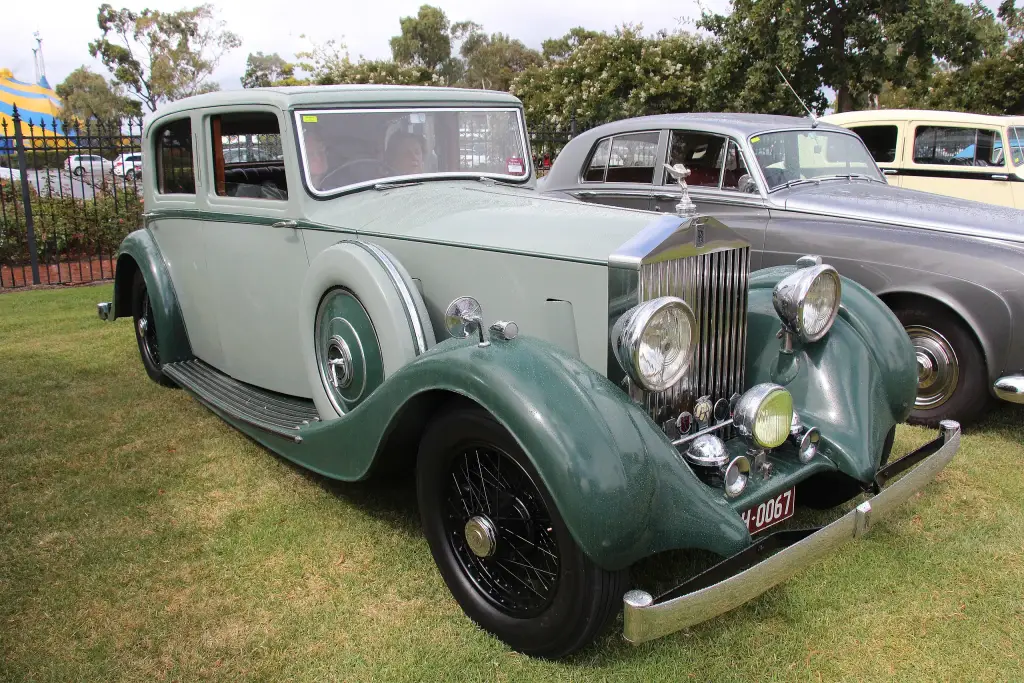
Under the bonnet was an inline six with pushrod-operated overhead valves, a separate cast-iron block and aluminium crankcase, a detachable cast-iron six-plug head and a seven-bearing crankshaft with vibration damper. Ignition used independent coil and standby magneto systems and a 12-volt battery. The famous radiator with its triangular top and vertical louvres had shutters that could be adjusted from the dashboard on early cars and were controlled thermostatically from 1931. Fuel came from a rear tank through an Autovac vacuum pump, and from 1933 there was an electric fuel gauge. The four-speed gearbox had synchromesh on third and top from 1932, and the chassis used semi-elliptic springs with hydraulic dampers and a mechanical servo for the four-wheel brakes.
Constant development
Rolls-Royce issued 36 technical releases during the run. The 1930 cars gained flexible engine suspension, a 5.25:1 compression ratio and a longer 3,355 mm wheelbase. In 1932 came centralised chassis lubrication, a high-lift camshaft, double-acting dampers, a deeper radiator, thermostatic shutters, synchromesh and a two-rate charging system. A Nitralloy crankshaft and a silent second gear arrived in 1933, single-jet carburation and Ride Control in 1934, and a voltage-controlled generator in 1935. The final 1936 cars had a Borg & Beck clutch, hypoid rear axle and Marles cam-and-roller steering.
Road test
Autocar tested a Hooper closed-coupled sports saloon in June 1935: 0–50 mph through the gears in 21.0 seconds, 0–60 mph in 31.4 seconds and a best timed speed of 76.27 mph (122.7 km/h), with maximum speeds of 18, 32, 53 and 76 mph in the four gears. Driven hard the car used 14 mpg. The engine and chassis were designed for owner-drivers and ideally for a saloon or coupé body, but many cars received larger, heavier limousine coachwork, which impaired performance.
Saving the company and the Derby Bentley
The 20/25’s popularity helped Rolls-Royce through the 1930s. It also allowed the company to make quick use of its 1931 purchase of Bentley Motors: with the Bentley 8 Litre dropped because it overlapped the Phantom II, Rolls-Royce built a new Bentley on the 20/25 engine and on a chassis developed for a cancelled 2¾-litre economy Rolls-Royce. That car became the Bentley 3½ litre, the first of the Derby Bentleys. In 1936 the 20/25 gave way to the 25/30, whose bore grew to 3.5 in (88.9 mm); in 1938 the 25/30 received a new chassis with independent front suspension and became the Wraith.
Design and features
- Most successful inter-war model: 3,827 built, more than twice the Phantom II.
- 3.7-litre six: 82 × 114 mm, 25.4 hp RAC rating and a seven-bearing crankshaft.
- Continuous update: 36 technical releases, from thermostatic radiator shutters to synchromesh.
- Owner-driver car: designed for saloon and coupé bodies, though many were fitted with heavy limousine coachwork.
- Bentley connection: its engine and a cancelled Rolls-Royce chassis produced the first Derby Bentley.
Rolls-Royce 20/25 versions
- 1929–1930: 5.25:1 compression and, from 1930, a 3,355 mm wheelbase.
- 1932 specification: synchromesh, thermostatic shutters, centralised lubrication and an 82-litre tank.
- 1934–1936: Ride Control, Nitralloy crankshaft and Marles steering.
- Coachbuilt bodies: saloons, coupés and limousines by Hooper and other coachbuilders.
- Bentley 3½ litre: the Derby Bentley built on the 20/25 engine.
The 20/25 replaced the Twenty and was succeeded by the 25/30. More cars are in the Rolls-Royce collection.
Sources
- Rolls-Royce 20/25, English Wikipedia: origin, engineering, yearly changes, road test, Bentley link