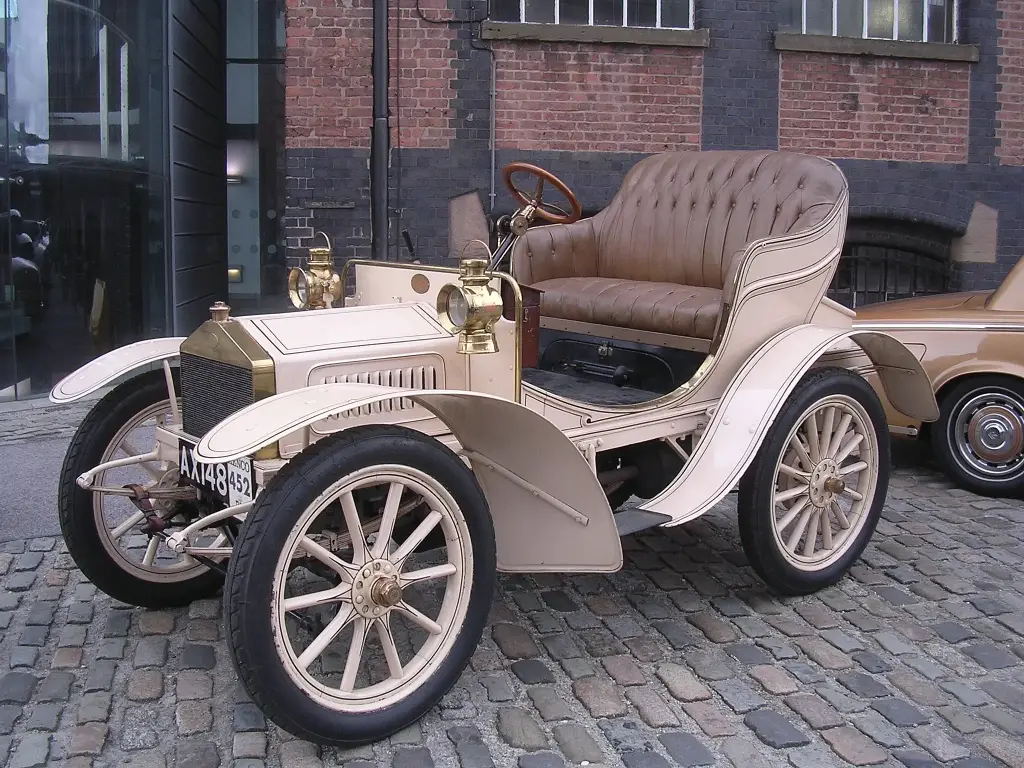
The Rolls-Royce 10 hp was the first car produced as a result of the agreement of 23 December 1904 between Charles Rolls and Henry Royce, and the first to carry the Rolls-Royce name. Royce’s company built it in Manchester and Rolls’s dealership sold it for £395.
Rolls-Royce 10 hp at a glance
| Maker | Royce Ltd., Cooke Street, Hulme, Manchester |
|---|---|
| Sold by | C.S. Rolls & Co. |
| Production | 1904–1906 |
| Engine | water-cooled twin, 1,800 cc, enlarged to 1,995 cc |
| Output | 12 hp (9 kW) at 1,000 rpm |
| Top speed | 39 mph (63 km/h) |
| Wheelbase | 75 in (1,905 mm) |
| Track | 48 in (1,219 mm) |
| Brakes | transmission brake behind the gearbox; drums on the rear axle |
| Price | £395 |
| Bodies | chassis only, Barker recommended |
| Built | 16, against 20 planned |
This page is based on English Wikipedia only, so the figures could not be checked against a second source.
History of the Rolls-Royce 10 hp
The agreement of 1904
The 10 hp was the first car to be produced as a result of the agreement of 23 December 1904 between Charles Rolls and Henry Royce, and the first to be badged as a Rolls-Royce. It was made by Royce’s company, Royce Ltd., at its Cooke Street factory in Hulme, Manchester, and sold exclusively through Rolls’s motor dealership, C.S. Rolls & Co., at a price of £395. The car was exhibited at the Paris Salon in December 1904 together with 15 hp and 20 hp cars and the engine for the 30 hp models.
From the Royce 10
The 10 hp was a development of Henry Royce’s first car, the Royce 10, of which he had built three prototypes in 1903. That car was itself based on a second-hand Decauville that Royce correctly believed he could improve, and in particular he succeeded in making his car significantly quieter than existing cars. The Rolls-Royce version replaced the Royce’s flat-topped radiator with one with a triangular top, a shape that would appear on all subsequent cars of the marque.
Engineering
The engine was a water-cooled twin of 1,800 cc, enlarged to 1,995 cc on later cars, with overhead inlet and side exhaust valves and an improved crankshaft. It produced 12 hp (9 kW) at 1,000 rpm and gave the car a top speed of 39 mph (63 km/h). A transmission brake behind the gearbox was operated by the foot pedal, while internal expanding drum brakes on the back axle were worked by the handbrake lever. Springing was by semi-elliptic leaf springs on both axles. The car was small, with a wheelbase of 75 in (1,905 mm) and a track of 48 in (1,219 mm).
Sixteen cars
Rolls-Royce intended to make 20 of the cars, but only 16 were built, as a twin-cylinder engine was thought not appropriate for the marque; the last 10 hp was made in 1906. Rolls-Royce did not supply the coachwork: the cars were sold in chassis form for the customer to arrange his own body, with Barker recommended.
Survivors
Four cars are believed to survive. The oldest, a 1904 car registered U44, chassis 20154, was sold for £3.2 million (about £3.6 million after commission and taxes) to a private collector by Bonhams in December 2007. AX 148 of 1905, chassis 20162, belongs to the UK Science Museum Collection and is usually on display at the Manchester Museum of Science and Industry, and SU 13, chassis 20165 of 1907, belongs to Bentley Motors. A fourth car, chassis 20159, is believed to be in a private collection.
Design and features
- First Rolls-Royce: the first car built under the Rolls–Royce agreement of December 1904 and the first to carry the badge.
- Triangular radiator: the shape introduced on this car appeared on every later Rolls-Royce.
- A quiet twin: developed from Royce’s own car, which was notably quieter than its contemporaries.
- Chassis only: bodies came from outside coachbuilders, with Barker the recommended firm.
- Rarity: 16 built against 20 planned, and four are thought to survive.
Rolls-Royce 10 hp versions
- Early cars: the 1,800 cc twin-cylinder engine.
- Later cars: engine enlarged to 1,995 cc.
- Chassis sales: delivered without bodywork, Barker recommended as coachbuilder.
- Surviving cars: U44 (1904), AX 148 (1905), SU 13 (1907) and chassis 20159.
The 10 hp began the line that continued with the Twenty and the 20/25. More cars are in the Rolls-Royce collection.
Sources
- Rolls-Royce 10 hp, English Wikipedia: origin, engineering, production, survivors