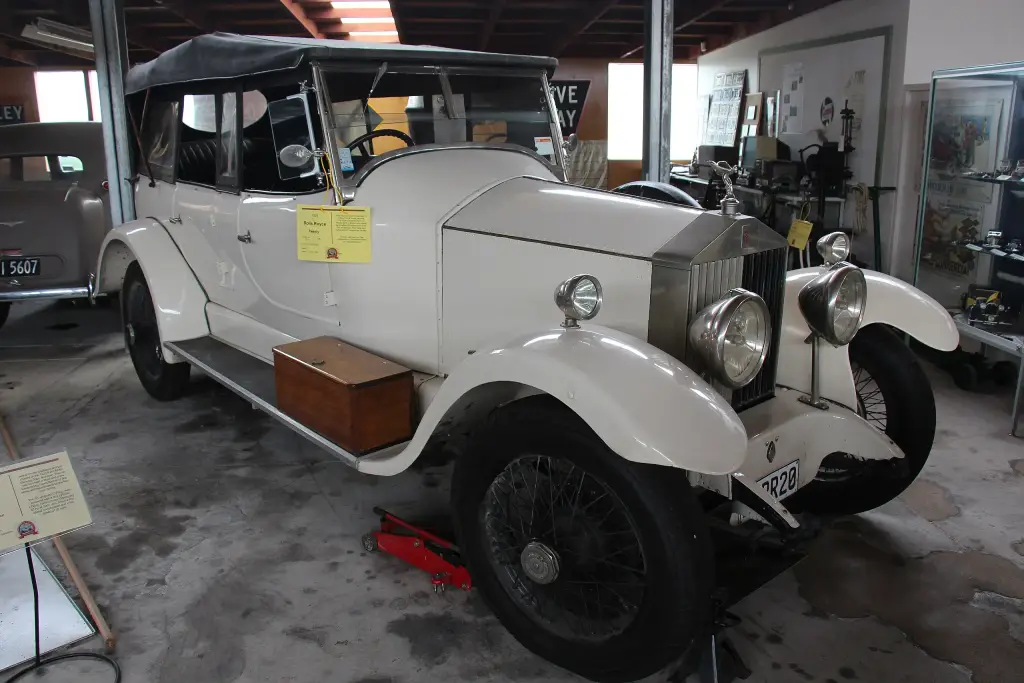
The Rolls-Royce Twenty was the company’s ‘small car’ for the 1920s, built from 1922 to 1929 alongside the 40/50 Silver Ghost and its successor, the Phantom. It was intended to appeal to owner-drivers, though many were sold to customers with chauffeurs.
Rolls-Royce Twenty at a glance
| Maker | Rolls-Royce Ltd., Derby |
|---|---|
| Production | 1922–1929 |
| Engine | inline six, 3,127 cc |
| Bore and stroke | 76 mm × 114 mm |
| Valve gear | overhead valves, one-piece cylinder block with detachable head |
| Ignition | coil and magneto |
| Gearbox | three-speed, four-speed from 1925 with right-hand change |
| Brakes | rear only at first; four-wheel with mechanical servo from 1925 |
| Suspension | rigid axles, half-elliptic springs |
| Chassis | rigid axles on half-elliptic springs, propeller shaft drive |
| Chassis price | £1,100 in 1920 |
| Top speed | 60 mph (97 km/h) with recommended coachwork |
This page is based on English Wikipedia only, so the figures could not be checked against a second source.
History of the Rolls-Royce Twenty
A Rolls for the owner-driver
The Twenty was Rolls-Royce’s small car for the 1920s, produced from 1922 to 1929 alongside the 40/50 Silver Ghost and the Phantom that succeeded it. It was intended to appeal to owner-drivers, but many cars were nevertheless sold to customers with chauffeurs.
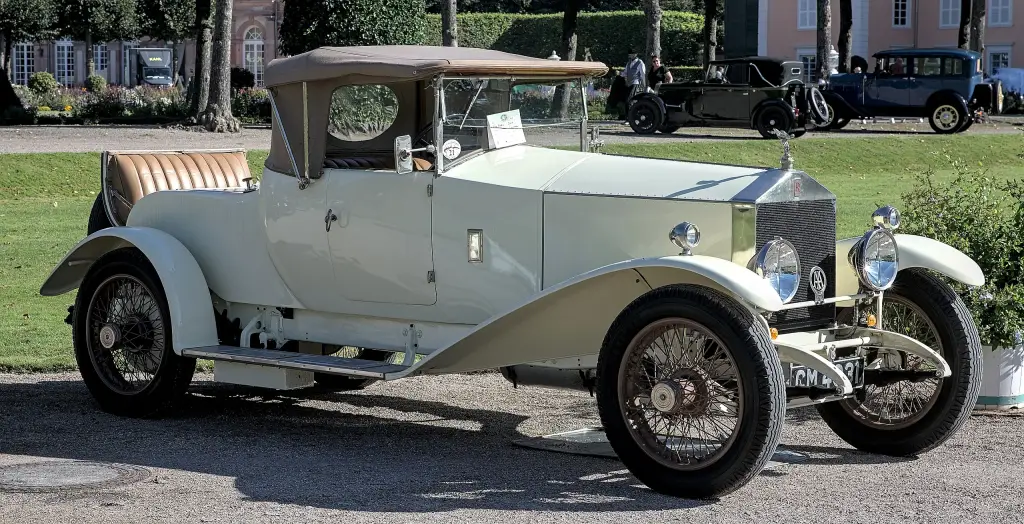
Engineering
A new inline six with overhead valves was designed for the car, of 3,127 cc with a bore of 76 mm and a stroke of 114 mm. Unlike the Silver Ghost engine, the cylinders were cast in one block and the cylinder head was detachable. Both coil and magneto ignition were fitted. Early cars had three-speed manual gearboxes with the lever in the centre of the car, changed in 1925 to a four-speed unit with the traditional right-hand change. Power reached the rear axle through a standard propeller shaft with a universal joint at each end, rather than the torque tube used on the 40/50 chassis.
Chassis and brakes
The substantial chassis had rigid front and rear axles on half-elliptic springs. Braking was at first on the rear wheels only; four-wheel brakes with a mechanical servo were introduced in 1925. The famous Rolls-Royce radiator with a triangular top was fitted, and early examples had enamel-finished horizontal slats, later changing to a nickel finish and finally to vertical slats. In 1920 a chassis cost £1,100, and a complete tourer typically cost around £1,600. With coachwork to the factory’s recommended weight the car could reach 60 mph (97 km/h), but many owners fitted large limousine bodies, with the inevitable effect on performance.
Bodywork and fame
Only the chassis and mechanical parts were made by Rolls-Royce; the body was made and fitted by a coachbuilder chosen by the owner, among the most famous Barker, Park Ward, Thrupp & Maberly, Mulliner and Hooper. The Twenty appeared in films including The Battle of the Sexes (1959), The Abominable Dr. Phibes (1971) and Candleshoe (1977).
Design and features
- Small Rolls: the 1920s model for owner-drivers, sold alongside the Silver Ghost and Phantom.
- 3.1-litre six: a new overhead-valve engine with a one-piece block and detachable head.
- Dual ignition: both coil and magneto were fitted.
- Brakes that improved: rear-wheel braking at first, four-wheel servo brakes from 1925.
- Coachbuilt: chassis only, with bodies by Barker, Park Ward, Mulliner and others.
Rolls-Royce Twenty versions
- Early cars (1922–1925): three-speed gearbox with a central lever and rear-wheel brakes.
- From 1925: four-speed gearbox with right-hand change and four-wheel servo brakes.
- Radiator finish: enamel horizontal slats, later nickel and finally vertical slats.
- Coachbuilt bodies: tourers, saloons and limousines by outside coachbuilders.
The Twenty was replaced by the 20/25, and its smallest ancestor was the 10 hp. More cars are in the Rolls-Royce collection.
Sources
- Rolls-Royce Twenty, English Wikipedia: engine, chassis, brakes, bodywork, film appearances