The RAF-10 “Festivāls” was the first minibus to be built in series in the Soviet Union. The Riga Automobile Factory made it from 1957 to 1959 on units of the GAZ-M20 Pobeda, and its all-metal wagon body set the pattern for the Latvian factory’s later vans.
RAF-10 at a glance
| Maker | Riga Automobile Factory (RAF), Riga |
|---|---|
| Production | 1957–1959 |
| Based on | GAZ-M20 Pobeda units |
| Body | all-metal, semi-load-bearing, wagon layout |
| Seats | 10 passengers |
| Engine location | above the front axle, between driver and front passenger |
| Roof glazing | four panes on each side |
| Top speed | 100 km/h |
| Fuel consumption | 13 litres per 100 km |
| Successor | RAF-977, from 1958 |
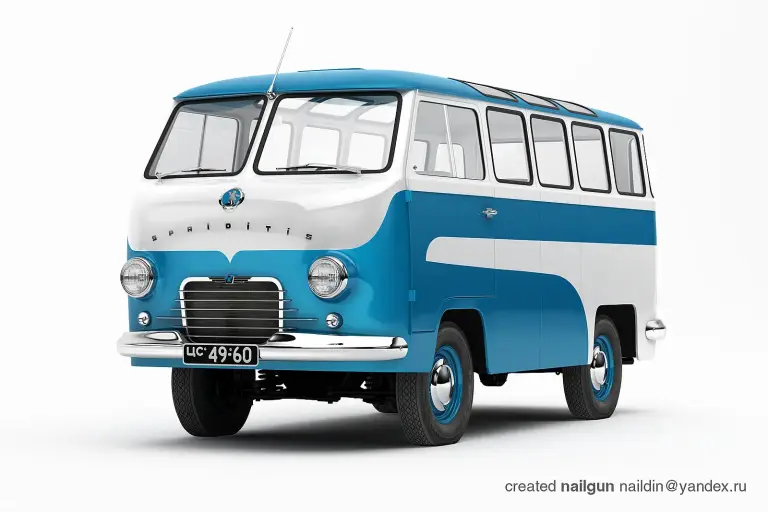
There is no English Wikipedia article on the RAF-10; this page is based on the Latvian and Russian articles. The photograph is a 3D reconstruction of the van, not an original press picture.
History of the RAF-10
RAF grew out of a bus-body works set up in Riga in 1949, which built its first 22-seat bus, the RAF-251, on the chassis of the GAZ-51 lorry. The RAF-10, which appeared in 1957, was a different kind of vehicle: a small van with a fully metal, semi-load-bearing body in the wagon layout, using the engine, transmission, front and rear axles, steering and wheels of the GAZ-M20 Pobeda. The name Festivāls was chosen for the sixth World Festival of Youth and Students, held in Moscow in 1957, and the number ten in the model name stood for the ten passenger seats.
In the context of the late 1950s the RAF-10 was an unusual machine. Its body had four glazed panes in each side of the roof, following the fashion of the period, and the engine sat above the front axle with its cover between the driver and the front passenger, unlike some foreign rivals that put the engine at the rear. The factory intended the van mainly for official and service use. Although it carried half as many people as the PAZ-652A, a contemporary service bus, it was far more economical, with an average consumption of 13 litres per 100 km, faster at 100 km/h, and easier to handle in town.
After a few months RAF began building an improved version with a revised body design and a better engine cooling system. It kept the same capacity but had a new arrangement of headlamps and a new radiator grille. In 1958 the van was modernised once more and received a new designation, RAF-977, which stayed in production into the 1970s. In its short life the RAF-10 had established the pattern for the Riga minibus: a light van on passenger-car units, built for state service.
Design and features
- First Soviet series minibus: RAF was the first factory in the USSR to put a minibus into series production.
- Pobeda underpinnings: engine, gearbox, axles, steering and wheels came from the GAZ-M20.
- All-metal body: fully metal and semi-load-bearing, with a wagon layout and no separate bonnet.
- Engine over the front axle: the engine cover sat between the driver and the front passenger.
- Economical for its day: 13 litres per 100 km and a 100 km/h top speed, against the PAZ-652A service bus.
RAF-10 versions
- RAF-10 Festival (1957): the first series version, on GAZ-M20 Pobeda units.
- Modernised RAF-10 (1957–1958): revised body and cooling system, new headlamp layout and radiator grille.
- RAF-977 (1958): the further modernisation that replaced the RAF-10 and carried the line into the 1970s.
The RAF-10 was followed by the smaller RAF-8 Sprīdītis and then by the RAF-977 Latvija, the van that made the factory famous. More Riga-built vehicles are in the RAF collection.
Sources
- RAF-10, Latvian Wikipedia: production years, body, seats, equipment
- РАФ-10, Russian Wikipedia: history, name, comparison with the PAZ-652A