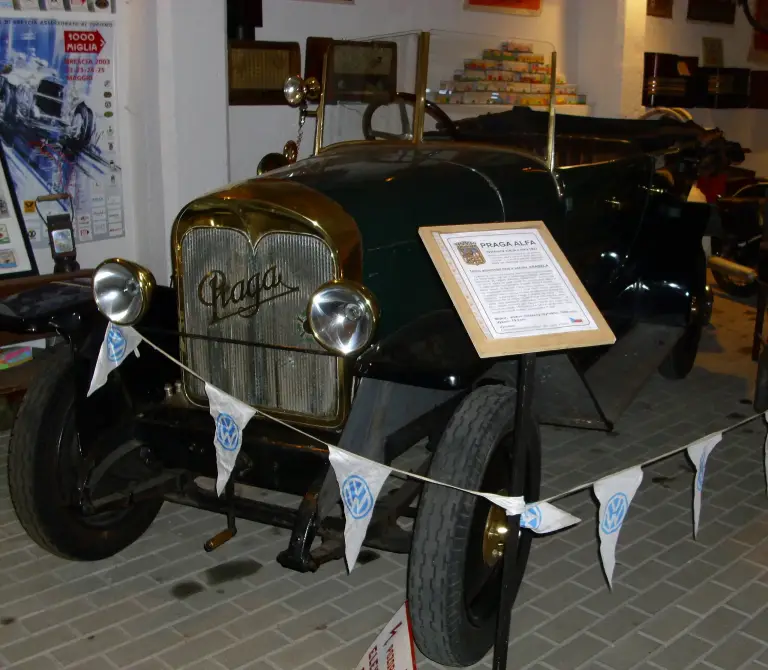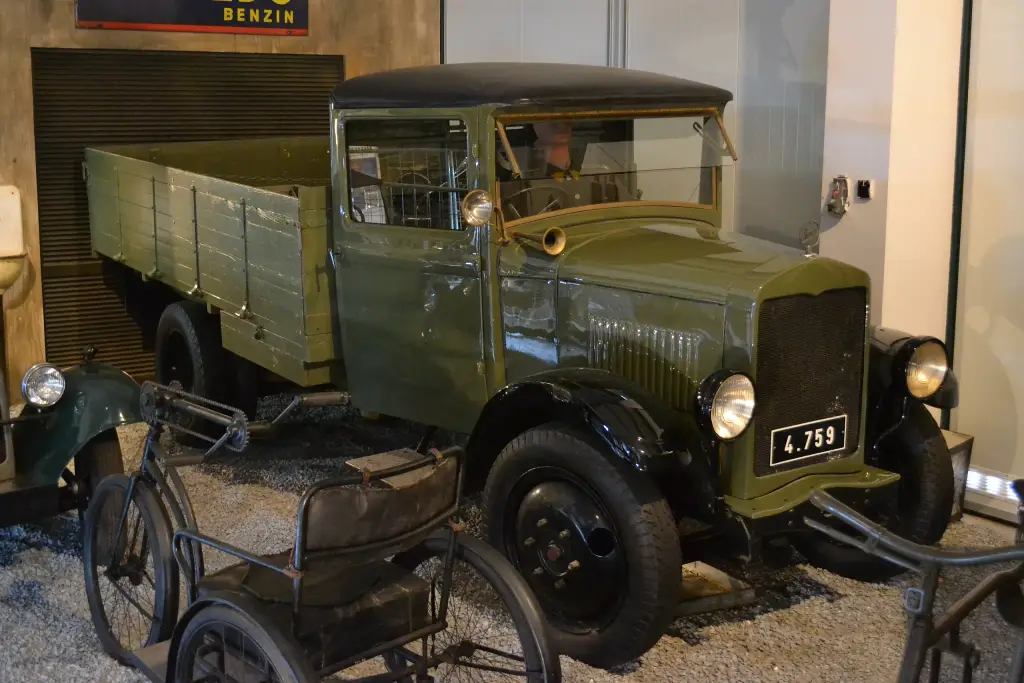
The Praga AN was the light truck and delivery van version of the Praga Alfa passenger car, built by the automobile department of the First Czech-Moravian Engineering Works in Prague-Libeň between 1924 and 1940. The chassis and the front of the car were kept, while the rear seating was replaced by a cargo platform, from 1929 available with a box body as well.
Praga AN at a glance
| Maker | Praga, Prague-Libeň, Czechoslovakia |
|---|---|
| Production | 1924–1940 |
| Based on | Praga Alfa passenger car |
| Body | flatbed; box body on request from 1929 |
| Bus version | Praga AO, 12 seats |
| Series 1–5 | 1924–1926, about 500–750 built |
| Series 6–10 | 1926–1928, about 1,100–1,110 built plus 70 buses |
| Series 11–12 | 1928–1929, about 800 built, 1,695 cc engine |
| Series 13 | 1929–1939, about 2,500 built |
| Price, series 11–12 | 55,000–58,000 Kč |
| Engine, series 11–12 | 62–70 mm bore, 1,695 cc |
| Engine, series 13 | 75 mm bore |
Built on the Czech and German Wikipedia articles, which give the same history; production figures are quoted as ranges where the sources differ.
History of the Praga AN
The Praga AN was created by taking the Praga Alfa of the day and removing its rear bodywork. The chassis and the front of the car were left unchanged, and the back was turned into a loading platform; from 1929 a closed box body could be ordered as well. A small bus with twelve seats was sold under the separate designation Praga AO, and a number of AN chassis were finished as fire engines.
The first five series, built from 1924 to 1926, were technically the same as the Alfa cars of series 5 to 11 being produced at the time; between 500 and 750 of them were made. Series 6 to 10 followed from 1926 to 1928 with the more powerful engine of the Praga Alfa series 12, and this batch accounted for about 1,100 to 1,110 trucks plus 70 Praga AO buses. The six-cylinder engine of the Alfa, however, was judged unsuitable for a working truck.
The answer was a smaller engine. Series 11 and 12 of 1928–1929 received a unit with cylinders bored out from 62 to 70 mm and a swept volume of 1,695 cm³; some 800 of these were built and they cost between 55,000 and 58,000 crowns. From 1929 the thirteenth series went further, with the bore enlarged to 75 mm, and 2,500 of these trucks were made up to 1939, with a slightly shorter chassis from 1937. In 1931 a hundred examples were built with the 2.5-litre six of the Praga Alfa series 22, and a handful of six-cylinder vehicles followed in 1934 and in 1938–1940. The engine of the AN was also fitted to the Tančík vz. 33 tankette.
Design and features
- Car-derived chassis: the Alfa’s frame and front end carried over unchanged, which kept the truck light and cheap to build.
- Two body styles: an open flatbed as standard, with a box body available from 1929.
- Bus and fire versions: the same chassis served as the twelve-seat Praga AO bus and as a fire engine.
- Long production: sixteen years of manufacture with a single basic design.
Praga AN versions
- Praga AN series 1–5 (1924–1926): Alfa running gear, about 500–750 built.
- Praga AN series 6–10 (1926–1928): the six-cylinder Alfa series 12 engine.
- Praga AN series 11–12 (1928–1929): 1,695 cc engine, about 800 built.
- Praga AN series 13 (1929–1939): 75 mm bore, about 2,500 built, shorter chassis from 1937.
- Praga AO: twelve-seat small bus on the same chassis, 70 built in 1926–1928.
- Six-cylinder batch (1931–1940): 100 trucks with the 2.5-litre Alfa 22 engine and a few later vehicles.
The AN was derived from the Praga Alfa, and the firm’s later light truck of the same class was the Praga RN. More vehicles are in the Praga collection.
Sources
- Praga AN, Czech Wikipedia: series, production numbers, engines, prices
- Praga AN, German Wikipedia: bodies, bus version, production figures