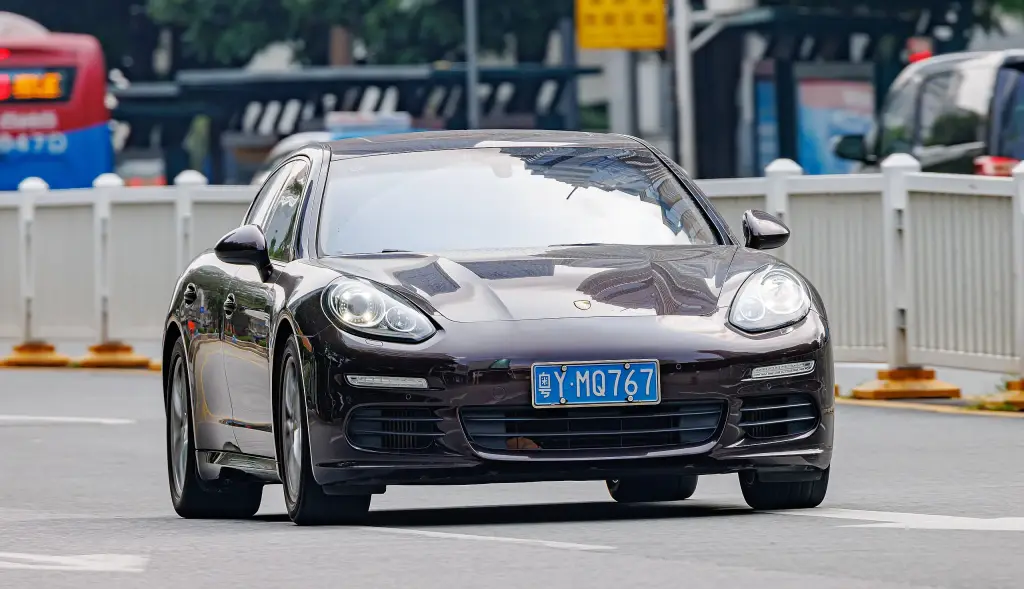
The Porsche Panamera is a mid- to full-sized luxury car made by Porsche since 2009, with its engine in front and rear- or all-wheel drive. It debuted at the Auto Shanghai show in April 2009, and it runs contrary to Porsche’s tradition of light rear-engined two-door sports cars.
Porsche Panamera at a glance
| Maker | Porsche; bodies assembled in Leipzig |
|---|---|
| Debut | Auto Shanghai, April 2009 |
| Layout | front engine, rear- or all-wheel drive |
| Class | E-segment luxury hatchback, four doors, four seats |
| Weight | about 1,800 kg |
| First V8s | 4.8-litre twin-turbo, 500 PS in the Turbo |
| V6 | 3.6 litres, 300 PS (2010) |
| Gearbox | seven-speed PDK; ZF eight-speed Tiptronic S for diesel and hybrid |
| Chassis systems | adaptive air suspension, PDCC, PASM, active anti-roll bars |
| Name | from the Carrera Panamericana race |
| Drag coefficient | 0.30 |
History of the Porsche Panamera
The name Panamera, like Carrera, comes from the Carrera Panamericana race. The car is a front-engined, full-sized, four-passenger, four-door luxury hatchback weighing nearly 1,800 kg. Its shape and profile resemble the 911’s, but where the 911 has a tight, performance-focused cabin, the Panamera offers much more space and luxury equipment.
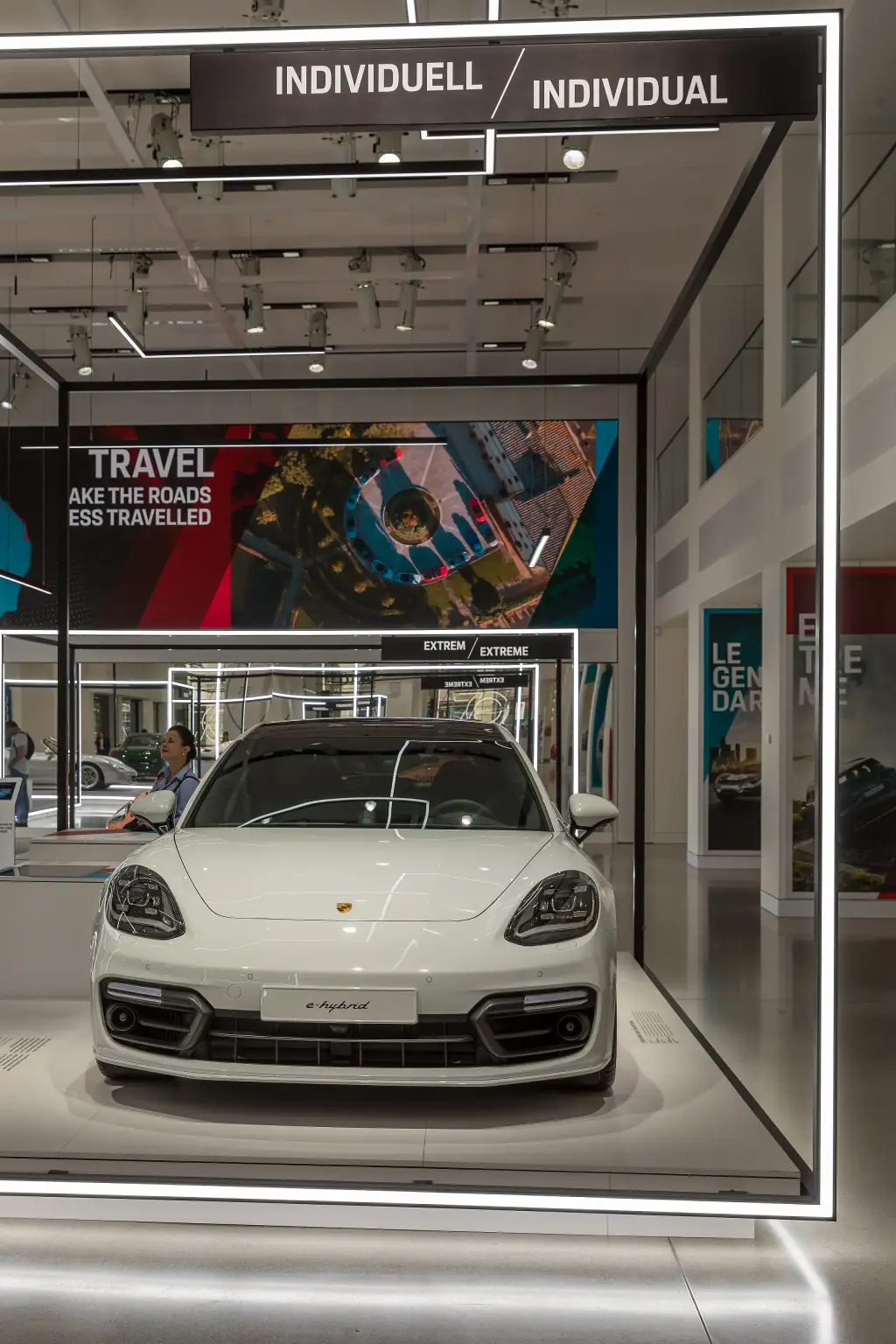
Production began in April 2009, a month after the Shanghai debut. Engines are assembled in Stuttgart, while the body is built, painted and assembled in Leipzig alongside the Cayenne and Macan; from 2009 to 2016 the bodies were built at the Volkswagen Group facility in Hannover.
The first versions, in 2009, were the V8-powered Panamera S, 4S and Turbo, the Turbo using a 4.8-litre twin-turbo V8 of 500 PS. In 2010 Porsche added the Panamera and Panamera 4 with 3.6-litre V6 engines of 300 PS. Derived from the V8, the V6 kept its direct fuel injection, infinitely variable intake camshaft adjustment with variable valve lift (VarioCam Plus), on-demand oil pump, thermal management, variable intake manifold and integrated dry-sump lubrication with two-stage oil extraction, plus an automatic start-stop function with the PDK gearbox. The Turbo had active aerodynamics with a multi-stage adjustable rear spoiler, and the optional Sport Chrono package added a Sport Plus button with tighter damping and air springs that lowered the body by 25 mm.
In 2011 the range grew with the Panamera S Hybrid, Diesel, Turbo S and GTS. The S, Hybrid and Diesel models were rear-wheel drive, while the 4, 4S, GTS, Turbo and Turbo S used Porsche Traction Management four-wheel drive. All cars had adaptive air suspension, Porsche Dynamic Chassis Control, active anti-roll bars and Porsche Active Suspension Management. The new seven-speed PDK dual-clutch gearbox was standard on the 4, 4S and Turbo, while the diesel and hybrid used the ZF eight-speed Tiptronic S shared with the Cayenne; in some markets a six-speed manual was offered on the naturally aspirated V6 and V8, with only 50 V6 and 96 V8 cars built worldwide.
The Turbo S had larger turbochargers than the Turbo, high-pressure fuel injection and aluminium pistons with low-friction-coated rings; it reached 100 km/h in 3.3 seconds with launch control. The S Hybrid of 2011 used the Cayenne S Hybrid’s drivetrain, an Audi-sourced supercharged 3.0-litre V6 of 333 PS and a 47 PS electric motor for 380 PS in total, reaching 100 km/h in 6.0 seconds and 270 km/h while emitting 193 g/km of CO2, the lowest in the Porsche range at the time. The Diesel, launched in May 2011, used the Audi 3.0-litre V6 of the Cayenne Diesel. A facelift followed at Shanghai in April 2013, the Panamera S E-Hybrid reached the United States in November 2013, the second generation arrived in 2016 and the third in November 2023.
Design and features
- Four doors, engine in front: a luxury hatchback instead of a rear-engined sports car.
- Twin-turbo V8: 500 PS in the Turbo, 521 PS in the Turbo S, with launch control.
- Chassis technology: adaptive air suspension, PDCC, PASM and active anti-roll bars.
- Hybrid and diesel: a supercharged V6 hybrid and an Audi-derived diesel V6.
Porsche Panamera versions
- Panamera S, 4S and Turbo (2009): the first V8 cars, up to 500 PS.
- Panamera and Panamera 4 (2010): 3.6-litre V6, 300 PS.
- Turbo S (2011): larger turbos, 3.3 seconds to 100 km/h.
- S Hybrid (2011): 380 PS combined, 193 g/km of CO2.
- Diesel (2011): Audi 3.0-litre V6.
- GTS (2011): 0.96 g of lateral acceleration.
The Panamera is built alongside the Porsche Cayenne in Leipzig, and it is the four-door counterpart of the Porsche 911. More cars are in the Porsche collection.
Sources
- Porsche Panamera, English Wikipedia: concept, production, first-generation models and engines