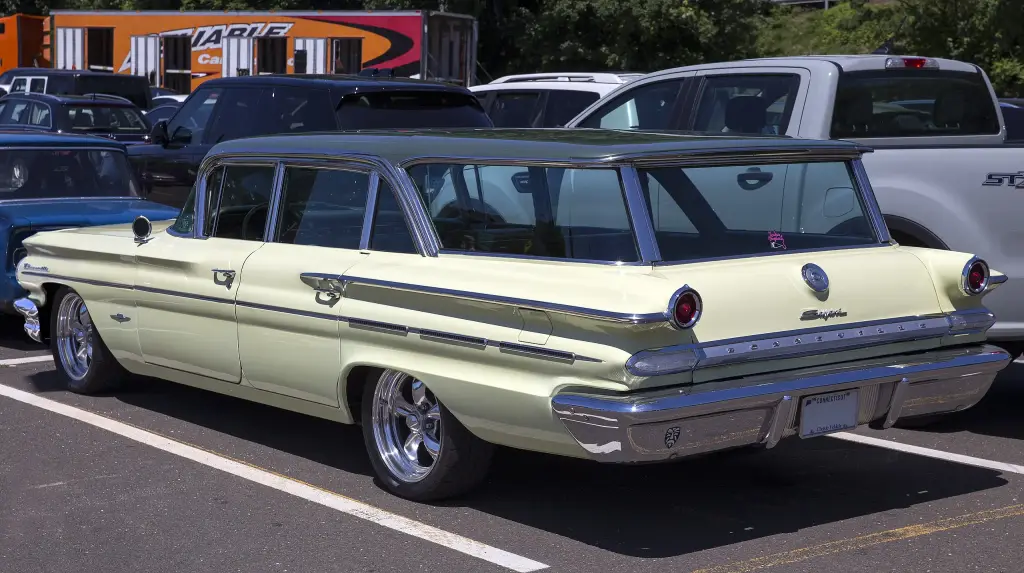
The Pontiac Safari was a line of station wagons built from 1955 to 1989. It began as Pontiac’s answer to the two-door Chevrolet Nomad, became the name for the division’s full-size wagons in 1957, and ended when Pontiac dropped full-size estates before its rivals.
Pontiac Safari at a glance
| Maker | Pontiac, General Motors |
|---|---|
| Years | 1955–1989 |
| First model | two-door sport wagon, Star Chief Custom Safari |
| First price, 1955 | $2,962 |
| 1955 engine | 287 cu in V8, 180 or 200 hp |
| 1955 output | 3,760 |
| 1956 output | 4,042 |
| 1957 change | Safari name used for all Pontiac station wagons |
| Wheelbase, 1955 | 122 in A-body, shared with the Nomad |
| Woodgrain trim | added in the mid-1960s |
| Last year | 1989 |
Based on one source: the English Wikipedia article on the Safari.
History of the Pontiac Safari
The Nomad’s cousin (1955–1957)
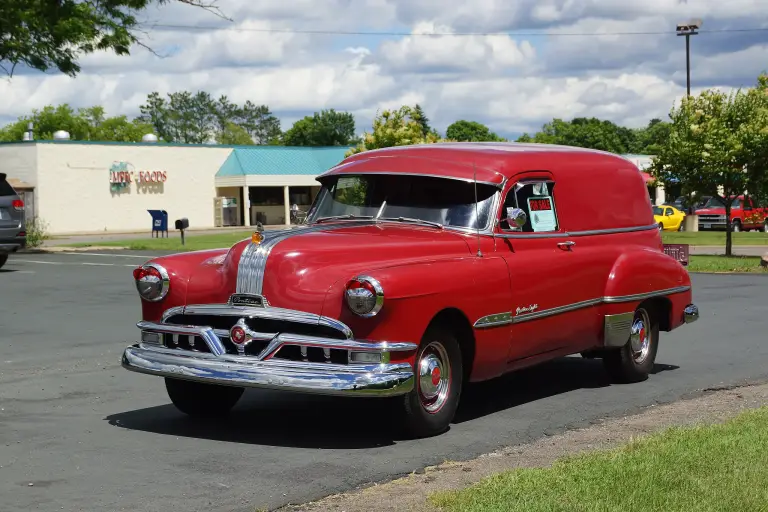
The first Safari was developed as Pontiac’s counterpart to the Chevrolet Nomad, a two-door sport wagon that began as a 1954 Motorama concept derived from the Corvette. To cut tooling costs the design moved to the full-size A-body chassis, and the Safari shared its 122-inch wheelbase with the Nomad and its exterior bodywork with the Pontiac Chieftain. Officially it was the Star Chief Custom Safari, Series 27. It went on sale on 31 January 1955 at $2,962, the most expensive Pontiac line before options, with a Chieftain front fascia and its own tail lamps styled by Paul Gillan, who patented the front design. Unlike the standard two-door 860 Colony wagon, the Safari had coupé-style front doors, forward-raked B-pillars with windows wrapping around, extra chrome and sliding rear-seat windows; its interior came from the Star Chief sedans. The 287 cu in V8 gave 180 hp with a two-barrel or 200 hp with a four-barrel. Only 3,760 were built in 1955, the lowest-production Pontiac that year. For 1956 the bumpers and side trim were revised, two-tone paint became standard with the roof in the accent colour, and the V8 grew to 317 cu in with 227 hp as standard; output rose to 4,042. For 1957 the Safari name spread to all Pontiac station wagons, as Chieftain Safari and Super Chief Safari, while the two-door Star Chief Custom continued with a 347 cu in V8 of 270 or 290 hp and sales fell to 1,294. A four-door Safari Transcontinental joined mid-year with its own side trim and a standard roof rack, selling 1,894.
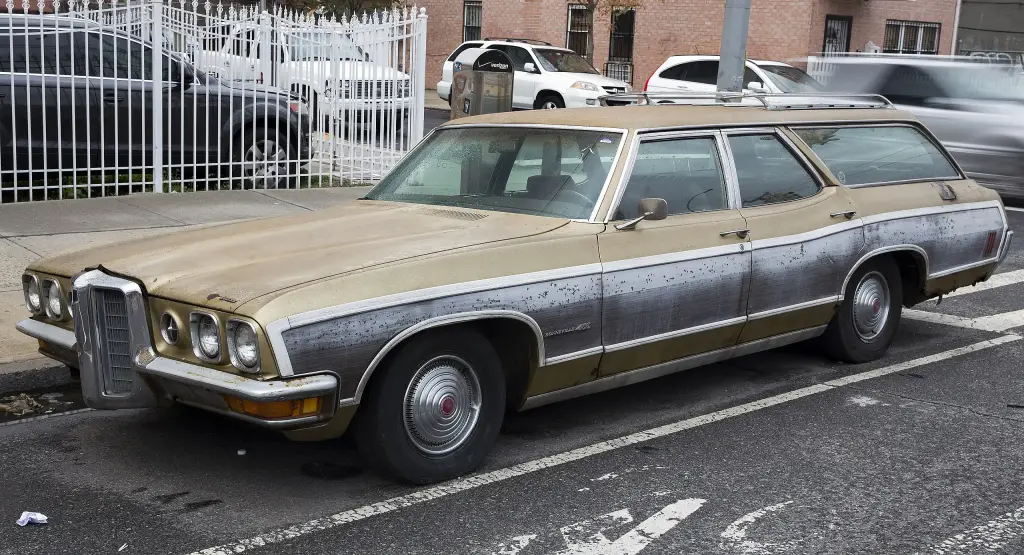
The full-size wagon years
From 1957 the Safari was the name for Pontiac’s full-size wagons and was positioned between Chevrolet’s full-size estates and the Buick and Oldsmobile equivalents. In the mid-1960s the Safari gained simulated woodgrain trim on the exterior, a feature that became associated with the line, and as GM expanded into other segments the name was used in the same way as Buick’s Estate and Oldsmobile’s Cruiser: the best-trimmed wagon in each range. The name also appeared on the Executive Safari and on Catalina, Bonneville and Grand Safari wagons.
The end
After 1989 Pontiac became the first GM division to drop its full-size wagons, as demand was taken over by minivans and the divisional models overlapped. For 1990 the Trans Sport arrived as Pontiac’s first minivan, and after 1991 the Safari name and Pontiac station wagons disappeared altogether, while the GMC Safari van continued to 2005.
Design and features
- Nomad twin: a two-door sport wagon on the same A-body chassis as the Chevrolet Nomad.
- Wraparound glass: forward-raked B-pillars and sliding rear windows.
- Most expensive Pontiac of 1955: $2,962 before options.
- Woodgrain: simulated timber trim from the mid-1960s, a Safari trademark.
- Top trim of every wagon range: used like Buick’s Estate and Oldsmobile’s Cruiser.
Pontiac Safari versions
- Star Chief Custom Safari (1955–1957): the two-door sport wagon.
- Safari Transcontinental (1957): the four-door with roof rack.
- Chieftain and Super Chief Safari (1957): the new full-size wagon range.
- Catalina, Bonneville and Executive Safari: later full-size wagon versions.
- Grand Safari (1973–1975): the Grand Ville-based estate.
The Safari was the wagon version of the Catalina and the Bonneville, and its role passed to the Trans Sport. More Pontiacs are in the Pontiac collection.
Sources
- Pontiac Safari, English Wikipedia: early sport wagons, name spread, end