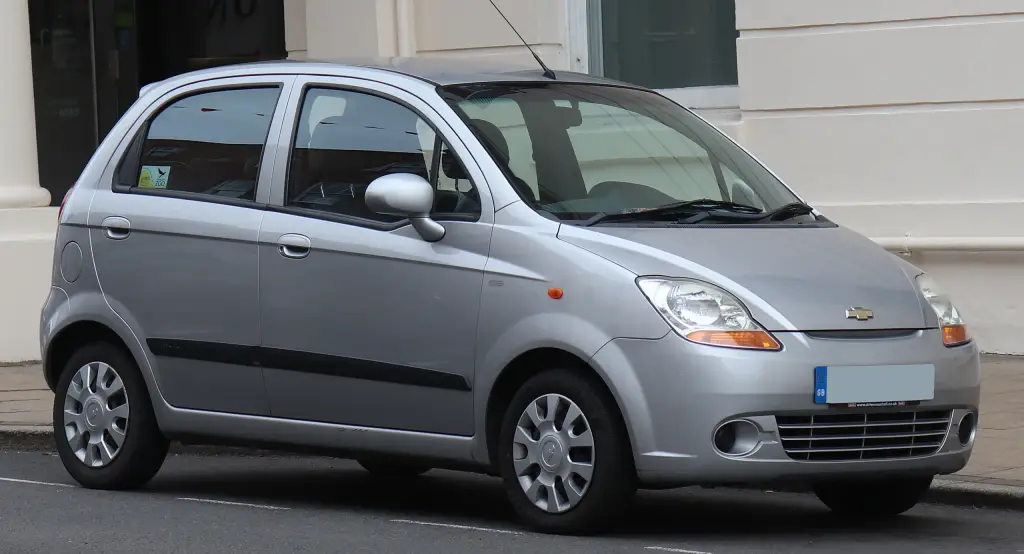
The Pontiac Matiz was Pontiac’s badge on the Daewoo Matiz, the city car developed by Daewoo and built from 1998. After General Motors bought Daewoo in 2002 the same car was sold under several GM marques, including Pontiac, and later became the Chevrolet Spark.
Pontiac Matiz at a glance
| Maker | Daewoo / GM Korea, sold by Pontiac |
|---|---|
| Original model | Daewoo Matiz, 1998 |
| Design | based on the 1993 Italdesign Lucciola concept |
| Class | city car |
| Width | narrow, set by Japanese kei-car tax rules |
| Engine | 0.8 L three-cylinder, 51 hp |
| Consumption | 6.4 L/100 km combined |
| Top speed | 144 km/h |
| 0–100 km/h | 17 seconds |
| Trim levels | E, S and SE |
Based on one source: the English Wikipedia article on the Chevrolet Spark, which covers the Matiz generations. The record’s original picture is kept.
History of the Pontiac Matiz
A Daewoo city car
Production of the Daewoo Matiz began in 1998, with the car sold in Korea and many European markets and designated M100 internally. Its exterior was based on the Italdesign Lucciola, a 1993 concept developed by Fabrizio Giugiaro from the 1992 Cinquecento study and rejected by Fiat. The 0.8 litre engine and transmission were carried over from the Daewoo Tico, itself a licensed Suzuki Alto, which is why the car is so narrow: the width followed Japanese kei-car tax rules. Engineering was done at Daewoo’s Worthing technical centre in England. The Matiz became Daewoo’s best-selling model in Europe and in India for the next four years.
The 0.8 litre car
The first Matiz had only a 0.8 litre straight-three derived from the Suzuki F8B and developed by Tickford in Milton Keynes, producing 51 hp and 68.5 N·m, with combined consumption of 6.4 L/100 km, a top speed of 144 km/h and 0–100 km/h in 17 seconds. It came in E, S and SE trim; the SE had air conditioning, wheel covers, body-coloured bumpers, a rear spoiler, fog lights and a stereo, with roof rails, power steering, central locking, electric front windows, anti-lock brakes and a driver’s airbag optional. Some markets also got an automatic.
Facelift and the GM years
The M150 facelift was designed at Worthing and introduced in Korea in late 2000, exported from 2001. Its front structure was modified for a four-cylinder engine, the 1.0 litre S-Tec, which arrived after GM’s takeover of Daewoo in 2002. The car was built in Uzbekistan until 2018 and sold in Russia as the Ravon Matiz; in China it was the Chevrolet Lechi. The Chery QQ3 became the centre of a copyright dispute when GM claimed it copied the Matiz so closely that the doors were interchangeable. A second generation arrived in 2005, and the line eventually became the Chevrolet Spark.
Design and features
- Italdesign shape: derived from the rejected Fiat Cinquecento study.
- Kei-car width: narrow body inherited from the Suzuki Alto-based Tico.
- Three-cylinder engine: 0.8 litres, 51 hp, 6.4 L/100 km combined.
- Simple trim ladder: E, S and SE, with air conditioning on the top car.
- Global badge engineering: sold as Daewoo, Chevrolet, Pontiac, Ravon and more.
Pontiac Matiz versions
- M100 (1998–2000): the original 0.8 litre car.
- M150 (2000–2005): the Worthing-designed facelift.
- SE trim: the best-equipped original version.
- 1.0 S-Tec: the four-cylinder engine added under GM.
The Matiz was the smallest car in the Pontiac range alongside the G3, and it shared its market with the Firefly. More Pontiacs are in the Pontiac collection.
Sources
- Chevrolet Spark, English Wikipedia: Matiz origins, engines, facelift