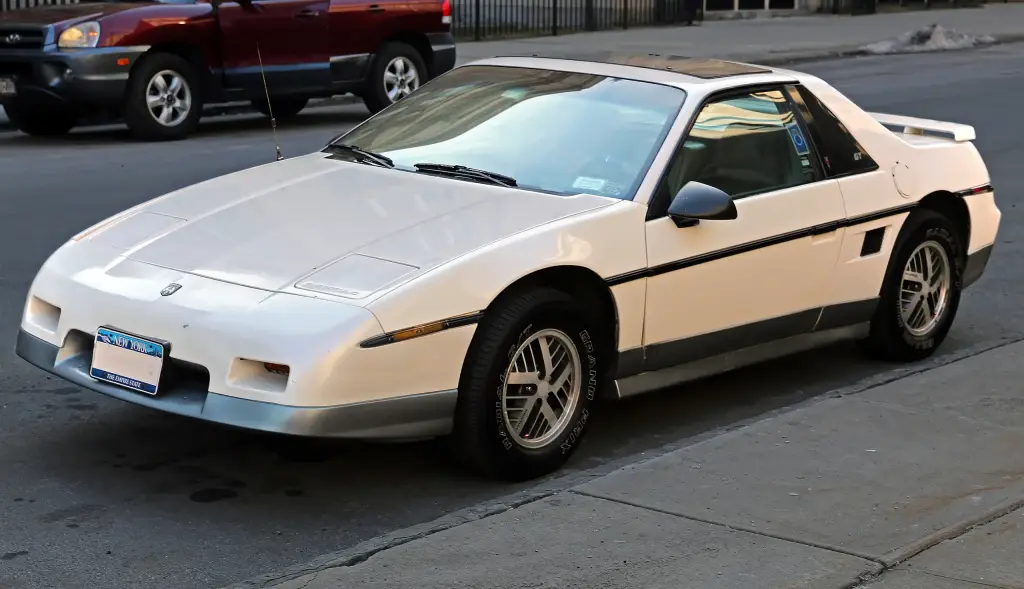
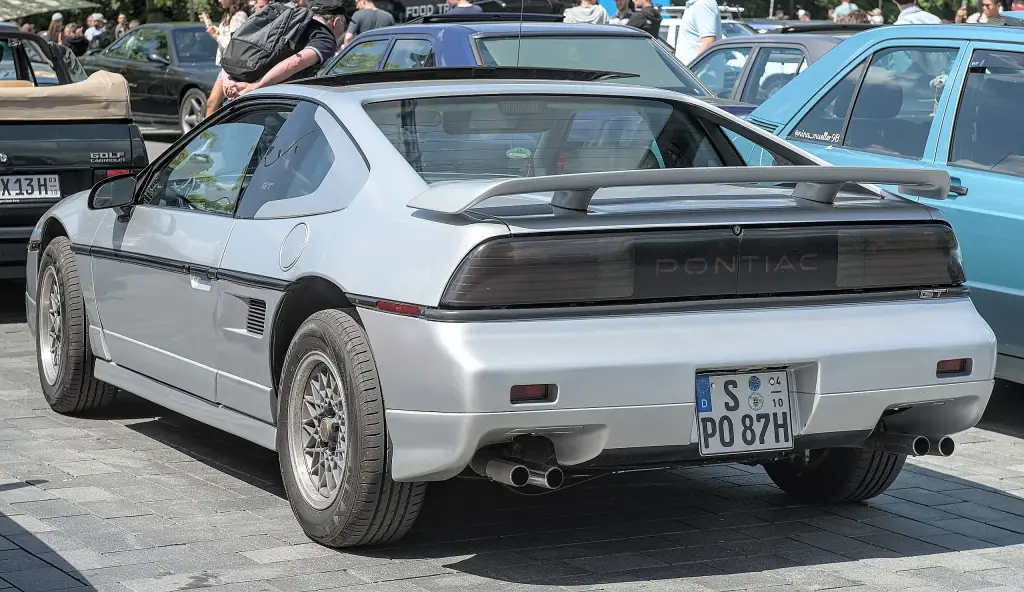
The Pontiac Fiero was a rear mid-engine, lightweight car sold for model years 1984 to 1988. It was Pontiac’s first two-seater since its 1926–1938 coupes and the first mass-produced rear mid-engine car from any American manufacturer.
Pontiac Fiero at a glance
| Maker | Pontiac, General Motors |
|---|---|
| Model years | 1984–1988 |
| Layout | rear mid-engine, rear-wheel drive |
| Body | non-load-bearing composite panels over a space frame |
| Engine, 1984 | 2.5 L Iron Duke four-cylinder |
| Gearbox | four-speed manual or three-speed automatic |
| Fuel economy | 31 mpg city, 50 mpg highway with the economy axle |
| Developed by | Hulki Aldikacti |
| Plant | Pontiac, Michigan |
| Total built | 370,168 |
| Honours | Car and Driver Ten Best 1984; Indy 500 pace car 1984 |
Based on one source: the English Wikipedia article on the Fiero.
History of the Pontiac Fiero
A commuter car with two seats
The Fiero was conceived in 1978 by young Pontiac engineers as a small two-seat sports car with new suspension and a V6. GM management opposed a two-seater that might compete with the Corvette, so the concept was sold as a fuel-efficient four-cylinder commuter car that happened to have two seats. A running prototype was built in less than six months and the project was approved. The oil crisis became the market opportunity: the car was redesigned around a fuel-efficient version of GM’s 2.5 litre Iron Duke four, capable of 31 mpg in the city and 50 mpg on the highway with the economy-ratio transmission, although the three-speed automatic cut highway economy to 32 mpg.
Engineering against the odds
Pontiac put Hulki Aldikacti, a Turkish-born executive with more than twenty years of experience, in charge. The budget from design to plant retooling was 400 million dollars, a fraction of a typical GM programme. Aldikacti had to work around GM’s split between car engineers and manufacturing engineers, and eventually sat the two teams next to each other. Cost pressure forced metal body pieces instead of the plastic panels he wanted, and the aluminium V6 was dropped because a new engine would have more than doubled the cost of the car; the Iron Duke stayed. Aldikacti was told three times by counterparts at other divisions that the project had been cancelled, but it survived with backing from William Hoglund, who became Pontiac’s chief in 1980 and wanted exciting, different cars. To reach 100,000 cars a year he reopened a closed plant in Pontiac, Michigan, where management and labour worked without the robots GM executives wanted. Hourly workers chose the name: “fiero” means proud, fierce or bold in Italian and wild or ferocious in Spanish.
What the car became
A mid-engine layout was chosen to cut drag and weight, improve fuel economy, and help handling, traction and braking. The performance potential was not realised at launch, because cost savings replaced the original brake and suspension designs with existing components, and the car was criticised for modest performance, reliability and safety. Pontiac revised the design through its life, adding a V6 and improving the chassis, but sales fell steadily and the Fiero was dropped after 1988. The 2M4 version made Car and Driver’s Ten Best list for 1984 and served as the Indianapolis 500 pace car that year.
Design and features
- Mid-engine layout: chosen for weight, drag and handling, a first for a mass-produced American car.
- Composite panels: non-load-bearing plastic body panels over a separate structure kept weight down.
- Iron Duke economy: up to 50 mpg on the highway with the economy axle.
- Low budget: 400 million dollars from design to retooling.
- Worker-chosen name: the Italian and Spanish word for proud and fierce.
Pontiac Fiero versions
- Fiero 2M4 (1984): two-seat, mid-engine, four-cylinder base car.
- Fiero GT (from 1985): the faster version with the V6.
- Economy-ratio cars: the high-geared version quoted at 50 mpg on the highway.
- Automatic cars: three-speed automatic, 32 mpg on the highway.
The Fiero shared the showroom with the Firebird and the Sunbird. More Pontiacs are in the Pontiac collection.
Sources
- Pontiac Fiero, English Wikipedia: development, engineering, production