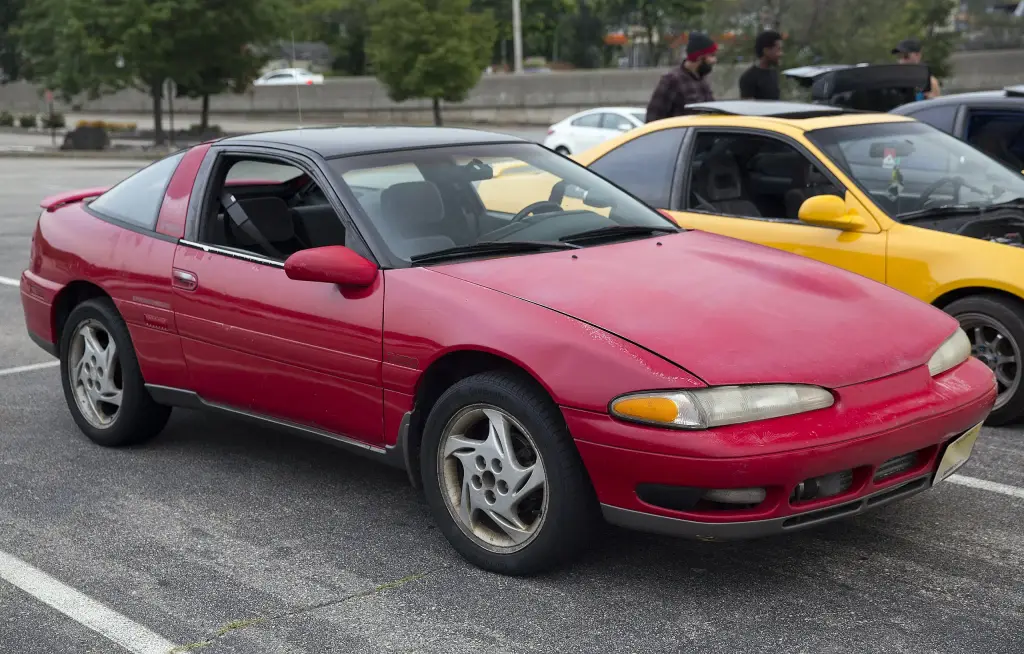
The Plymouth Laser is a two-door 2+2 sports coupe sold by Plymouth from 1989 until 1994. The Laser and its siblings, the Mitsubishi Eclipse and the Eagle Talon, were the first cars built by Diamond-Star Motors, the joint venture between Chrysler and Mitsubishi.
Plymouth Laser at a glance
| Maker | Diamond-Star Motors for Plymouth |
|---|---|
| Sold | 1989–1994, from January 1989 as a 1990 model |
| Body | two-door 2+2 hatchback coupe |
| Base engine | 1.8 L four, 92 hp |
| RS engine | 2.0 L 16-valve DOHC four, 135 hp |
| RS Turbo engine | 2.0 L turbo four, 195 hp |
| Gearboxes | five-speed manual standard, four-speed automatic optional |
| Drive | front-wheel drive; all-wheel drive from 1992 |
| Sister cars | Mitsubishi Eclipse, Eagle Talon |
| Award | Car and Driver Ten Best, 1989–1992 (Laser Turbo) |
History of the Plymouth Laser
Advertised as “the first Plymouth of the ‘90s”, the Laser debuted in January 1989 as a 1990 model. The two-door hatchback took over a name that Chrysler had used on a Dodge Daytona-based model from 1984 to 1986. With three engines, two transmissions and sporty aero styling, it was the most performance-oriented Plymouth since the Barracuda, Duster and Road Runner of the 1970s, and Tina Turner appeared in the 1990 commercials.
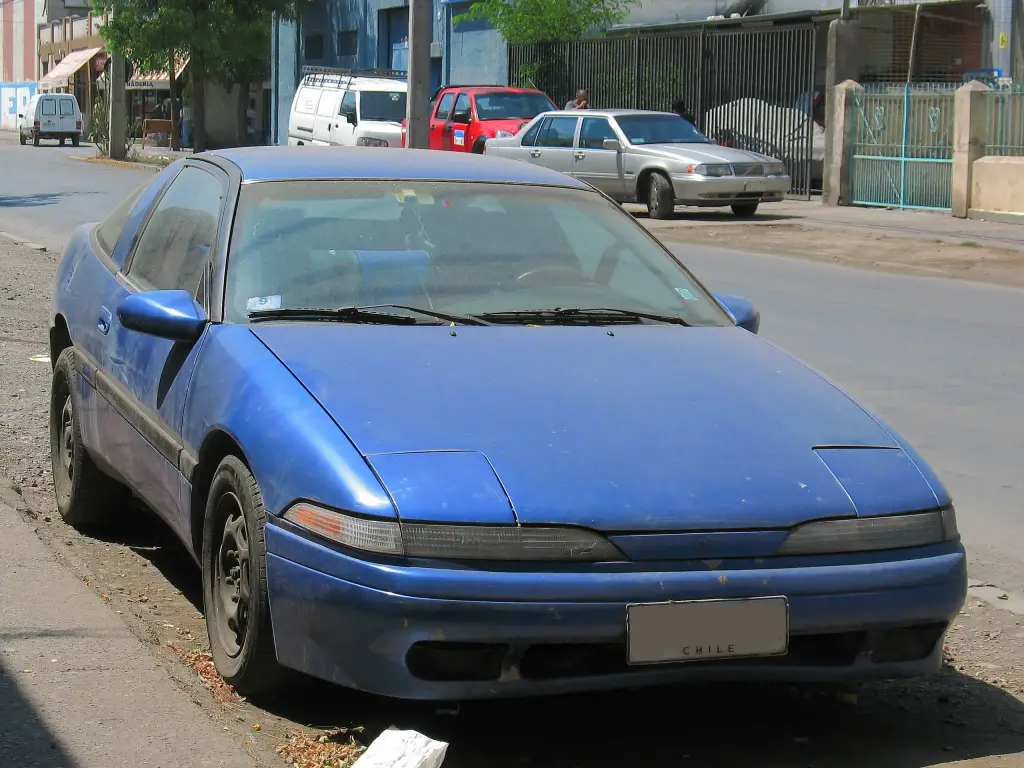
Despite its close resemblance to its Mitsubishi and Eagle siblings, the Laser had several unique styling cues. Apart from the badge, it wore a race-inspired look with a plastic panel where the grille would be, a full-width rear light bar, a bulge in the bonnet on 2.0-litre cars and optional lace-pattern alloy wheels. Rallye Sport models were set apart by a black roof with a body-coloured targa band, power steering, lower bodyside stripes, twin power mirrors and options not offered on the base car.
The base Laser used a 92 hp 1.8-litre four. The RS had a 135 hp 2.0-litre 16-valve DOHC engine, and the RS Turbo the turbocharged version of that engine rated at 195 hp. A five-speed manual was standard and a four-speed automatic optional, except with the turbo, which came only with the manual until the 1991 models.
Model year changes
1990: the range opened with base, RS and RS Turbo models, and RS cars could be ordered with a factory CD player, a first for Plymouth. 1991: anti-lock brakes arrived and the turbo could be had with the automatic. 1992: cosmetic changes brought an all-wheel-drive model, available only with the manual while the front-drive car kept the automatic option; pop-up headlights gave way to fixed multi-form lights, the rear light bar was replaced by two separate taillights, and the RS gained alloy wheels and an optional Gold Package. 1993: all-wheel-drive cars could be ordered with the automatic, which cut turbo output to 180 hp, and every Laser except the base model could have anti-lock brakes. 1994: production ended on 3 June 1994 because of poor sales, with nothing changed for the final year.
The Laser was never a big seller: it competed with two virtually identical cars, the Eagle Talon received far more advertising as Chrysler’s performance brand, and the car did not fit a Plymouth range built around K-car derivatives and minivans. Its end coincided with the arrival of the 1995 Plymouth Neon.
Design and features
- Diamond-Star build: the first product of the Chrysler–Mitsubishi joint venture, shared with the Eclipse and Talon.
- Turbo performance: 195 hp from the 2.0-litre turbo, with all-wheel drive from 1992.
- Own styling: a plastic grille panel, a full-width rear light bar and a bonnet bulge marked it out from its siblings.
- Equipment firsts: a factory CD player option in 1990, anti-lock brakes from 1991.
Plymouth Laser versions
- Laser (1990–1994): the base car with the 1.8-litre engine.
- Laser RS: the 2.0-litre 16-valve model with the targa-band roof and extra equipment.
- Laser RS Turbo: the 195 hp turbo, front-wheel drive and later all-wheel drive.
- Laser RS Turbo AWD (1992–1994): all-wheel drive, manual only at first.
The Laser was replaced by the Neon, and Plymouth’s other hatchback of the period was the Sundance. More cars are in the Plymouth collection.
Video: 10 Second Plymouth Laser Turbo on Hoosiers! Kyle Cimbron 10.60 @ 132mph
Video by uRaceIfilm.com on YouTube.
Sources
- Plymouth Laser, English Wikipedia: engines, trims, model year changes, sales history