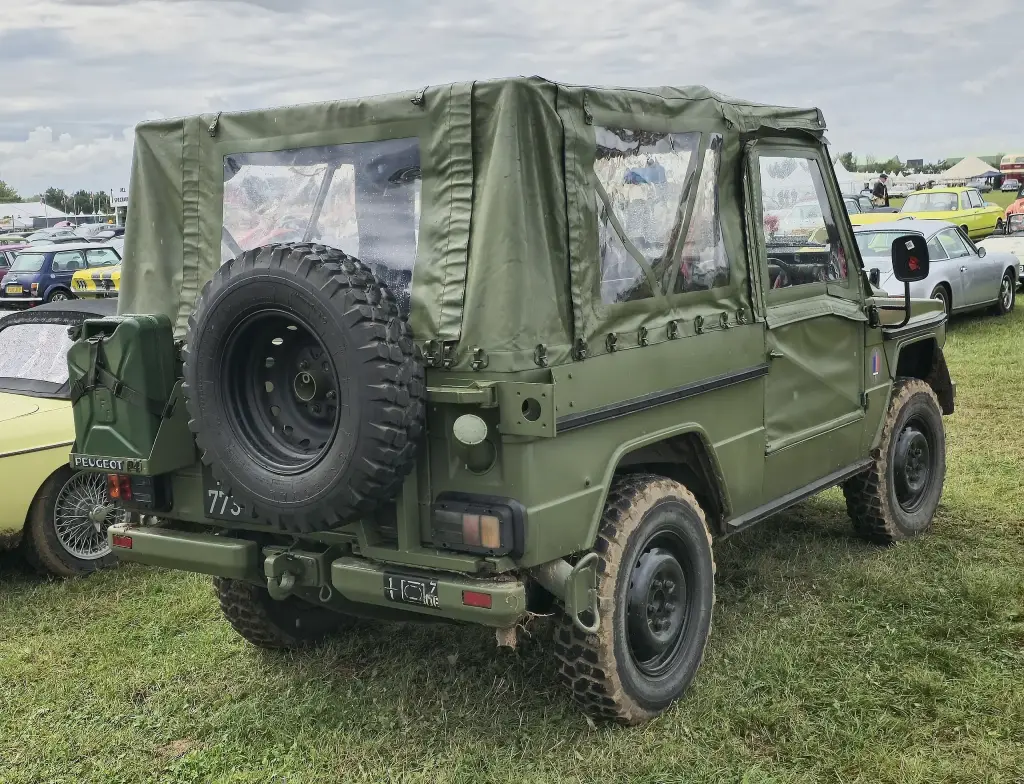
The P4 is an unarmoured off-road vehicle used by the French military. It was manufactured by Peugeot and later by Panhard, and it is a derivative of the military Mercedes-Benz G-Class built under licence for the French army.
Peugeot P4 at a glance
| Type | unarmoured military off-roader |
|---|---|
| Based on | Mercedes-Benz G-Class military version |
| Engine | Peugeot 504 unit; later a 2.5-litre Peugeot diesel |
| Transmission | from the Peugeot 604 |
| Built by | Peugeot at Sochaux, then Panhard from 1985 |
| First prototype | tested in 1978 |
| French order | 15,000, reduced to 13,500 in 1981 |
| Civilian version | offered, but little success |
| Replaced by | Technamm Masstech T4 VLTP from 2016 |
History of the Peugeot P4
Why France needed it
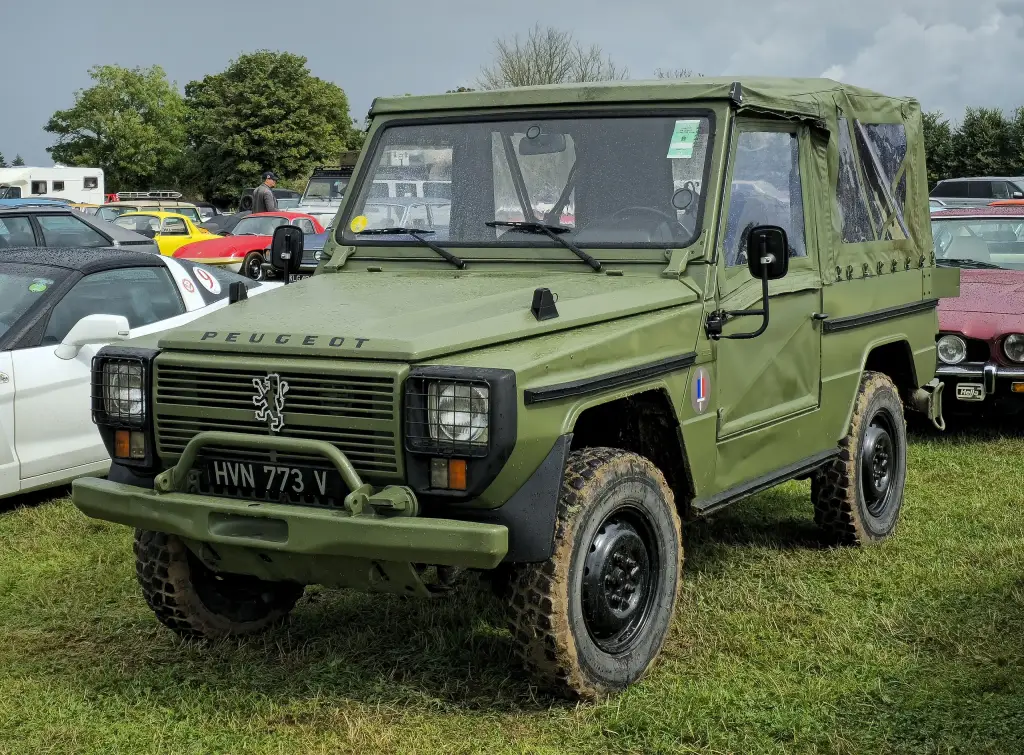
In the late 1960s the French army decided that its 10,001 Jeeps had to be replaced. The new vehicle would carry four men with radio equipment and be small enough to be parachuted and transported by plane. After many technical problems it was designed in the 1970s, and Peugeot and Mercedes agreed to co-produce it on a 50:50 basis.
How it was built
Peugeot installed the engine of the Peugeot 504 and the transmission of the Peugeot 604 in the Mercedes-Benz G-Class, along with the electrical systems, and welded and painted the body; Mercedes did the rest. Final assembly took place at Sochaux. The first prototype was tested in 1978, beginning a long series of trials that included a rally in southern Algeria with a petrol and a diesel P4. The French army ordered 15,000 vehicles in petrol and diesel form, reduced in 1981 to 13,500 as the army shrank. From 1985 production moved to Panhard at Marolles-en-Hurepoix, where 6,000 were built.
Variants
In 1992 the army converted around 1,300 petrol P4s into diesel P4D models, a conversion carried out by Panhard and the regional material establishments, using the 2.5-litre Peugeot four-cylinder of the original diesel P4. The P4P, or P4 Protégé, was an armoured version of which about 80 were built in the 1990s by CBH Institutions of Hardricourt, in five versions and three wheelbases of 2,400, 2,850 and 3,120 mm; some were made for Lebanon. A P4 VPS for the special forces was ordered from Panhard in 2005 in 51 examples, with armoured floors for mine protection and air transport by Transall or Hercules. In 2016 Arquus created the P4 VIPAIR, converting 19 P4 ASPICs, a programme completed on 15 October 2020.
Use and replacement
A civilian version was made but had little success because of its high price and poor power-to-weight ratio. The French army has also used P4s in Cameroon, Chile and Ukraine, where 120 were in service, and in 2016 donated vehicles to the Cameroonian special forces. In 2016 the French military ordered 500 Technamm Masstech T4 VLTP vehicles as an interim replacement.
Design and features
- Licensed G-Class: a Mercedes body and chassis with Peugeot mechanicals.
- Peugeot engines: the 504 petrol unit and a 2.5-litre diesel.
- 604 transmission: the gearbox came from Peugeot’s large saloon.
- P4P: an armoured version built by CBH on three wheelbases.
- P4 VPS: a special-forces model with a mine-protected floor.
Peugeot P4 versions
- P4 (1981): the standard petrol and diesel vehicles.
- P4D (1992): around 1,300 petrol cars converted to diesel.
- P4P: armoured version, about 80 built in the 1990s.
- P4 VPS (2005): 51 vehicles for the special forces.
- P4 VIPAIR (2016): 19 conversions by Arquus.
The P4 used the engines of the Peugeot 504 and the gearbox of the 604, making it the only military vehicle in the Peugeot range. More in the Peugeot collection.
Video: Peugeot p4 OffRoad
Video by on YouTube.
Sources
- Peugeot P4, English Wikipedia: origin, construction, orders, variants, replacement