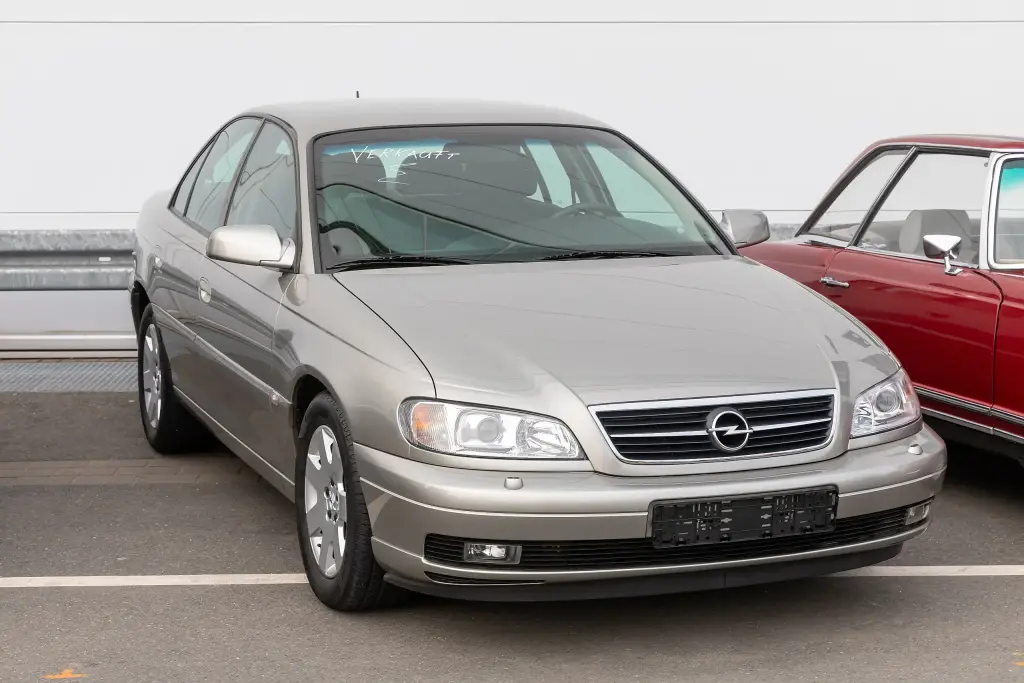
The Opel Omega was Opel’s executive car from 1986 to 2003, replacing the Rekord. The Omega A was voted European Car of the Year for 1987 and went on to become the Cadillac Catera and Chevrolet Omega, and its 3.0-litre version was the base of the Lotus Omega.
Opel Omega at a glance
| Maker | Adam Opel AG, Rüsselsheim |
|---|---|
| Production | 1986–2003 |
| Omega A | 1986–1994 |
| Omega B | 1994–2003 |
| Replaced | Opel Rekord |
| Award | European Car of the Year 1987 |
| Bodies | saloon and Caravan estate |
| Drag coefficient | 0.28 saloon, 0.32 Caravan |
| Development cost | 2.5 billion Deutschmarks |
| Engines | 1.8 to 3.0 litres, petrol and diesel |
| Omega 3000 | 3.0 six of 177 PS, 220 km/h |
| Other badges | Vauxhall Carlton/Omega, Cadillac Catera, Chevrolet Omega |
Based on one source, the English Wikipedia article on the Opel Omega.
History of the Opel Omega
A new Rekord for the 1980s
The Omega went into production in September 1986 as a replacement for the final Rekord, which had been in production since 1978, and sales began in November; in Britain the retained name was Vauxhall Carlton. The body evolved the previous Opel design theme towards aerodynamics, in response to higher fuel prices and the general push for efficiency, and the result was a drag coefficient of 0.28 for the saloon and 0.32 for the Caravan estate. The whole programme cost 2.5 billion Deutschmarks. Late in 1986 the Omega was voted European Car of the Year for 1987, ahead of the new Audi 80 and BMW 7 Series.
Technology new to Opel
Compared with the Rekord the Omega brought many features that were new to Opel, and in several cases new to the volume segment: electronic engine management, ABS, an on-board computer showing fuel consumption and average speed, an air-conditioned glovebox and even an LCD instrument cluster, offered on the CD from 1987 and dropped in 1991. It also had a self-diagnosis system whose output could be read by authorised workshop equipment, and it was one of the first cars to offer individually heated rear seats. All Omegas used a longitudinally mounted engine and rear-wheel drive, with a five-speed manual or four-speed automatic. Engines ran from 1.8, 2.0 and 2.4-litre fours, including 2.0, 2.3 and 2.3 turbodiesel units, to 2.6, 3.0 and 3.0 24-valve sixes; the fours were Family II designs, while the sixes and the 2.4 came from the older cam-in-head family.
Trims and the Omega 3000
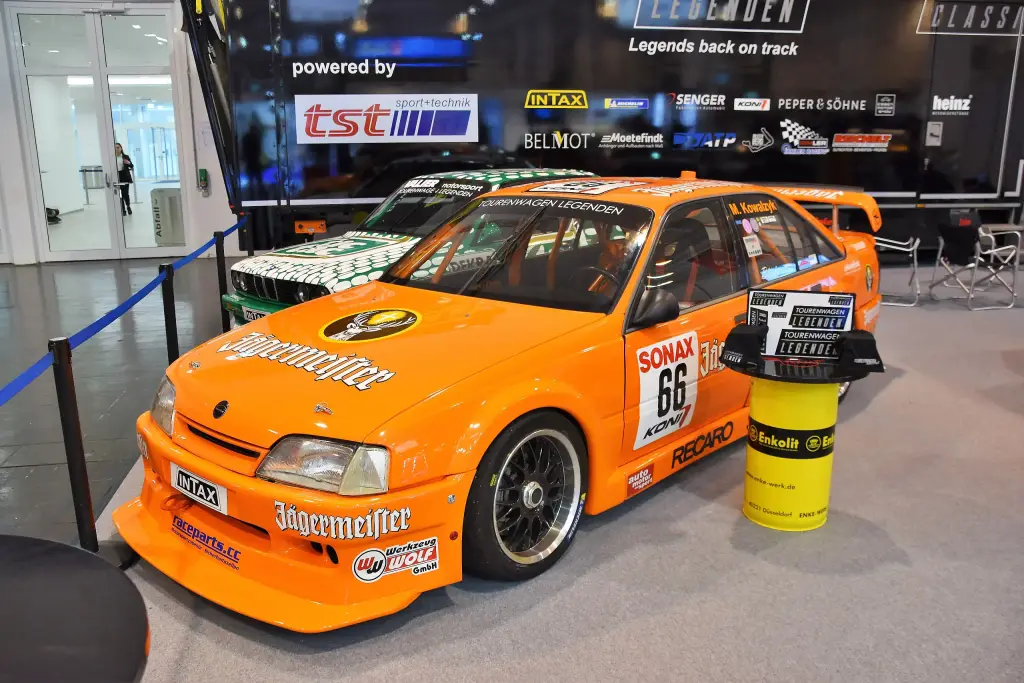
The four trim levels were LS, GL, GLS and CD, with the base LS aimed at fleets; the LS Caravan was even sold as a panel van with its rear side windows covered in body-coloured foil. The Omega Diamant package, introduced in 1988 and available on GLS, LS and CD, added alloy wheels, metallic paint, tinted windows, a cassette stereo, leather trim and a painted grille and mirrors, and sold well enough to survive the facelift. The sporting Omega 3000 used a 3.0-litre 12-valve six of 177 PS with lowered suspension, a limited-slip differential, different fascias and a rear spoiler, reaching 220 km/h and 100 km/h in 8.8 seconds; the catalysed engine first had only 156 PS, and uncatalysed production ended in August 1988. In Britain it was the Carlton GSi 3000. In October 1989 a 24-valve engine became an option, and in 1991 the range was facelifted: new front and rear fascias, better interior materials, more sound insulation, the 1.8 dropped and LS and GLS replaced by Club and CD Diamant.
Worldwide and the Omega B
The Omega was sold around the world: as the Cadillac Catera in North America, the Vauxhall Omega in Britain and the Chevrolet Omega in South America, where it was built until 1998 with local engines including a 4.1-litre straight-six tuned by Lotus. In Australia, re-engineered versions of the platform became the Holden Commodore from 1988. The second generation, the Omega B, was built from 1994 to 2003, when production ended and the Signum took over.
Design and features
- European Car of the Year 1987: chosen ahead of the Audi 80 and BMW 7 Series.
- Low drag: 0.28 for the saloon, remarkable for a large family car of 1986.
- Self-diagnosis: one of the first volume cars with a diagnostic system for workshop equipment.
- Omega 3000: 177 PS, lowered suspension and a limited-slip differential.
Opel Omega versions
- Omega A saloon and Caravan (1986): the original range.
- Omega Diamant: the options package of 1988.
- Omega 3000: the sporting version with a 3.0 six.
- 1991 facelift: new fascias and Club and CD Diamant trims.
- Omega B (1994): the second generation, built until 2003.
- Cadillac Catera and Chevrolet Omega: the same car under other badges.
The Omega replaced the Rekord, was related to the Senator, and its fastest version was the Lotus Omega. More cars are in the Opel collection.
Video: Der Checker Opel Omega Check
Video by Cross River on YouTube.
Sources
- Opel Omega, English Wikipedia: development, technology, trims, Omega 3000, worldwide versions