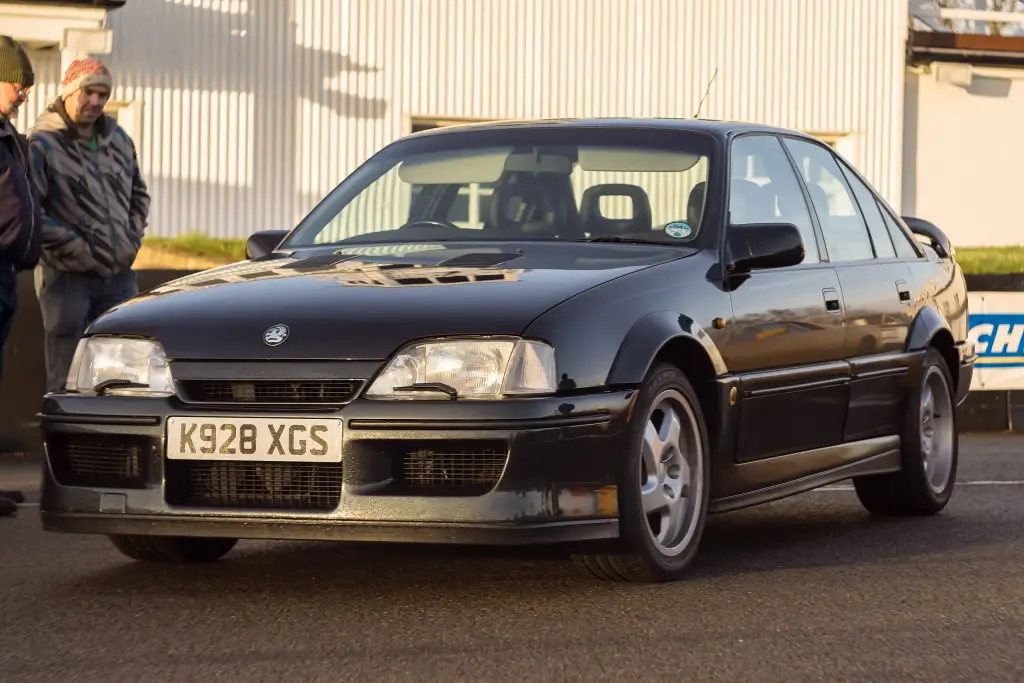
The Opel Lotus Omega — sold in Britain as the Vauxhall Lotus Carlton — was an Omega A saloon rebuilt by Lotus as a high-performance sports saloon. With 382 PS and a top speed of 283 km/h it was the fastest four-door production car for many years, and only 950 were made.
Opel Lotus Omega at a glance
| Maker | Opel, modified by Lotus |
|---|---|
| Production | 1990 – December 1992 |
| Lotus type number | Type 104 |
| Base | Opel Omega A 3.0 24-valve |
| Engine | 3,615 cc straight-six, two Garrett T25 turbos |
| Boost | up to 0.7 bar from about 2,500 rpm |
| Power | 382 PS (281 kW) at 5,200 rpm |
| Torque | 568 Nm at 4,200 rpm |
| 0–97 km/h | 5.1 seconds |
| Top speed | over 283 km/h |
| Gearbox | ZF six-speed manual, limited-slip differential |
| Built | 950, of them 630 Omegas and 320 Carltons |
| Colour | Imperial Green only |
Based on one source, the English Wikipedia article on the Lotus Carlton, which covers the Opel Lotus Omega as the same car.
History of the Opel Lotus Omega
A bigger, stronger six
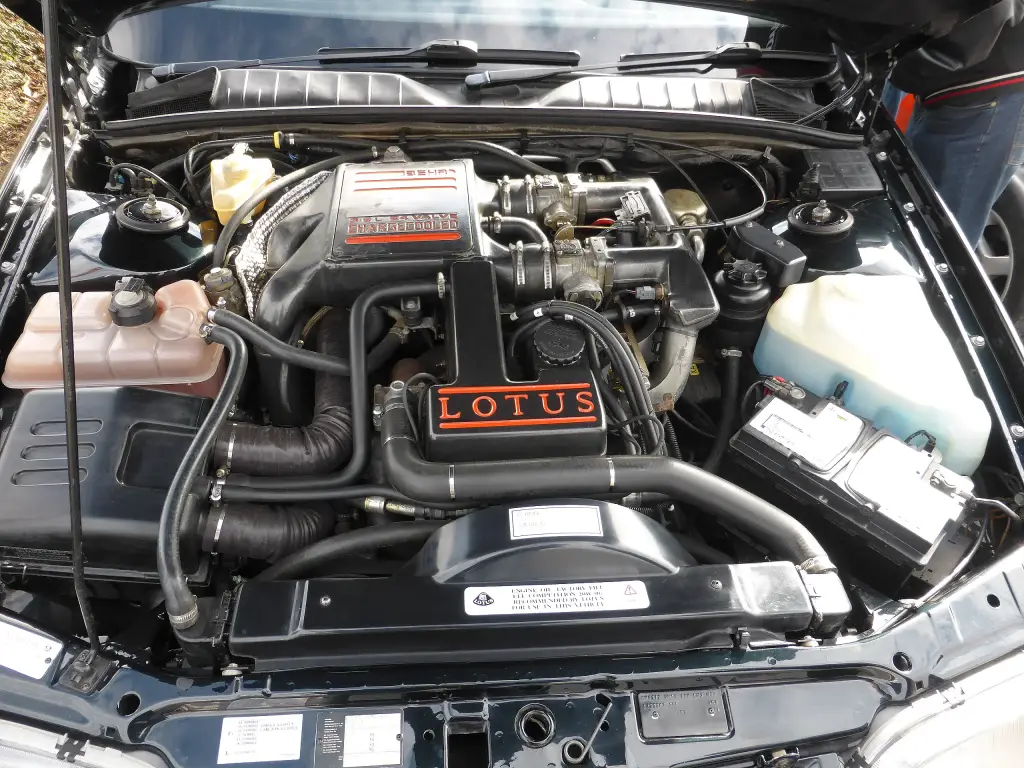
Lotus began with the 2,969 cc 24-valve straight-six of the Omega GSi and enlarged it to 3,615 cc. Two Garrett T25 turbochargers provided up to 0.7 bar of boost from about 2,500 rpm, the distributor ignition was replaced by a three-coil wasted-spark system, and the distributor drive was re-used to drive the water pump of the water-air intercooler, built by Behr, which dropped charge temperature from 120 to 60 °C. To survive cylinder pressures of about 95 bar the block was reinforced, the crankshaft was new — forged by Opel and machined by Alfing Kessler — the combustion chambers were machined to lower compression from 10.0:1 to 8.2:1, and Mahle forged slipper pistons went in.
Chassis and body
Power went to the rear wheels through the same ZF six-speed manual used in the Chevrolet Corvette ZR-1 and a limited-slip differential shared with the V8 Holden Commodore. Lotus modified the Omega’s rear suspension with a new arm and revised bushings to change toe and camber, added the self-levelling suspension and Servotronic steering of the Opel Senator, and fitted 17-inch Ronal wheels with wider Goodyear Eagle tyres using the compound of the Esprit Turbo SE. Brakes were 328 mm discs at the front and 300 mm at the rear from Portland Engineering, with four-piston AP calipers in front. Outside there was a rear spoiler, bonnet vents, Lotus badges, a body kit and much wider arches, all in one colour, Imperial Green.
Performance and sales
The C36GET engine gave 382 PS at 5,200 rpm and 568 Nm at 4,200 rpm, with 470 Nm available from 2,000 rpm. The car reached 97 km/h in 5.1 seconds and 160 km/h in 11.1, and its tall gearing allowed about 89 km/h in first gear and more than 283 km/h flat out. Production began in 1990, four years after the Omega went on sale. Opel had hoped for 1,100 cars, but the recession of the early 1990s held sales back — the price was £48,000 — and production at Lotus stopped in December 1992 with 950 cars completed. The performance caused controversy in the press, since a four-door family saloon could match Ferrari and Porsche sports cars; Pininfarina even built a single coupé concept, the Chronos, to take the drivetrain.
Design and features
- Twin turbos: two Garrett T25 units giving 0.7 bar and 382 PS from a 3.6-litre six.
- ZF six-speed: the same gearbox as the Chevrolet Corvette ZR-1.
- Senator chassis parts: self-levelling suspension and Servotronic steering.
- One colour: every car was painted Imperial Green.
Opel Lotus Omega versions
- Opel Lotus Omega: the continental European version.
- Vauxhall Lotus Carlton: the British version, 320 of the 950 cars.
- Pininfarina Chronos (1991): a single coupé concept built for the drivetrain.
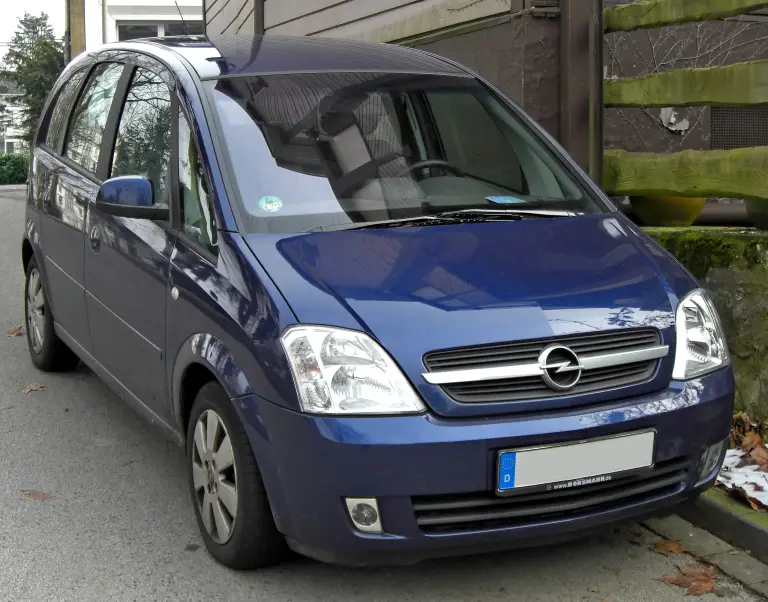
The Lotus Omega was built from the Omega, and its chassis parts came from the Senator. More cars are in the Opel collection.
Video: Lotus Omega vs Swedish police (Very high quality)
Video by fyllefinken on YouTube.
Sources
- Lotus Carlton, English Wikipedia: engine, chassis, performance, production